
Indoor plants
Agapanthus
Agapanthus
Agapanthus (lat. Agapánthus) — a genus of perennial herbs of the family Agapanthaceae (Agapanthaceae). The name comes from Greek αγαπη — «love» and ανθος — «flower».
The natural range is Central and Southern Africa.
Perennial herbaceous plants with fleshy rhizomes.
Leaves are thick, strap-shaped, reaching 50-70 cm in length. The leaf blades form a basal rosette. Even when the plant is not flowering, it still attracts attention with its lush green foliage.
During flowering Agapanthus sends up a long scape that can reach 1 m in height. The plant's flowers are gathered in large umbel-like inflorescences, colored white, pale blue or blue-lilac. It blooms from July to September, and with good care — abundantly.
The natural range is Central and Southern Africa.
Perennial herbaceous plants with fleshy rhizomes.
Leaves are thick, strap-shaped, reaching 50-70 cm in length. The leaf blades form a basal rosette. Even when the plant is not flowering, it still attracts attention with its lush green foliage.
During flowering Agapanthus sends up a long scape that can reach 1 m in height. The plant's flowers are gathered in large umbel-like inflorescences, colored white, pale blue or blue-lilac. It blooms from July to September, and with good care — abundantly.
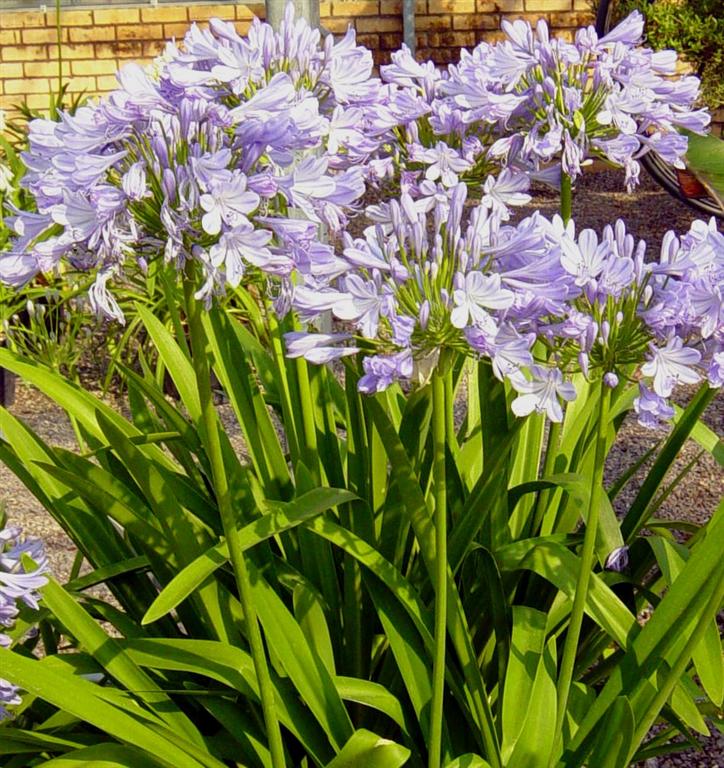
Growing this plant is not difficult if you can keep it in a cool place in winter. The plant is grown in a large pot or tub, as it is a fairly large plant. Agapanthus is good for decorating rooms, balconies and staircases. With the application of fertilizers, large container-grown specimens can open from 20 to 200 umbels of light-blue, blue or white flowers when in bloom.
Agapanthus grows well only on slightly acidic to acidic soils; lime impurities in the water lead to soil alkalization, so when a white crust or film appears on the soil surface, the top layer of soil should be replaced with fresh soil. Use well-settled water, rainwater or meltwater for watering.
Temperature: Moderate. In winter 10-12°C, minimum 6°C.
Lighting: Light-loving; tolerates semi-shaded positions, but in that case will not bloom.
Watering: During the growth period the soil should be kept constantly moist. Infrequent watering in winter.
Fertilizer: From May to August feed with special mineral fertilizers for flowering houseplants every 2 weeks. You can use "Raduga", "Ideal" etc.
Air humidity: Does not require spraying, but in very dry indoor air it can be affected by the red spider mite.
Repotting: Does not need repotting until it is time to divide the clump or until the plant begins to protrude from the tub. On average repotting is done every 3-4 years. The fleshy roots must not be cut or damaged during repotting. Soil: 2 parts clay-loam turf, 2 parts humus-rich soil, 2 parts leaf mold and 1 part sand. Good drainage is essential.
Propagation: By division of the clump (after flowering, flowers every 5-6 years) and by seeds.
Temperature: Moderate. In winter 10-12°C, minimum 6°C.
Lighting: Light-loving; tolerates semi-shaded positions, but in that case will not bloom.
Watering: During the growth period the soil should be kept constantly moist. Infrequent watering in winter.
Fertilizer: From May to August feed with special mineral fertilizers for flowering houseplants every 2 weeks. You can use "Raduga", "Ideal" etc.
Air humidity: Does not require spraying, but in very dry indoor air it can be affected by the red spider mite.
Repotting: Does not need repotting until it is time to divide the clump or until the plant begins to protrude from the tub. On average repotting is done every 3-4 years. The fleshy roots must not be cut or damaged during repotting. Soil: 2 parts clay-loam turf, 2 parts humus-rich soil, 2 parts leaf mold and 1 part sand. Good drainage is essential.
Propagation: By division of the clump (after flowering, flowers every 5-6 years) and by seeds.