
Flowers for the garden
Adonis
Adonis
Adonis (lat. Adonis) — a genus of annual and perennial herbaceous plants of the Buttercup family (Ranunculáceae).
Most likely the name comes from the name of the god Adonis, the favorite of Aphrodite, who was killed while hunting by a wild boar and from whose blood this flower grew. According to other sources, the plant was named after the Assyrian god Adon.
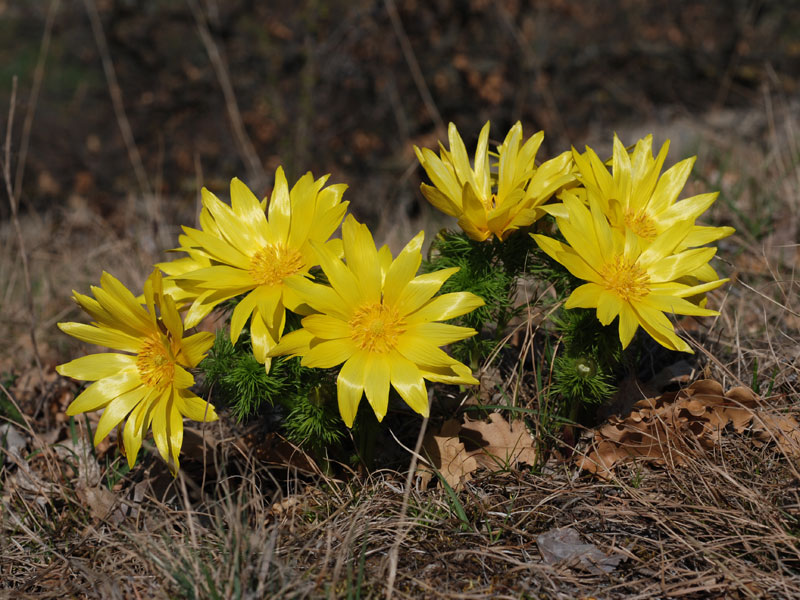
Native range - temperate regions of Eurasia. About 25 species of this plant are known.
Adonis comprises annual and perennial herbaceous plants with simple or branched stems. Leaves are repeatedly pinnately or palmately divided into narrow lobes. Flowers are bright, yellow or red, solitary, borne at the ends of shoots; outer perianth segments numbering about 5-8, inner ones 5-24 lobes; pistils numerous. Fruit - a schizocarp (achenes). Seeds are wrinkled with a straight or downward-curved beak. The ornamental value of Adonis was appreciated only at the end of the 17th century, and since then it has become a popular ornamental plant in gardens and parks.
In cultivation:
Hairy Adonis - Adonis villosa
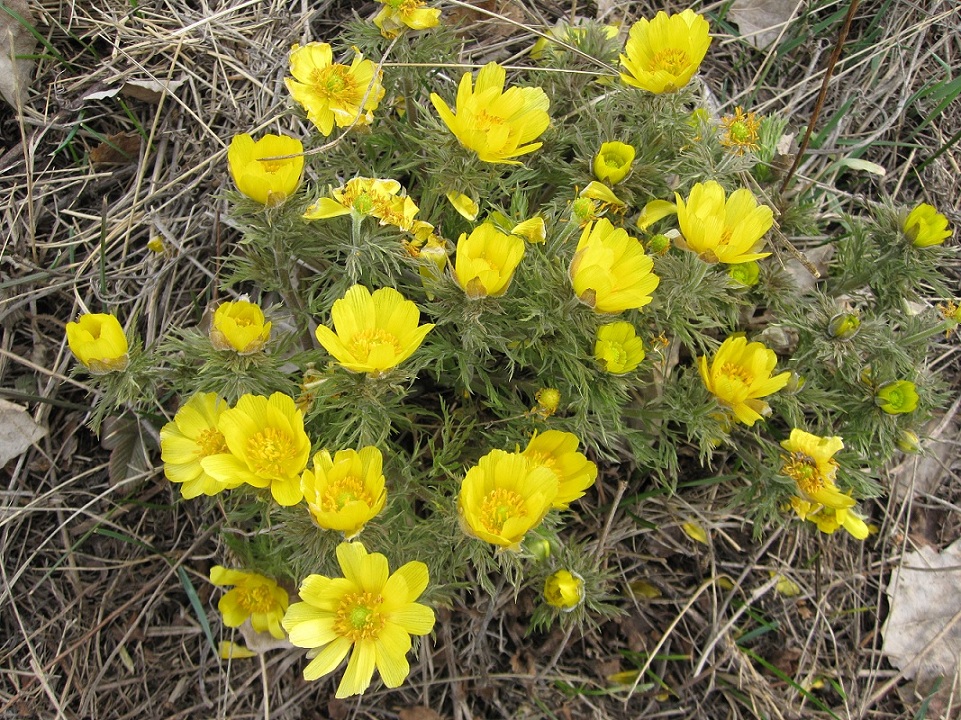
Natural range - Siberia, Kazakhstan. Grows in lowland steppes, near rocks and stones, less often on the edges of birch copses.
Perennial plants with short brownish rhizomes. Stems solitary, densely hairy at the beginning of flowering, 5 to 15 cm tall, later lengthening to 25-30 cm and becoming sparsely hairy, clothed at the base with brown scales, openly branched. Blades of stem leaves twice pinnate, in outline oval or broadly triangular. Flowers simple, pale yellow to yellow. Fruit heads spherical or ovoid, on reflexed stalks. Seeds oval, hairy, wrinkled, with a hooked, downward-curved beak.
Summer Adonis — Adonis aestivalis
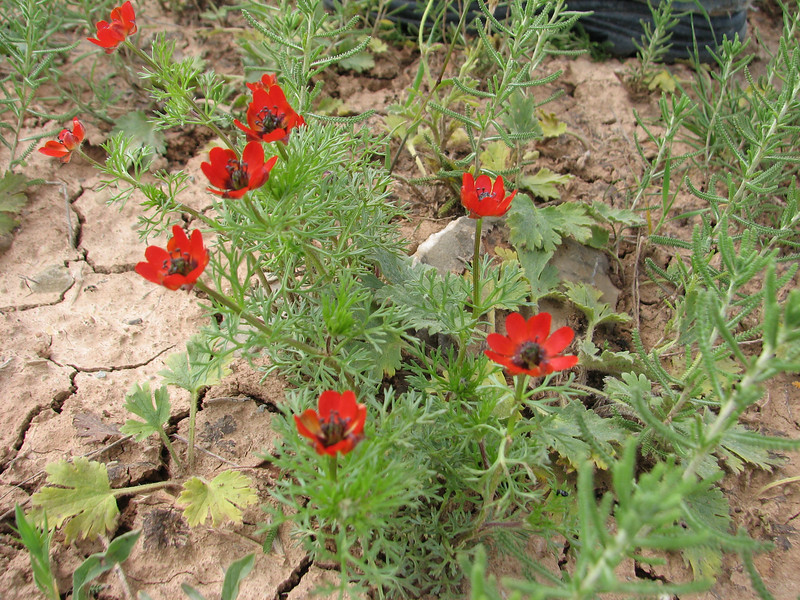
Natural habitat: southern European Russia, the Caucasus, southern Western Siberia and Central Asia (except deserts and high mountains). Also occurs in Western Europe.
It is an annual herbaceous plant. Stems erect, simple or several times branched, grooved, glabrous, 10-50 cm tall. Leaves sessile, lower ones petiolate, twice or three times divided into small segments. Flowers solitary at stem tips, small, 2-3 cm in diameter; perianth segments red with a black spot at the base, flat, glossy. Flowering lasts from June to August.
Seeds have low germination. Sow early; in April to early May sowing can be done in the permanent location. Seedlings appear in one and a half to two weeks, gradually. It is better to sow in autumn, in which case seeds undergo stratification and germinate more uniformly in spring. Seedlings grow slowly. Thin out the seedlings, leaving 15-20 cm between plants. Adonis is cold-hardy, undemanding, can grow on any soils but prefers calcareous ones. It is light-loving, but may bloom in partial shade. In hot weather, when the soil dries, watering is necessary. On poor soils, feed with balanced fertilizers.
Amur Adonis — Adonis amurensis = Adonis vernalis var. amurensis
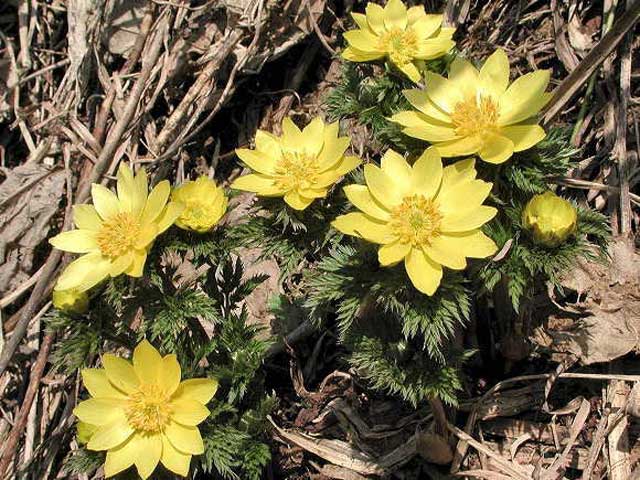
Native range — the Far East, Japan, northeastern China, Korean Peninsula. Grows in gaps in deciduous forests, on herb-rich coastal slopes, on rich moist humus soils. Mesophyte.
A perennial woodland plant with pinnately divided leaves on long petioles. Like many bulbous plants, it ends vegetation in mid-summer. Plant height during flowering, which occurs earlier than that of spring Adonis and lasts for about two weeks, does not exceed 12 cm. Flowers golden-yellow, widely open, up to 5 cm in diameter. Flowers usually appear before the pinnately divided leaves, which persist until mid-summer. During this period plants reach 35 cm in height. By early July the above-ground parts completely die back. Adonis flowers are very sensitive to changes in temperature and humidity: they close in cold and overcast weather. The plant is poisonous!
A good early-flowering plant for loose fertile moist soils in partial shade and in open sites.
Location: all perennial Adonis species are winter-hardy and grow equally well in open and slightly shaded sites. They develop best in well-lit areas with shading during midday hours.
Soil: for abundant flowering they require a light soil rich in organic matter and lime.
Care: they grow slowly and are very sensitive to transplantation. The soil should be kept loose and moist. Renewal buds are formed 2-4 years in advance, so plants should be cut carefully to avoid damaging the buds.
Propagation: by seed and by division of the clump. Planting is carried out in August - early September so that plants can root well before frost. Division and transplanting of Adonis should not be done before 4-5 years of cultivation; sometimes they grow well in one place without transplanting for up to 10 years. The best option is to transplant plants with a clump of soil without disturbing the roots; they grow slowly, and dividing them into small parts is not recommended. In the first year after planting plants bloom and develop weakly; normal flowering occurs only from the second year. Propagation of perennial Adonis by seed is difficult because they have low germination; moreover, some seeds germinate only in the second year. Sowing of seeds, preferably cleaned, should be done immediately after collection. Until winter, seed trays should be stored in a cold cellar and then buried under the snow. It is possible to store seeds in a slightly moist substrate in the refrigerator until early spring, followed by germination in a greenhouse at 18-22 °C. Young plants grow slowly, reaching full development only by the 4th-5th year.
Uses: perennial Adonis are unsuitable for cutting, but they are very effective in group plantings or among sparsely planted shrubs. When planting, they should be placed closer to paths; they are also good on rock gardens on eastern and western aspects.