
Indoor plants
Adiantum
Adiantum
Adiantum (Adiantum) — a genus of ferns belonging to the monotypic family Adiantaceae (C.Presl) Ching (the latter is quite often included in the family Pteridaceae). The genus includes about 200 species.
The Latin name of the genus comes from the Greek α- — not, without, and διαινειν — to moisten, because water easily runs off the plant, leaving it dry.
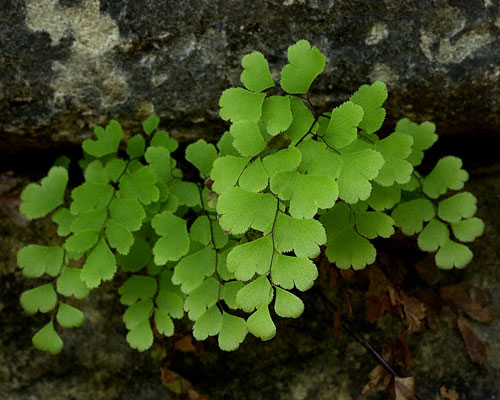
Adiantum is predominantly a tropical genus. Two centers of species diversity are distinguished — in the South American Andes and in East Asia (in particular, the Chinese flora includes 39 species of the genus). As a rule, species of the genus grow on rich, moist yet well-drained soils; they are very characteristic of rocks along the banks of waterfalls.
This is one of the most beautiful types of ferns with lacy light-green pinnately divided fronds on thin, wire-like petioles. In some species the pinnules are yellow-green, in others they have a light-red coloration. Adiantums are delicate plants and require more careful care than, for example, Nephrolepis. The fragile fronds should not be exposed to direct sunlight or to water flow.
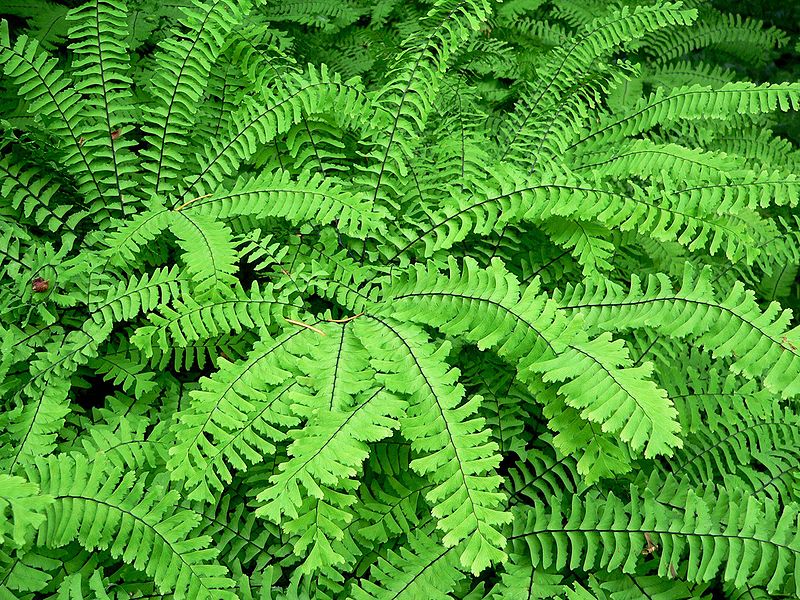
The best place for an adiantum is not on a windowsill (only a north-facing windowsill), but directly beside the window, behind a sheer curtain. Drainage in the pot must be very good. Adiantum does not tolerate cool rooms and drafts. Problems may arise if the plant is found to have disease or pests, because adiantums do not tolerate spraying with chemical plant protection products.
In cultivation:
Maidenhair fern - Adiantum capillus-veneris L.
Widespread in Western Europe, the Mediterranean, in the Crimean mountains, the Caucasus, Central Asia, Asia Minor, Africa, and in North and Central America. Grows on the banks of mountain rivers and streams, in rock crevices, at seepage sites, and near waterfalls; prefers carbonate rocks. One of the best-known ornamental ferns.
A perennial up to 60 cm tall with a short creeping rhizome covered with narrow, dark scales. Leaf stalks 10—15 (up to 25) cm long, blackish-brown, thin, glossy. The blade 20—40 cm long, light green, twice- to thrice-pinnate, broadly oblong in outline, water-repellent. Leaf segments 2.5—3 cm long and 1.5—2 cm wide, very delicate and thin, on hairlike stalks, broadly obovate in outline, with a cuneate base and a fan-lobed apex. Sori show through the thin tissue of the segment, framing it with a dark dotted line. Sporulates all summer from late spring to early autumn. Widely cultivated in greenhouses, and easily grown indoors.
Adiantum hispidulum - Adiantum hispidulum Sw.
A small plant with a creeping rhizome. Leaves forked, twice- to three-times pinnate, 15-22 cm long. Segments broadly rhomboid or rounded-inversely triangular, hairy on both sides, stiff. Petiole 15-35 cm long, brown, minutely bristly-hairy, rough. Sori horseshoe-shaped, located at the ends of the veins. Native to the humid subtropics and tropics of the Old World.
Adiantum formosum - Adiantum formosum
Temperature: The temperature during active growth should not exceed 20 °C, and during the dormancy period - 15 °C. Does not tolerate drafts.
Light: Light partial shade; protection from direct sunlight both in winter and summer. If an adiantum stands in too dark a place, its fronds become pale.
Fertilizer: Adiantums respond poorly to high doses of fertilizers, so feed from May to September only once a month with a complete mineral fertilizer, and only at half the dose recommended for other houseplants. Fertilizers should not contain lime.
Air humidity: Adiantums require humid air, around 60%. In dry air plants may even perish. Adiantum raddianum is best suited for growing in a terrarium. Other species are best placed on a wide tray filled with expanded clay or gravel. Water both the soil in the pot and pour water into the tray. If a central heating radiator is nearby, it should always be covered with a damp towel or sheet.
Repotting: This plant needs loose soil with a slightly acidic reaction. Soil: 1 part leaf mold, 2 parts peat, 0.5 part humus soil and 1 part sand. Repot annually. Does not tolerate being placed in a pot that is too large.
Propagation: Adiantums are mainly propagated by division of old clumps.