
Indoor plants
Adenanthos
Adenanthos
Synonyms: Australian fir
Adenanthos – a genus of ornamental foliage plants in the Proteaceae family. Represented by shrubs or small trees up to 2.5 m tall. Native to Australia. In cultivation it rarely exceeds 100 cm.
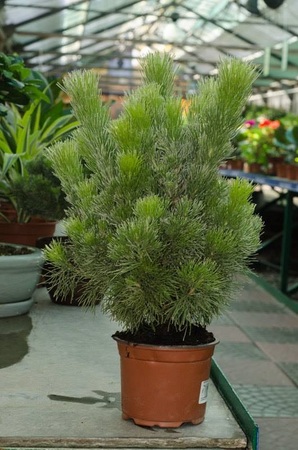
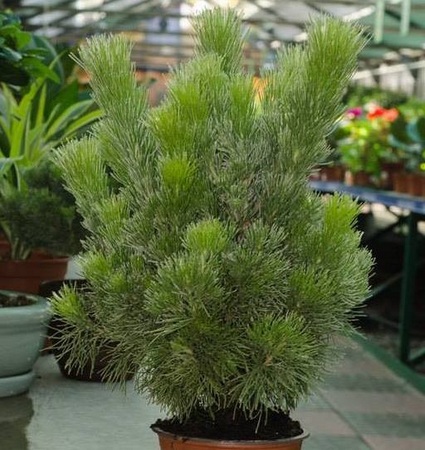
The genus Adenanthos includes 31 species, but as a houseplant 2 species are cultivated: Adenanthos detmoldii and Adenanthos sericeus.
Almost all species of Adenanthos grow on sandy, rocky soils, so good drainage in the pot is necessary.
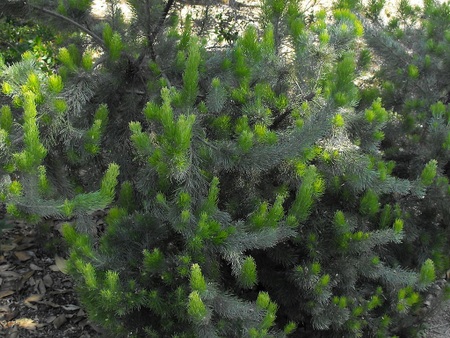
Regarding light, some species, for example Adenanthos terminalis, cuneatus – require full sun; in nature they grow in open areas. And since there is always less light in winter, these species may require supplementary lighting.
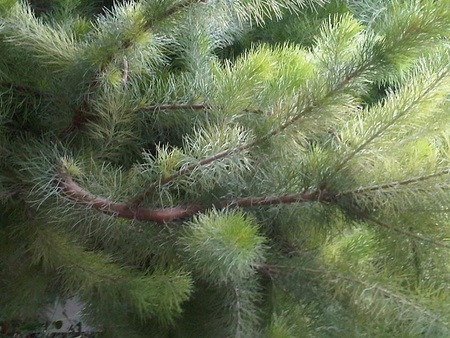
Adenanthos is notable for its needle-like leaves, which make it resemble a conifer. In appearance it can easily be mistaken for a little fir or a young pine. However, this is a flowering plant. Before flowering the tips of the shoots acquire a yellow or purple tint, which gives the plant special decorative appeal.
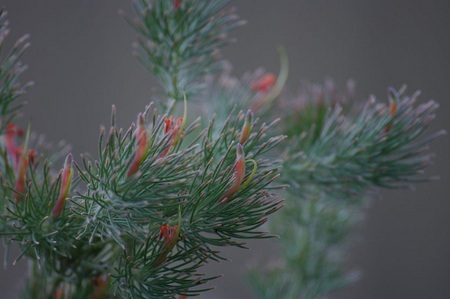
Solitary flowers of a dark-red shade appear on the needle-like shoots regardless of the time of year.
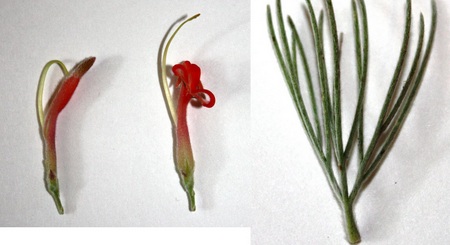
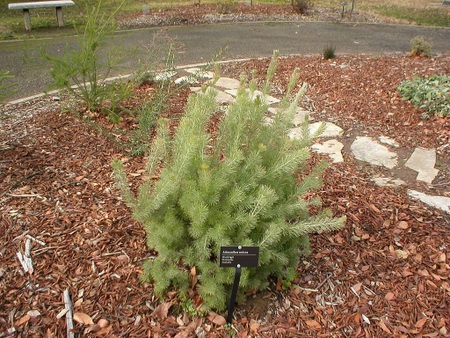
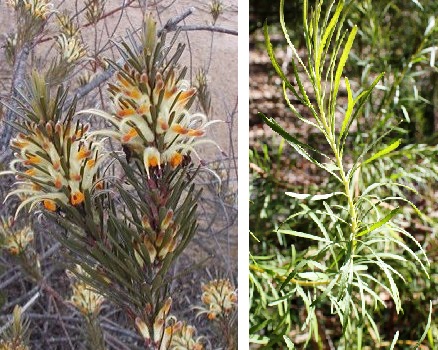
Adenanthos detmoldii - a low shrub 1.5-1.7 m high, leaves sessile, spirally arranged on the stems, grey-green in color, linear in shape, young leaves pubescent, becoming smooth with age. Flowers tubular, pale-yellow or orange, pubescent, solitary, axillary.
Adenanthos sericeus - a small tree reaching 2-2.5 m in height, leaves sessile, grey-green in color, thin like needles. Trunk and young leaves are silvery-pubescent. Flowers tubular, dark-red, pubescent, solitary, axillary; they may appear throughout the year.
Location: Prefers bright, diffused light (in summer it should be shaded from direct sunlight at midday). Best placement – east- or west-facing windows.
Soil: The soil mix is prepared from peat and leaf soil, sand, vermiculite, fine expanded clay or gravel chips with the addition of pine bark. A drainage layer at the bottom of the pot is mandatory. Soil reaction slightly acidic pH 5.0–5.5.
Repotting: Young plants - annually in spring, older plants – once every 2 years.
Pruning: tolerates trimming and pruning well; can be formed as a bonsai.
Care: Water preferably with soft water. Responds well to spraying (only in summer!). Do not allow either drying out of the root ball or waterlogging in the pot. Overwatering in winter is especially dangerous. Optimal temperature in summer 25-28°C, in winter 14-15°C (minimum 10°C!). In well-heated rooms it suffers in winter from dry air and lack of light.
Fertilize during the growing season every 3-4 weeks with fertilizers for azaleas and gardenias.
Propagation: By seeds. Seeds remain viable for 2-3 years. Before sowing it is recommended to stratify the seeds for 2 months in moist sand or vermiculite at 10°C. Sow in February-March in a sand and peat mix. Germination temperature 20–25°C, seedlings appear within 1.5-2 months.
Pests: aphids, spider mite, scale insects.
Diseases: gray rot
Use: for decorating residential and office interiors
Fertilizers: For feeding during the growing season use the same fertilizers as for azaleas and gardenias. Feed every 3-4 weeks.