
Climbing plants
Actinidia kolomikta
Actinidia kolomikta
Synonyms: kolomikta, polzun
Actinidia kolomikta – a species of woody climbers in the genus Actinidia (Actinidia) of the family Actinidiaceae (Actinidiaceae). In the wild it occurs in the Far East: China (provinces Yunnan, Hebei, Sichuan, Heilongjiang, Liaoning, Jilin), Japan (islands Honshu, Hokkaido), Korea, Russia. It is found in fir- and cedar-broadleaf, spruce-broadleaf and fir-spruce forests, but grows best in fir-spruce forests where cedar and broadleaf trees also occur. It also grows well on burn sites and clearings, forest edges and glades. It forms an understory together with Maack's honeysuckle, mock orange (Philadelphus), Manchurian hazel, spiny eleutherococcus, Manchurian aralia, spiny eleutherococcus, Amur grape and Chinese magnolia vine. In the mountains of southern Primorye it rises to 1300-1400 m above sea level, where it grows along the edges of stony screes as a small shrub with annually pruned shoots. In the northern part of its range it rises to 150 m above sea level. In cultivation since 1855.
It is a woody climber 2 (5) m long with slightly peeling bark. Shoots are dark brown, glossy, smooth, with erect or twining branches that climb up to 14 m. Lenticels numerous, longitudinal, punctate, pale. Shoots twine around supports counterclockwise. With supports thicker than 10 cm or when support is absent, the upper part of the shoot bends sharply downward and twines around its own stem. Vegetative period about 150 days. Fast growth in the first 3 years. In favorable conditions lives 80-100 years.
Root system delicate, poorly tolerates prolonged exposure on the surface. Located at the depth of the arable layer.
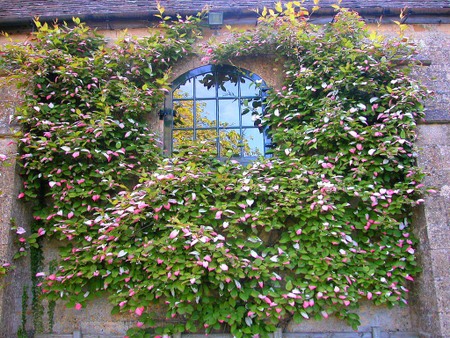
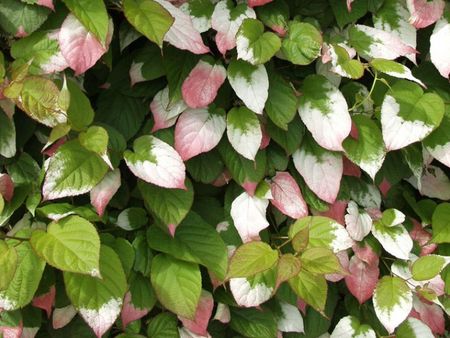
Leaves alternate, elliptical or ovate, on petioles 2-7 cm long, base cordate or rounded, long-acuminate and doubly serrate. Leaf blade thin, shortly pubescent along the veins, without bristly hairs underneath, reaching 5-13 cm in length, often asymmetric. A distinctive feature of Actinidia kolomikta is its color-changing leaves. When unfolding they have a bronze color, later become green, before flowering the tips of most leaves acquire a bright white coloration, after flowering – pink, and then raspberry-red. In autumn leaves turn pink, yellow, pale yellow and purple-red. Variegation is well expressed in plants growing in sunny locations, but is completely absent in shrub-like plants.
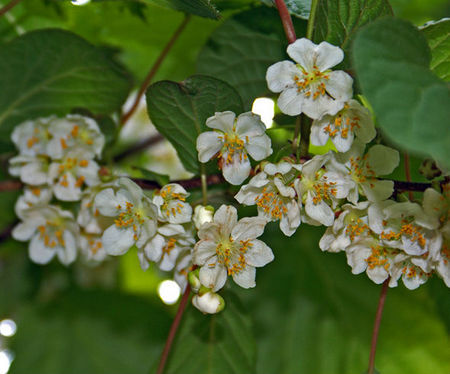
Begins to flower at 5 years, in late June. Flowering duration – 20 days.
Flowers regular (actinomorphic), white or pinkish on the outside, with a pleasant delicate fragrance, dioecious, less often monoecious, unisexual, with a double perianth. Pedicels thin, pendulous. Petals and sepals 5. Calyx withering, persistent on the fruit. Staminate flowers reach 10 mm in diameter, grow in three-flowered clusters. Hermaphrodite and pistillate flowers small, up to 15 mm in diameter, borne singly in leaf axils. Styles numbering 8-12 (16), fused at the base and arched at the tip, ending in capitate stigmas. Pistil with a multi-locular ovary. Stamens numerous, free. Ovary superior, glabrous.
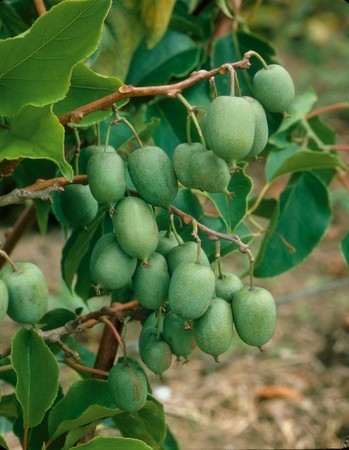
Fruits – edible elongated dark-green berries with 12 dark stripes, elliptical, more rarely round, up to 3 cm long and 15 mm wide. When fully ripe they become soft, fragrant, sweet. Taste dessert-like, pleasant. Strong aroma may cause a tickle in the throat. Seeds numerous, a berry may contain up to 90 seeds, small, dark brown or yellowish, with a finely reticulate surface. Weight of 1000 seeds 0.82—1 g. Begins to bear fruit at 9 years, some cultivated varieties fruit at 4-6 years. Fruits ripen unevenly, in late August – early September, and during ripening they drop (5-40%). Can bear on one site for more than 50 years.
Cultivars: Ароматная, ВИР-1, Крупноплодная, Парковая, Сорока, Сентябрьская, Ранняя Заря, Фантазия садов.
Hardiness zone: zone 4a. Can be successfully cultivated in locations where the frost-free period is 105-160 days, and where the sum of active temperatures exceeds 1400°C.
Site: prefers well-drained, fertile soils with a neutral reaction. Does not tolerate waterlogging and high groundwater. Choose a sunny site, away from large trees. Does not tolerate proximity to apple trees, but can be planted near currants. Poorly tolerates calcareous soil.
Care: in the second year after planting it is necessary to install a trellis at least 2-2.5 m high. Vines must be tied to the trellis in one vertical plane. In the third year all shoots growing from the main canes should be tied vertically so they do not entangle each other. During hot periods spraying can be done in the morning and evening. In conditions of Ukraine the plant does not need to be taken off the trellis for the winter.
Planting: recommended in early spring. Optimal seedling age – 2-3 years, but not later than 4 years. Planting hole size: 50-60 cm x 40-50 cm. Place drainage at the bottom of the hole: stones, gravel or crushed brick. Do not use construction rubble as it contains a large amount of lime. Add 8-10 kg peat, compost or humus to the hole and a mixture of mineral fertilizers – 200-300 g superphosphate, 100-150 g ammonium nitrate, 30-40 g potassium sulfate (wood ash). Do not use chlorine-containing fertilizers. On the drainage mound fertile soil, then a mound of the fertilizer-soil-sand mixture. After planting water the plant with 2-3 buckets of water. Recommended distance between plants – at least 2 m.
Pruning: In the second year after planting leave 2 main shoots and cut out all other shoots. Thinning of the crown is done in summer or late autumn. Do not prune in late winter or early spring due to strong sap flow. In the 4th year cut out one of the old vines, replacing it with a new main one.
Propagation: propagated by seeds or summer stem cuttings with three buds. For cutting in June (before and at the beginning of flowering) take semi-woody and early lignifying cuttings. When treated with a rooting hormone they root very quickly.
For seed propagation use freshly collected seeds, as germination declines with long storage. Sow in autumn or spring (after fractionated stratification of seeds throughout the winter in moist sand). In early November remove seeds from the sand, wrap in a thin lightweight cloth and soak in water for 4 days, changing the water daily. After soaking, seeds wrapped in cloth are buried in sterilized, clean moist sand and kept for 2 months at room temperature 18-20°C. During this period once a week remove the bundle, unfold for 5 minutes to ventilate, wrap, rinse under running water, squeeze lightly and re-bury in the sand. After 2 months the box with seeds is buried deep under snow for 2 months and after that stored at 10—12 °C. Seeds germinate in 20-30 days and after that can be sown in a box with fertile soil and kept at room temperature. Transplanting to open ground is done at the 3-4 true leaf stage.
Pests: in the first years of life vines can be damaged by cats, which like to lick the plant sap. Leaves are also damaged by geometrid caterpillars, leaf-eating beetles, lacewings, and bark beetles.
Diseases: Can be affected by phyllostictosis and powdery mildew.
Uses: an adult plant is very decorative. Can be used for vertical greening. Fruits can be consumed fresh or used for processing. Good nectar plant.