Flowers for the garden
Common yarrow
Achillea millefolium
Common yarrow (lat. Achilléa millefólium) — a perennial herbaceous plant; a species of the genus Yarrow (Achillea) of the family Asteraceae, or Compositae. Used as a medicinal, aromatic, ornamental and honey plant.
The generic name lat. Achilléa — “yarrow” originates from Ancient Greek ἀχίλλειος (achílleios) — “of Achilles”, the name of an unknown plant associated with Achilles (Achilleos = Achílles), son of Peleus and Thetis, the mythological hero of the Trojan War, a pupil of the centaur Chiron, who used this plant as a remedy to heal wounds. The specific epithet lat. millefólium — millefolium (literally “thousand-leaved”): from mille — thousand and fólium — leaf, referring to the numerous leaf segments.
A widely distributed species in Europe and Asia, it has also been introduced to other continents. A common plant in all regions of Ukraine, the European part of Russia, and in many areas of Western and Eastern Siberia, the Far East, the Caucasus and Central Asia. Common yarrow grows in forest, forest-steppe and steppe zones, dry forest meadows, meadow-steppes, among shrubs, in sparse forests, at forest edges, along roads, in ravines, on fallow land, wastelands, dumps, in settlements, on the banks of water bodies, and at field margins.
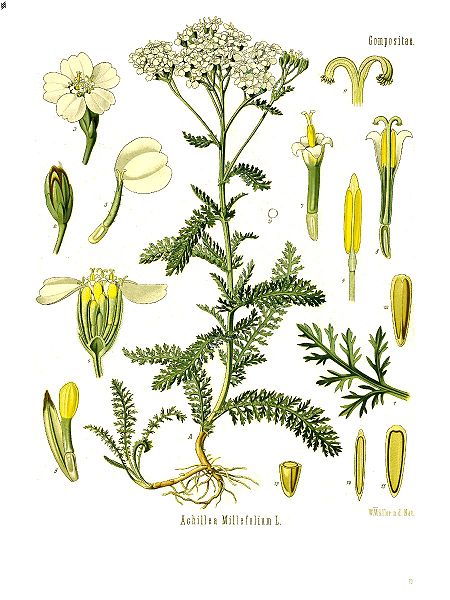
Herbaceous perennial, rhizome thick, creeping, branched, with numerous thin, fibrous roots and underground shoots.
Stems few or solitary, erect or ascending, straight, less often zigzag, terete, 20—80 cm high, angular-grooved, glabrous or slightly pubescent, branching only in the upper part. Leaves up to 15 cm long, 3 cm wide with numerous oil glands on the underside, alternate, overall lanceolate or linear-lanceolate, pinnately divided twice or three times, not to the very base, into fine segments.
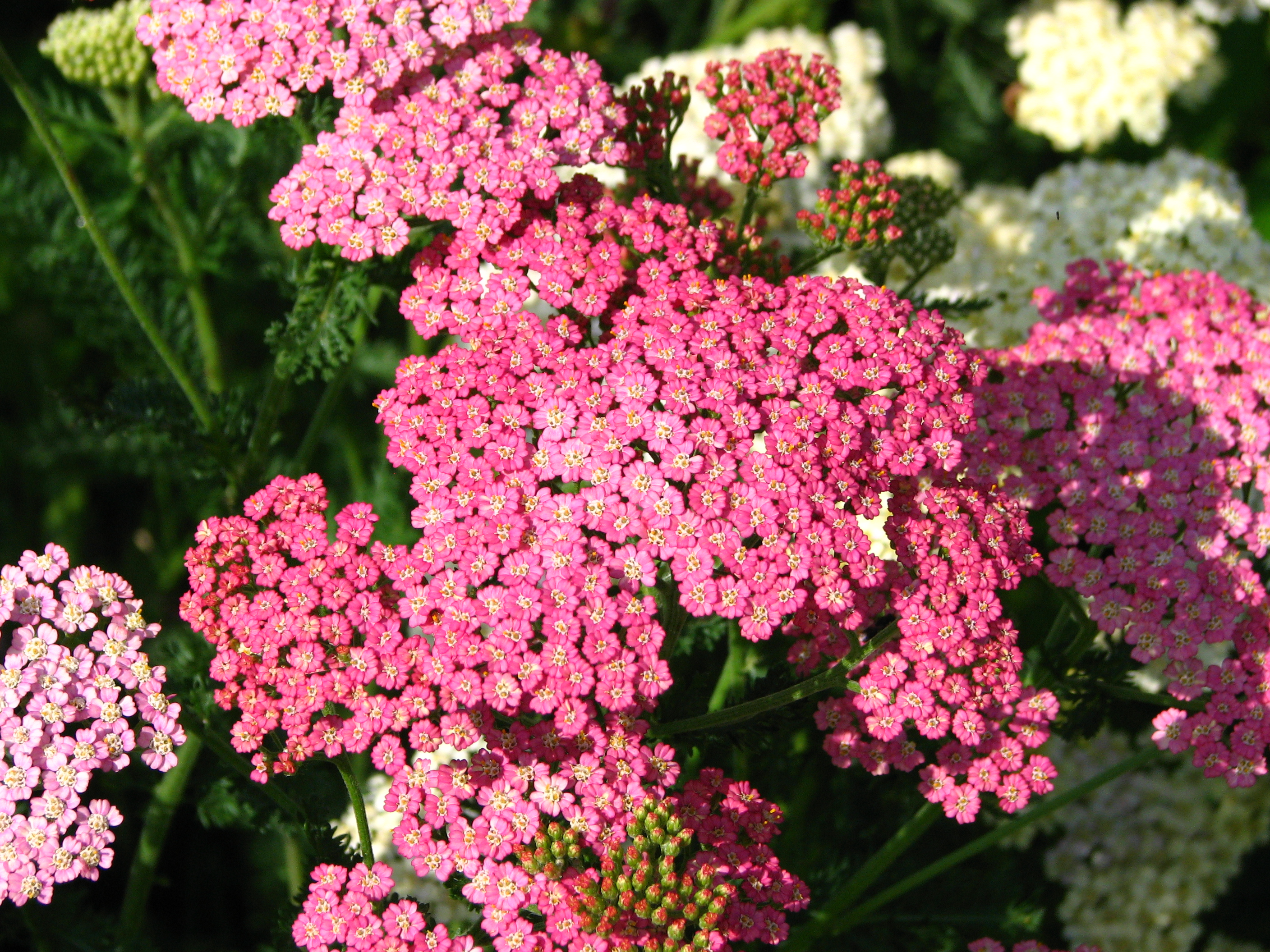
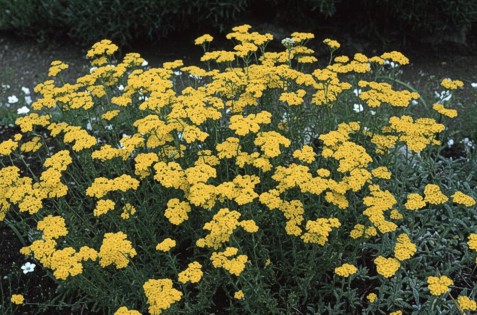
Flowers small, white or pink, gathered in small inflorescences — capitula (heads), which in turn form an overall corymb-like inflorescence composed of numerous heads. Fruit — an achene, flat, wingless, oblong, silvery-gray, 1.5—2 mm long. Blooms from June until the end of summer; seeds ripen in July—September.
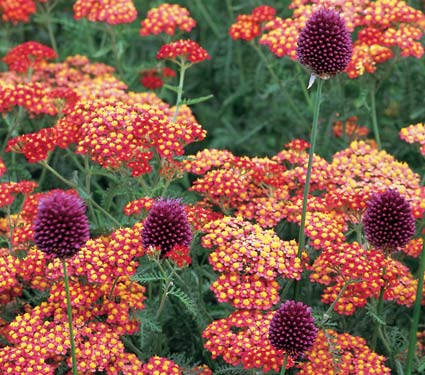
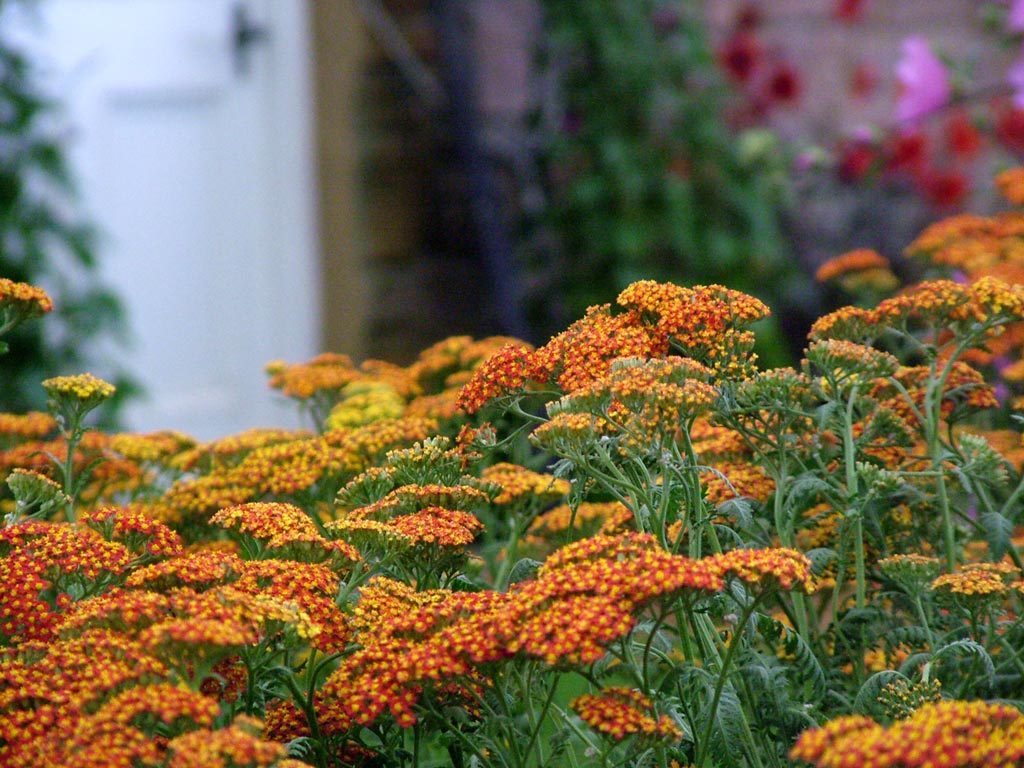
Has many ornamental cultivars that differ in flower color:
'Cerise Queen' , 'Kirschkonigin' - shades of the inflorescences range from cherry-red to purplish-pink;
'Walther Funche' - orange-salmon;
'Great Expectations' - bright yellow inflorescences,
'Marie Ann' - pale lemon-yellow;
'Terracota' – brownish-orange tones;
'Lilac Beauty' - delicate lilac;
'Appleblossom' - white-pink flowers;
'White Beauty' – pure white inflorescences.
Location: prefers a sunny position. Adapts to any soil, but prefers neutral, sandy soil.
Care: responds well to fertilizers and feedings. Common yarrow needs watering in dry, hot weather. Does not require shelter. Remove faded or dry parts of the plant in a timely manner.
Propagation: mainly by division of the clump, which should be performed every 2–3 years. Can be propagated in summer by green cuttings. Seed propagation is used rarely.