
Deciduous trees
Palmatum maple or fan maple
Acer palmatum
Synonyms: palmate maple, fan maple, palm maple, Acer amoenum Carrière, Acer decompositum Dippel, Acer dissectum Thunb., Acer formosum Carrière, Acer friederici-guillelmii Carr, Acer incisum Dippel, Acer jucundum Carrière, Acer ornatum Carrière, Acer pinnatifidum Dippel, Acer polymorphum Siebold & Zucc., Acer pulverulentum Dippel, Acer ribesifolium Dippel, Acer roseomarginatum (Van Houtte) Koidz., Acer sanguineum Carrière, Acer septemlobum Thunb., Acer sessilifolium Siebold & Zucc., Negundo sessilifolium Miq., Acer matsumurae (Koidz.) Koidz.
Palmatum maple (Acer palmatum (Thunb.)) – a species of deciduous plants in the genus Maple (Acer) of the family Sapindaceae (Aceraceae). The species was first described in 1784 by Johan Andreas Murray and Carl Peter Thunberg in Syst. Veg., ed. 14, 911. In cultivation since 1820.
Author V.Kudelya
Occurs naturally in North Korea, South Korea, eastern Mongolia, southeastern Russia, and Japan. It is found in mountains up to 1100 m above sea level. Grows at forest edges or in the understory beneath a dense forest canopy, in places sheltered from strong winds.
Author V.Kudelya
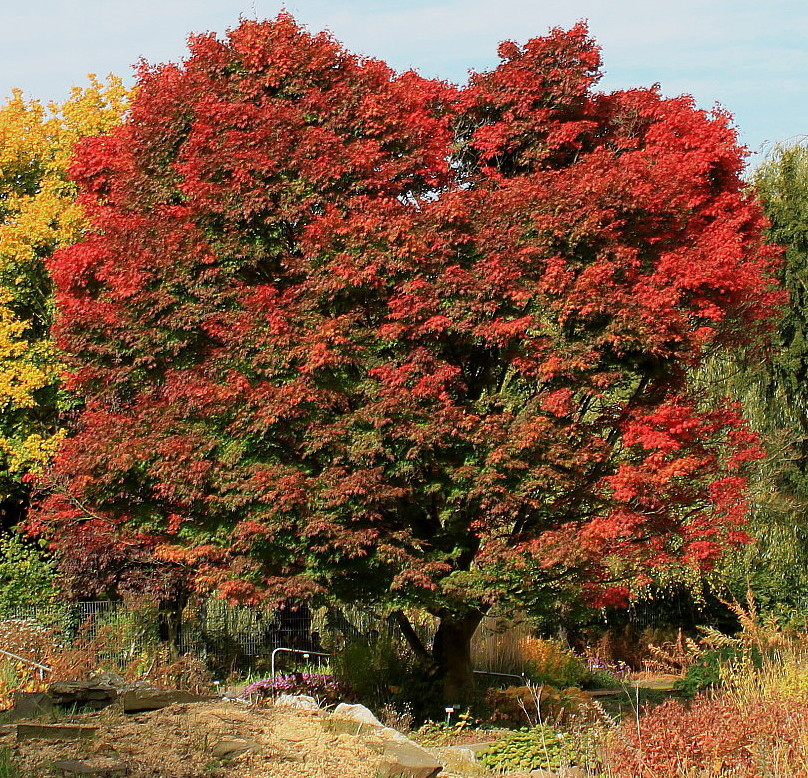
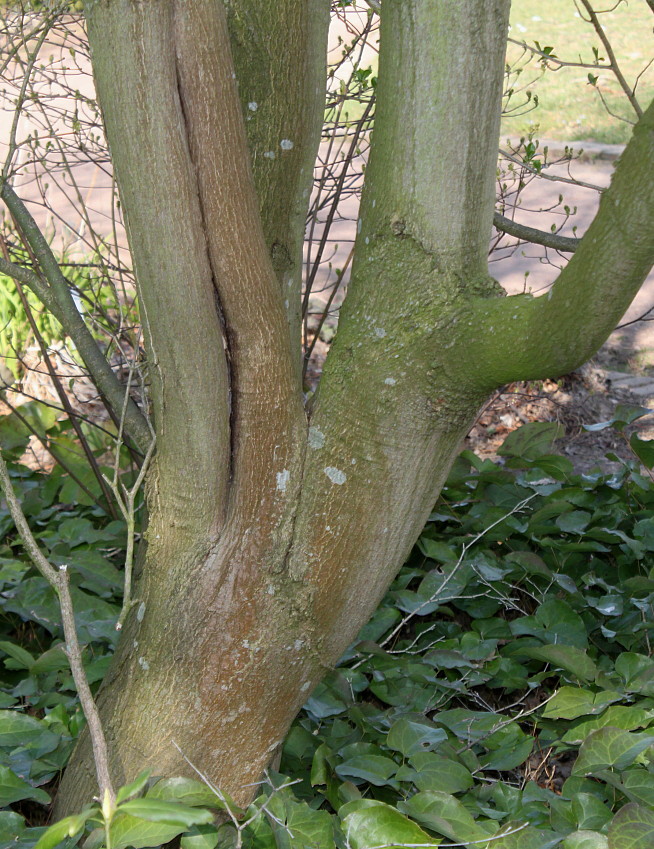
Is a deciduous small tree or shrub, 6-10 (16) m tall. Grows slowly. Annual increment is about 15 cm in height and 30 cm in width. Lives 100-150 years. Crown spherical when young, later pyramidal, dense. Has several trunks joining near the ground. Shoots glabrous, thin, greenish or purple. Bark greenish-gray or light brown, smooth. Winter buds purplish-red, conical, small.
Author V.Kudelya
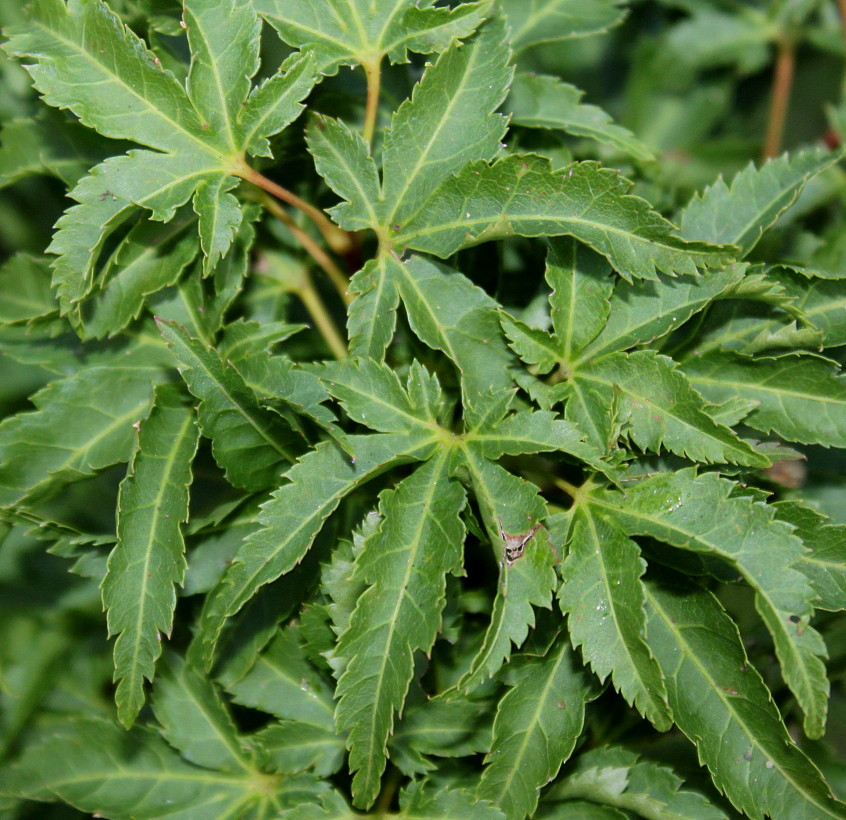
Leaves 4-12 cm long and wide, palmate with five, seven, or nine pointed lobes, simple, variable in shape and coloration. Segments in the typical form number 5, less often 7, ovate-lanceolate or oblong, acuminate, margins coarsely and sharply doubly serrate. Leaves smooth, glabrous, with hairs in the axils of the veins on the underside; in autumn leaves turn rich, bright scarlet-red and purple tones. Petioles 4-5 cm long, thin.
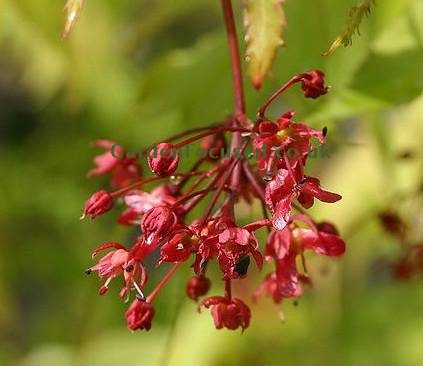
Flowers small, collected in erect, few-flowered corymbs of 10-20 flowers; each flower has five red or purple sepals and five whitish petals. Stamens 8. Ovary glabrous. Flowers in May.
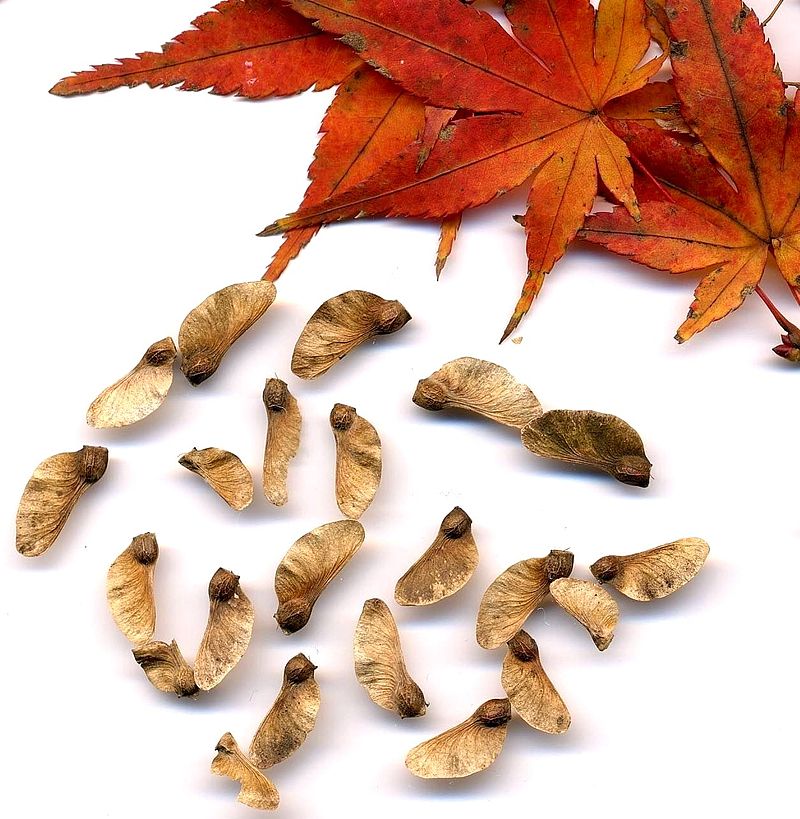
Author Tomomarusan
Fruits – samaras up to 2 cm long, diverging at an obtuse angle or directed almost horizontally, curved. Fruits in September.
Subspecies:
- Acer palmatum subsp. palmatum.
- Acer palmatum subsp. amoenum (Carrière) H.Hara
- Acer palmatum subsp. matsumurae Koidz.
Forms:
- Acer palmatum var. coreanum Nakai
- Acer palmatum var. koreanum Nakai
Hardiness zone: 5b (-25°C)
Site: requires moisture in soil and air. It is recommended to plant in locations protected from cold winds and strong sun. Optimal acidity — pH 6.0 - 7.5
Planting: Root collar at ground level; for plants producing abundant root suckers slightly planted to (5 cm). If groundwater is close, drainage made of crushed stone 10-20 cm thick is necessary. Soil mixture: humus or peat-compost, topsoil (sod soil), sand in a ratio of 3:2:1. Mineral fertilizer (120-150 g of nitroammofoska) can be added to the planting hole.
Indoor temperature: prefers moderate temperatures. In winter not below 0°C, optimal +8-10°C. From late May to August can be kept outdoors, shaded from bright midday sun and protected from drafts. Poorly tolerates hot air from radiators.
Watering: After planting - 20 L per plant. Most maples can tolerate soil dryness, but grow better with watering. Watering rate in dry season 10-20 L per plant once a week. With normal rainfall 10-20 L per plant once a month.
Care: Young plants in severe winters with insufficient snow cover should be covered with conifer boughs near the root collar. If damaged by frost, one-year shoots should be pruned. The crown will recover due to new shoots that have time to lignify before the onset of frosts. Standard (single-stem) plants in the first 2-3 years after planting should be protected from frost cracks by wrapping the trunk with burlap in 1-2 layers. Their winter hardiness increases with age.
Pruning: can be grown in bonsai style. Requires sanitary pruning.
Pests: whitefly, mealybug, leaf weevil.
Diseases: powdery mildew, black spot
Propagation: Fruits after collection are sown in the ground or stored in a dry cool place at 0 — 5 °C and 10 — 15% humidity, and before spring sowing stratified at 0 — 3 °C in moist sand for 2 months. Sowing depth 1.5 — 2 cm. Germination of plump seeds 60 — 65%.
Uses: an attractive ornamental tree with a pyramidal crown, unusual leaf shape and color, and beautiful flowers. Used in solitary and group plantings in parks, squares, and along pathways.