
Flowers for the garden
Acantholimon
Acantholimon
The name derives from the Greek words acanthos - thorn, spine, leimon - meadow.
A perennial evergreen plant with needle-like, rather stiff spiny leaves; Acantholimon eventually forms large mats. Its native range is the steppes and mountains of Armenia and Asia Minor. The genus includes about 90 species.
Acantholimon alatavsky - Acantholimon alatavicum Bge.
Central Asia (Tian Shan, Pamir-Alay). In steppe and desert conditions from foothills to highlands at an altitude of 1200-1300 m above sea level.
Subshrub. Cushions quite dense, tall (almost hemispherical), up to 30-40 cm in diameter. Summer leaves 1.5-2.5 cm long and about 1-1.5 mm wide, light green or bluish, flat-triangular, linear-acicular, stiff, with a hard tip at the apex, glabrous, with the margin (sometimes only at the base) finely ciliate-rough; spring leaves slightly shorter and just wider than the summer ones. Flower stems slightly exceed the leaves or almost do not exceed them, 3-6 cm high, simple, more or less densely and shortly pubescent. Flowers in single-flowered spikelets 11-14 mm long, which form small (about 2 cm long), dense, clearly two-ranked 5-8-spikelet spikes. The bracts of the spike are all glabrous; the outer is 1.5, rarely 2 times shorter than the inner ones, oblong-ovate, gradually acuminate above, with a short tip, rather narrowly membranously margined; the inner ones slightly exceed the calyx tube or are almost equal to it, broadly membranously margined, acuminate or bluntly rounded at the top, scarcely bifid at the apex, with a very short tip or without it. Calyx about 10-13 mm long, funnel-shaped; its tube in the upper half or along the whole length between the veins (rarely also on the veins) sparsely to more or less densely pubescent; the limb white, more or less distinctly ten-lobed, with veins either glabrous or more or less pubescent in the lower half. Petals bright pink or pink. Flowers in July-August.
Acantholimon armenian — Acantholimon armenum
Native range — the Caucasus (South Transcaucasia), Asia Minor. On dry rocky and stony-scree southern slopes. In the lower and middle mountain belts.
Leaves sabre-lanceolate or sabre-linear, with a hard tip, stiff, 2-3 (3.5-4) cm long, 1-1.5 mm wide, glabrous, with the margin finely and shortly ciliate. Flower stems up to 20 cm long, sometimes two on one branch; both the stem and the axis of the spike are covered with very small sparse calcareous scales and stiff hairs; indumentum on the spike axis only on the inner side (in the part adjacent to the spikelet). Spikelets single-flowered, 14-15 (16) mm long. Bracts all glabrous; outer 6 (7)-8(9) mm, always shorter than the two inner ones, ovate-lanceolate, almost gradually acuminate from the base, with a fairly long tip, green below, brown above; inner ones slightly unequal, shorter, equal to, or longer than the calyx tube, the innermost usually longer than the calyx tube, acuminate or bluntly rounded above, with a fairly long tip. Calyx 13-14 (15) mm long; calyx tube (7) 8-9 mm long, fairly densely and longly pubescent; calyx limb 5-6 mm wide, with veins reaching and exceeding the margin, with appressed pubescent veins in the lower half. Petals bright pink, exceeding the calyx by more than half the length of the limb.
For cultivation a dry, sunny, well-drained site with calcium-rich soil is required. Plant in rock garden crevices; protection from dampness is required during winter.
Acantholimon compact - Acantholimon compactum Korov.
Distribution: Alai and Turkestan ranges. Endemic. In wormwood and grass-wormwood grasslands on shallow-soiled rocky mountain slopes, at an altitude of 1500-2000 m above sea level.
Subshrub. Cushions very dense, tall (hemispherical), 5-15 cm in diameter. Leaves (0.5)1-1.5(2.5) cm long and about 1-1.5 mm wide, above more or less gradually narrowed, with a short hard tip, glabrous, along the whole margin finely ciliate-rough. Flower stems considerably exceed the leaves, up to 15-20 cm high, simple, densely and shortly pubescent. Flowers gathered in 2-3-flowered spikelets, which form sparse (the distance between spikelets is more or less equal to their length) 5-8-spikelet spikes, 4-7 cm long. Spikelets about 15 mm long. Bracts of the spike all pubescent; outer 1.5 times shorter than the inner ones, irregularly ovate, gradually narrowed, with a short tip, rather narrowly membranously margined; inner ones noticeably exceed the calyx tube, very broadly membranously margined or membranous, with a narrow keeled winged vein, with a short tip usually set below the apex. Calyx 10-12 mm long, funnel-shaped, between the veins sparsely pubescent; limb pink, indistinctly ten-lobed, with pubescent purplish veins. Flowers in July-August.
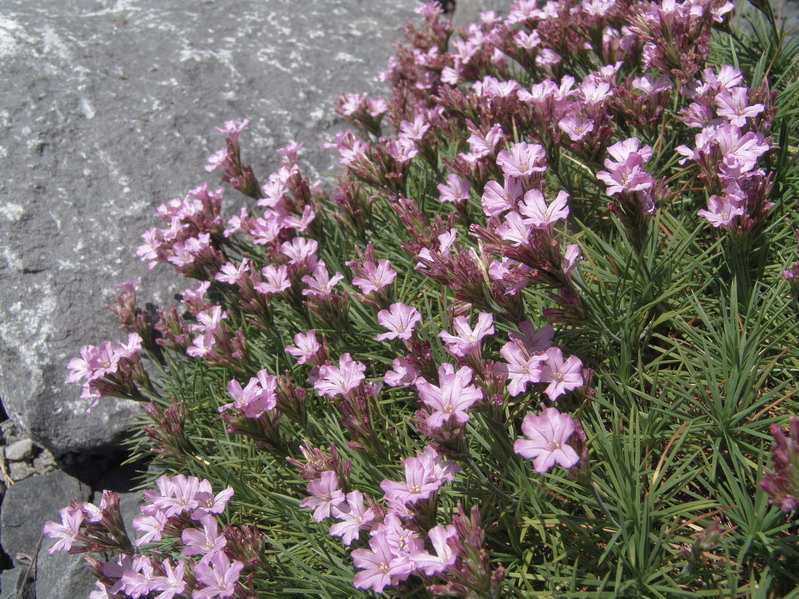
Note. Plants from the right bank of the Shakhimardan River have weak indumentum on the flower stems; bracts are weakly pubescent only along the median vein; in the inner ones the wingedness of the vein is little noticeable.
Location: for successful development Acantholimon requires sun-warmed, well-drained soil. The most suitable site is a rock crevice. In an improperly chosen site Acantholimon almost never blooms.
Soil: best to use poor calcareous soil with the addition of sand and crushed limestone.
Care: winter shelter is required to protect the plant from accidental winter rains.
Propagation: by seeds or cuttings in July — August. In autumn the plant is lightly covered with soil, and in spring the stems that have taken root are cut off. It is also possible to graft onto the roots of kermek. It is easier to propagate Acantholimon by seeds, sowing them immediately after ripening or in February. However, the plant in cultivation does not set seed, and if it does, they do not germinate. Transplanting adult specimens from place to place in most cases ends in failure.