
Indoor plants
Acalypha or Fox Tail
Acalypha
Acalypha or fox tail (Acalypha) — a genus of ornamental flowering plants that includes about 400 species in the family Euphorbiaceae (Euphorbiaceae). Native to the tropics and subtropics of Southeast Asia, Australia, Polynesia, and the Fiji Islands.
The Latin name of the genus comes from the ancient Greek word akalephe, "nettle", and was given to the plant because its leaves resemble those of nettle. Its inflorescences are commonly called "fox" or "cat tails".
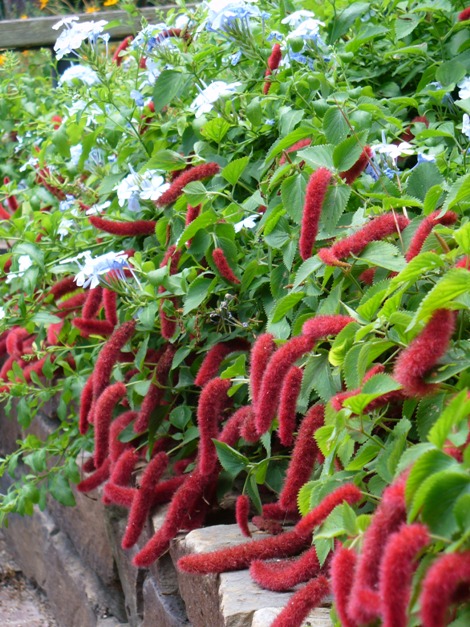
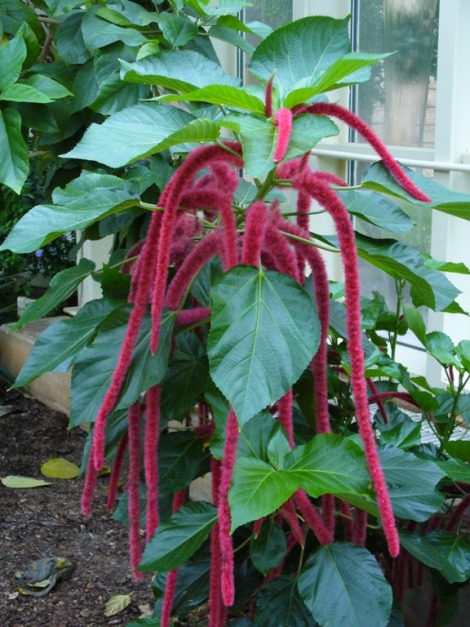
Evergreen plants: ornamental-flowering shrubs as well as herbaceous plants, more rarely trees. Leaves are ovate, serrated at the margins, on long petioles, alternate, often variegated. Flowers are gathered in more or less large pendulous spikes colored in various shades of red, less often white or green.
In cultivation:
Acalypha chamaedrifolia or Haitian - Acalypha chamaedrifolia = Acalypha hispaniolae Urb.
Natural range: Latin America. A creeping plant with spreading, pendulous shoots. Leaves light green, cordate, up to 4 cm long, alternate, with toothed margins. Inflorescences spike-like, pubescent, bright red, pendulous, from 3-4 cm to 10 cm. Cultivated as a groundcover or hanging (ampelous) plant.
Acalypha wilkesiana - Acalypha wilkesiana Muell. Arg
An evergreen dioecious shrub up to 3 m high with straight reddish, sparsely pubescent shoots. Leaves opposite, 20 cm long and 15 cm wide, simple, ovate, sharply pointed at the tip, serrated at the margin, bronze-green with bright copper-red spots. Flowers inconspicuous, small, gathered in axillary spike-like inflorescences 5-10 cm long. Native to Polynesia. Several garden forms are known, in particular "Godseffiana" - with lanceolate, densely pubescent leaves with golden edging, and "Musaica" - with broadly ovate or obovate green leaves with orange and bronze blotches.
Acalypha hispida - Acalypha hispida Burm
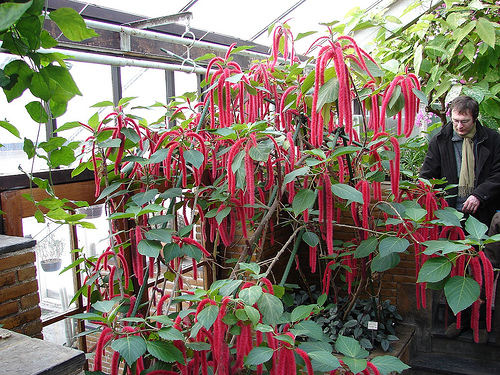
This is a graceful evergreen shrub, native to Polynesia, reaching up to three meters in the wild. It blooms with beautiful bright red, pubescent, pendulous spike-like inflorescences, reaching up to 50 cm in length. With good care, flowering occurs year-round. In cultivation since 1898. A form with white inflorescences, "Alba", is known.
Location: Throughout the year acalypha prefers to be in a room with a constant temperature not below 16°C, on a well-lit windowsill, but should be protected from direct sunlight.
Watering: In summer the soil in the pot should be kept constantly moist. In winter watering is limited, as the acalypha is frequently misted.
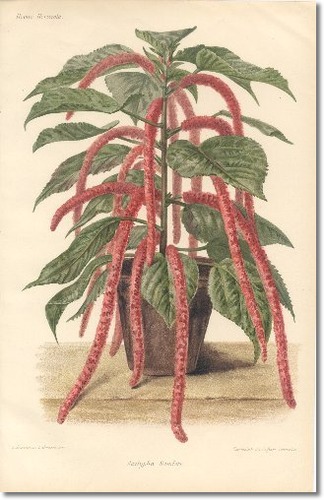
Humidity: High air humidity is required. It is recommended to place the plant on a tray with gravel and fill it with water.
Care: Older plants are regularly pruned, leaving stumps of 25-30 cm. In spring and summer (from March to August) it is fed weekly with balanced fertilizers. In winter plants are not fertilized.
Repotting: The soil mix should be dominated by acidic peat, to which equal parts leaf mold and sand are added. Acalypha is repotted only after roots appear from the drainage hole, usually after flowering.
Possible problems: Plants are susceptible to attack by aphids, whiteflies, and spider mites. Leaf spot often affects the foliage.