
Flowers for the garden
Acaena
Acaena
About 60 species of Acaena occur in nature, distributed primarily in the Southern Hemisphere, especially in New Zealand, Australia, Tasmania, the Andes, Mexico and South America.
These are mat-forming shrubs or subshrubs 10 to
Acaena appeared in cultivation with us relatively recently but quickly began to gain ground. It is undemanding and easy to grow. By spreading, it forms attractive carpets thanks to the prostrate stems, which root where they touch the soil. Stem leaves are alternate and do not fall in autumn.
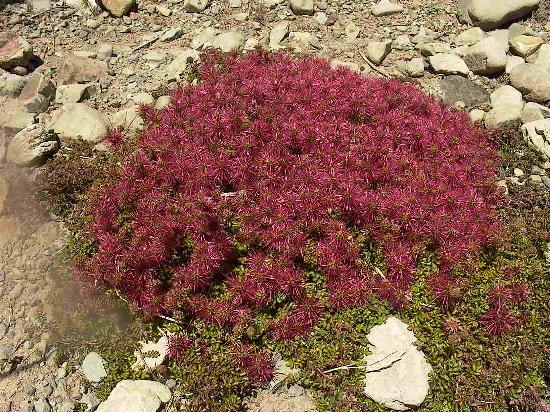
Acaena argentea — Acaena argentea Ruiz & Pav. = Ancistrum argenteum (Ruiz & Pav.) Kunth
Native range - South America; found in Peru and Chile in the alpine zone of the Andes. Grows at altitudes of 1000-
Perennial 1-
Acaena buchananii — Acaena buchananii Hook.f.
Native range - New Zealand. Hardiness zone: 6.
Plant up to
Acaena inermis — Acaena inermis Hook.f.
Native range - New Zealand, where it grows on the mountain meadows of the South Island.
Perennial 5-
Acaena microphylla — Acaena microphylla Hook.f.
Native range - New Zealand. Not very frost-hardy. Hardiness zones: 6-8.
One of the most common in gardens. A plant with solitary rounded brownish-green leaves with finely toothed margins. Its not very long shoots (maximum length 60–65 cm) are highly branched, intertwining to form a very dense sward 5–7 cm high, resembling a lawn. Leaves withstand being under the snow without damage. Small flowers are grouped into spherical inflorescences on thin flower stalks about 5 cm long. Fruiting specimens are especially attractive. Their inflorescences turn into a dark brown head about
Acaena splendens — Acaena splendens Hook. & Arn.
Perennial 10-
Location: Acaena grows in sunny positions and in partial shade; however, in partial shade the plants grow taller than usual and the mat becomes loose.
Soil: Acaena requires humus-rich, not very heavy, well-drained garden soil. It does not like waterlogged or excessively dry sites. Excess moisture adversely affects the plant's winter survival.
Care: in winter acaena suffer not so much from low temperatures (they are protected under a layer of snow) as from dampness during snowmelt. If snow does not lie on the ground for a long time, it is better to cover acaena with a single layer of brushwood or conifer boughs.
Propagation: acaena are easily propagated by seed. Sow them in spring. A week of stratification promotes more uniform germination. Seedlings appear relatively quickly, are pricked out, and by the end of summer form small plants capable of overwintering under snow. But it is easier to propagate acaena by stem cuttings. Lifting an acaena runner you will find aerial roots at the nodes of last year's shoots. A cutting must be taken with a segment of the previous year's shoot, only on it do roots form actively. In late spring to early summer, when acaena shows active shoot growth, cut 12–15 cm long cuttings. For successful rooting the cuttings require regular misting.