
Flowers for the garden
Abronia
Abronia
Synonyms: sand-verbena, Tricratus L'Hér. ex Willd.
Abronia (Abrōnia) – a genus of flowering plants in the Nyctaginaceae family. The genus name comes from the Greek «ἁβρός», which means «delicate, graceful, joyful». The genus was first described by the French botanist Antoine-Laurent de Jussieu in his work «Genera Plantarum» in 1789. In cultivation since the early 19th century.
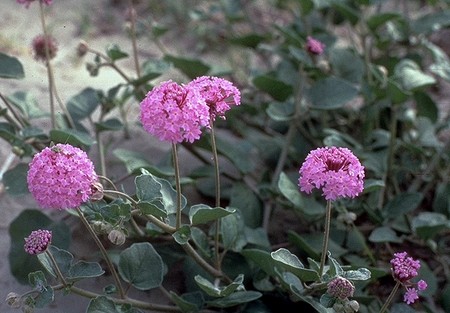
Abronia ameliae
In the wild it grows in the western part of North America, from the provinces of Alberta and Saskatchewan, Canada, south to west Texas, California and central Mexico. It grows on dry sandy soils.
Members of the genus are annual and perennial rhizomatous subshrubs or herbaceous plants up to 35 (50) cm tall. Stems forked, prostrate or creeping, often sticky from short glandular pubescence.
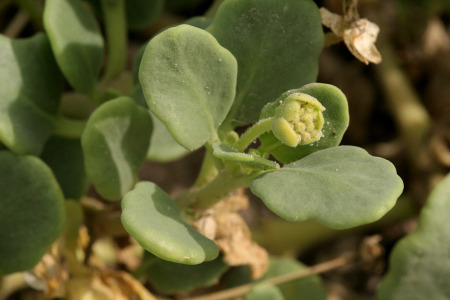
Leaves opposite, entire, often succulent, often sticky from glandular pubescence. Petioles long.
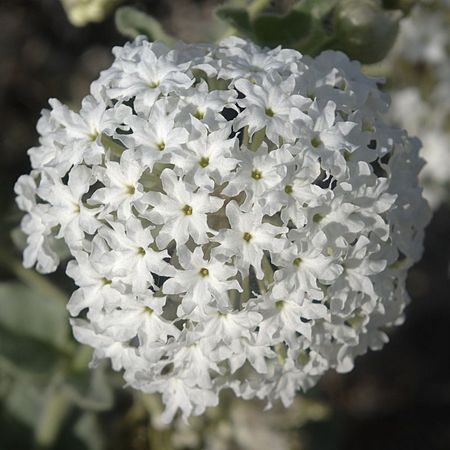
Abronia fragrans
Flowers bisexual, fragrant, borne at the tips of ascending leafless peduncles. They are gathered in dense, verbena-like, head-shaped half-umbels, surrounded by a panicle-like, inconspicuous involucre. The calyx is corolla-like in shape, the tube long, narrow, cylindrical or slightly widening upward with 4-5 spreading lobes of a small limb. The corolla is absent. Stamens 5, they are enclosed within the corolla. Inflorescences very similar to verbena flowers, which is why many call it sand-verbena. Flowers in June-July.
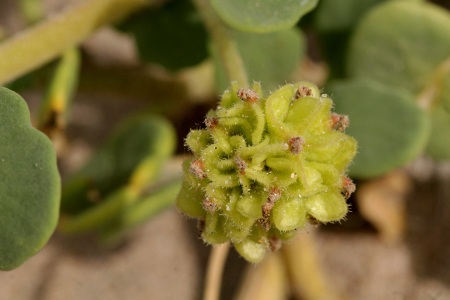
Fruits – single-seeded nutlets enclosed in the base of the calyx, which persists with the fruits. Fruits ripen in October.
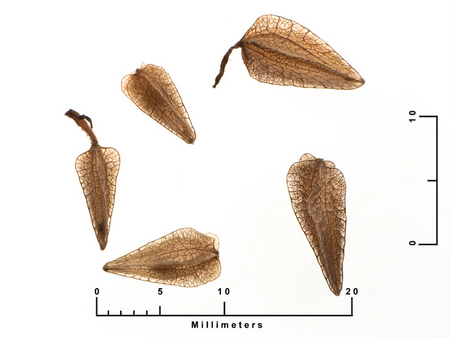
Abronia ameliae
Species: about 35 species are known. Only 8 are used in cultivation. Some species:
- Abronia ×alba Eastw.
- Abronia alpina Brandegee
- Abronia ameliae Lundell
- Abronia ammophila Greene
- Abronia angustifolia Greene
- Abronia argillosa S.L.Welsh & Goodrich
- Abronia bigelovii Heimerl
- Abronia bolackii N.D.Atwood, S.L.Welsh & K.D.Heil
- Abronia carnea Greene
- Abronia crux-maltae Kellogg
- Abronia elliptica A.Nelson
- Abronia fragrans Nutt. ex Hook.
- Abronia gracilis Benth.
- Abronia latifolia Eschsch. — broad-leaved sand-verbena
- Abronia macrocarpa L.A.Galloway
- Abronia maritima Nutt. ex S.Watson
- Abronia mellifera Douglas ex Hook.
- Abronia micrantha Torr.
- Abronia ×minor Standl.
- Abronia nana S.Watson
- Abronia nealleyi Standl.
- Abronia parviflora Kunth
- Abronia pogonantha Heimerl
- Abronia turbinata Torr. ex S.Watson
- Abronia umbellata Lam.— umbellate Abronia, umbel-shaped (type species)
- Abronia villosa S.Watson – hairy Abronia
Frost hardiness zone: 12 (6-8 °C).
Location/exposure: all members of the genus prefer warm, sunny sites with a south-facing exposure. Drought-tolerant. Heat-loving, moderately cold-hardy.
Soil: grow well on light, dry or moderately moist sandy soil. Poorly tolerate excessive and stagnant moisture, as well as heavy soil. Requires good drainage. Not demanding in soil fertility; can grow on ordinary garden soil, including poor, loamy-sandy or sandy soils.
Pruning: because the plant spreads rapidly over a large area, it should be lightly pruned. Pruning can be done throughout the summer.
Care: in spring before flowering apply organic and mineral fertilizers. Manure is ideal as an organic fertilizer because it is fairly rich in nitrogen.
Planting: transplanting into open ground is carried out in mid-April.
Propagation: propagated by seed. For growing seedlings, seeds are sown in March-April in a warm greenhouse. Seeds can be sown in autumn, before winter; then plants bloom earlier and more abundantly.
Pests: aphids
Diseases: rots
Uses: widely used for floral design in flower beds, borders, groups, as well as in container culture. Looks effective on lawns, edgings, rock gardens, in hanging containers, vases or hanging baskets.