
Conifers
Korean fir
Abies koreana
Synonyms: Korean fir
Korean fir – a species of evergreen trees of the genus Abies in the Pinaceae family. Range – the southern part of Korea, including Jeju-do island. It ascends the mountains to 1000-1850 m above sea level. Forms pure and mixed forests with Erman's birch and Ayan spruce. The species resembles Veitch's fir, differing by shorter needles, deeply fissured bark and upturned, protruding bracts.
Introduced to Europe in 1905. Lives up to 150 years. The root system is powerful, well-branched and deeply penetrating into the soil.
It is an evergreen tree with a broad conical crown. Reaches 15 m in height, 3-4.5 m in width, with a trunk diameter of 50-80 cm. In youth it grows slowly, later – faster. Annual increment reaches 5 cm per year. Bark of young trees is ashy-gray with a purplish tint, smooth; in old trees – reddish-brown, with deep fissures. Young shoots are yellowish, later acquire a purplish tint, weakly grooved, rarely hairy, later glabrous. Buds nearly globular, slightly resinous.
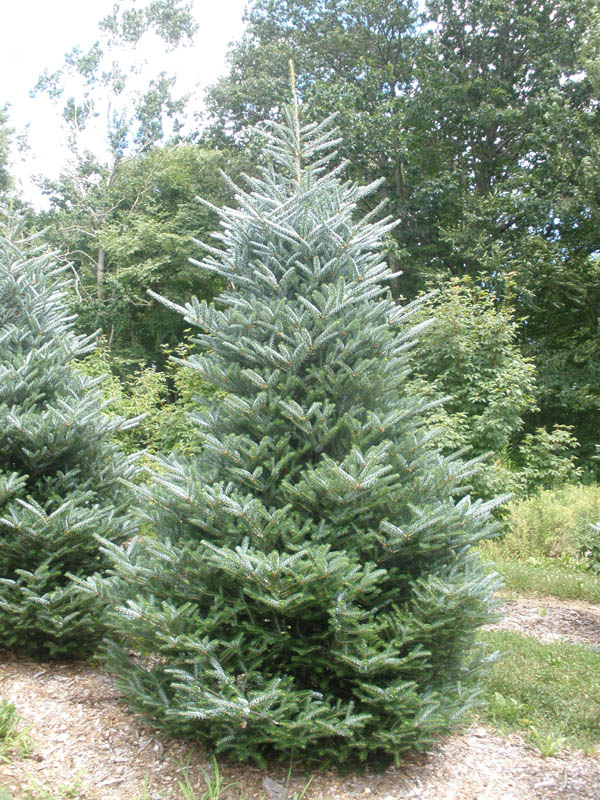
Needles short, 10-15 (20) mm long and 2-2.5 mm wide, densely appressed, arranged radially, saber-shaped curved, stiff, often slightly notched at the tip. In young plants the needles are often prickly. Upper surface of the needles dark green, underside shiny, with 2 wide bands, resin canals internal.
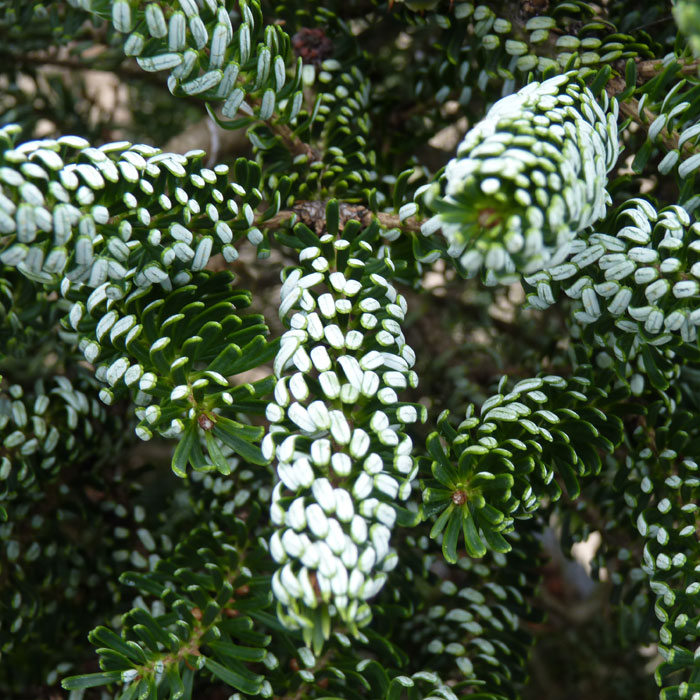
Korean fir Silberlocke
First pollination and fruiting observed at 17 years. Pollinates for 3-4 days from 18.V ± 3.
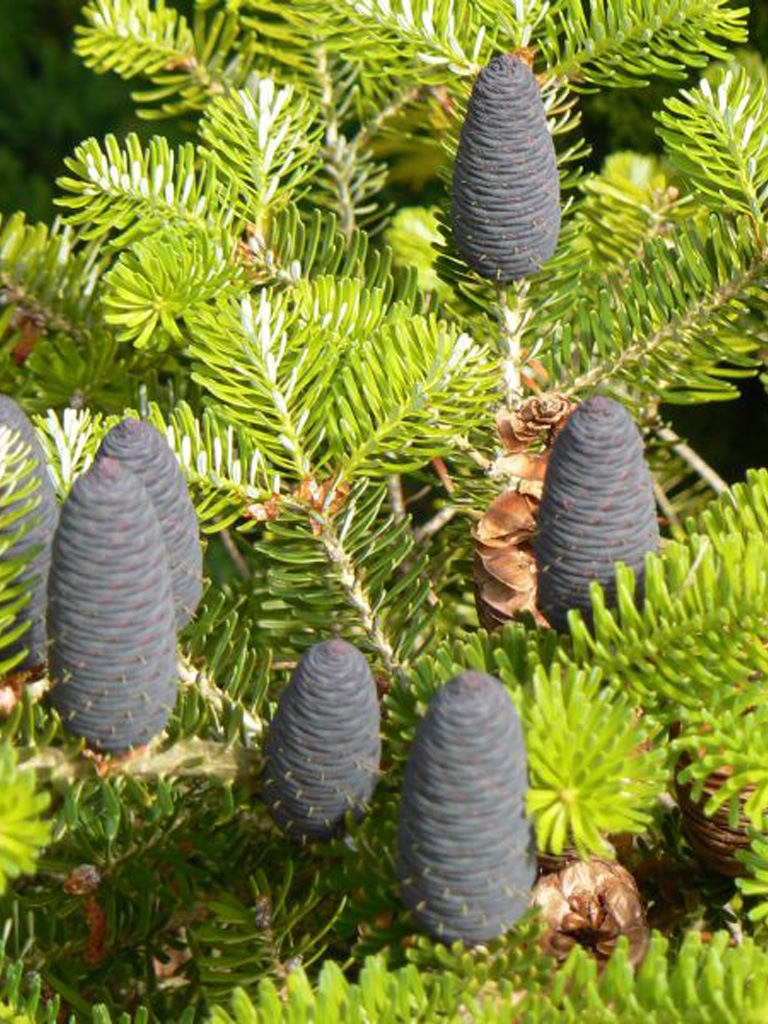
Cones cylindrical, 5-7 cm long, 2-2.8 cm wide, purple-violet before ripening. Ripen at the end of August. Seed scales 4-4.5 mm long and 12-13.5 mm wide, narrowly pocket-shaped, with a short stalk 4-5 mm long. Bracts slightly longer than seed scales, oblong-obovate, expanded into a rounded plate 5-5.5 mm in diameter, with a small point 2-3 mm long. Seeds light or dark brown with a purplish tint, ovate-cuneate in shape. Fruits annually, but not abundantly every year.
Cultivars: "Adelba", "Alpin Star", "Blue Standard"), "Brevifolia", "Silberzwerg", "Piccolo", "Aurea", "Blaue Zwo", "Blauer Eskimo", "Blauer Pfiff", "Blue Cones", "Blue Magic", "Blue Standard", "Bonsai Blue", "Compact Dwarf", "Silberlocke".
Hardiness: 5-7
Location: Prefers sunny sites but can tolerate partial shade. Prefers fresh fertile soil, evenly moist. Prefers sandy loam or loam soil. Needs protection from cold winter winds. Does not like drought and air pollution.
Planting: In avenue plantings the recommended distance between trees is at least 4-5 m; in dense groups – 2.5 m; in loose groups – 3-3.5 m. Optimal planting times: spring in April, autumn – late August to September. Minimum planting pit dimensions: 50x50x60 cm. The root collar should be at ground level. Recommended soil mix: peat, sand, clay, leaf soil or humus in ratio 1:1:2:3. On heavy soils drainage is mandatory – place broken brick or gravel 20 cm deep at the bottom of the pit. When planting it is recommended to add nitroammophoska in the amount of 250-300 g per pit and 10 kg of sawdust. Optimal age for planting – 5-10 years.
Care: In the 2nd-3rd year after planting it is recommended to apply Kemira-Universal (150 g/m2). Loosen soil to a depth of 25-30 cm. Mulch the trunk circle with sawdust, peat or wood chips to a depth of 5-8 cm. Young plants need shelter with fir branches in harsh winters.
Pruning: Sanitary pruning is performed in early spring.
Diseases and pests: resistance to pests and diseases is high. Preventive treatment against adelgids is recommended.
Propagation: propagated by seeds, cuttings, grafting. Seed germination 30%. Cuttings without treatment with stimulants do not root.
Uses: used for landscape greening purposes. Looks good in compositions. Suitable for greening small plots. Combines well with other conifers, deciduous shrubs and trees. Can be used as a Christmas tree.