
Conifers
Balsam fir
Abies balsamea
Grows in the coniferous forest zone of North America, in Canada and the USA, reaching almost to the tundra zone, and in mountains to the upper tree line (1500—2500 m). Often found in low-lying sites and near bodies of water mixed with other species; forms pure stands on bogs and high in the mountains. Shade-tolerant. The most widespread fir in North America. Considered short-lived, living up to 150—200 years.
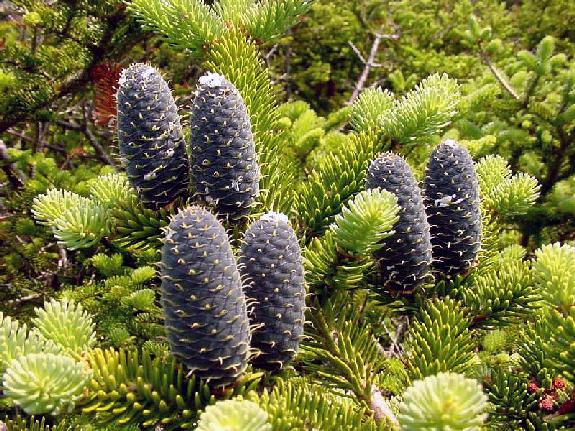
A slender tree up to 15–25 m tall, with a regular, conical or narrow-pyramidal, dense crown that in solitary trees reaches the ground, and with blackish-gray bark; with dark green, aromatic needles, glossy above with two whitish bands beneath, arranged on shoots in several rows one above another, functioning for up to 5 years.
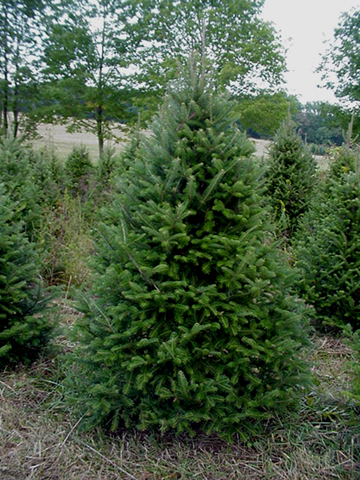
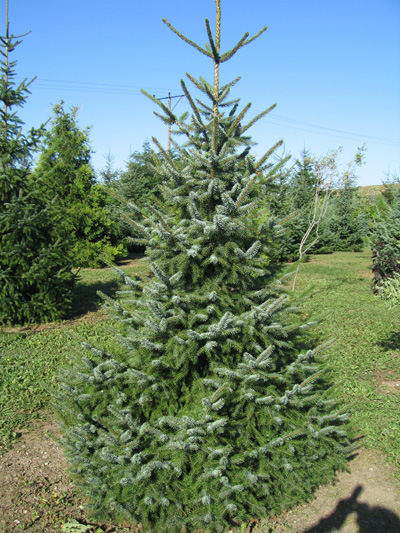
Shade-tolerant, frost-hardy, grows relatively quickly, shoots fully mature. Lower branches, when covered with humus, root easily, and the young trees that grow around the parent plant create a very attractive group. Begins to bear cones at 20–30 years. Pollination occurs at intervals of 1–4 years. Responds negatively to trampling and breakage. Good for avenue, group and solitary plantings. Very striking with numerous young dark purple cones. It should be noted that with a shallow root system it is wind-prone. In cultivation since 1697.
Forms in cultivation:
"Hudsonia"(Hudsonia). A dwarf mountain form from the state of New Hampshire, where it grows at the upper tree line. Crown broad. Branches very dense, shoots numerous and short. Needles short, flat, broad, dark green above, bluish-green below. Known since 1810. Rarely used in solitary or group plantings.
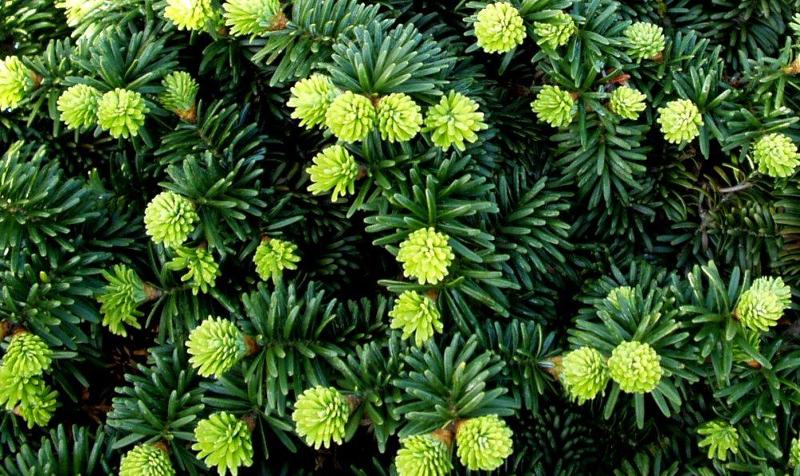
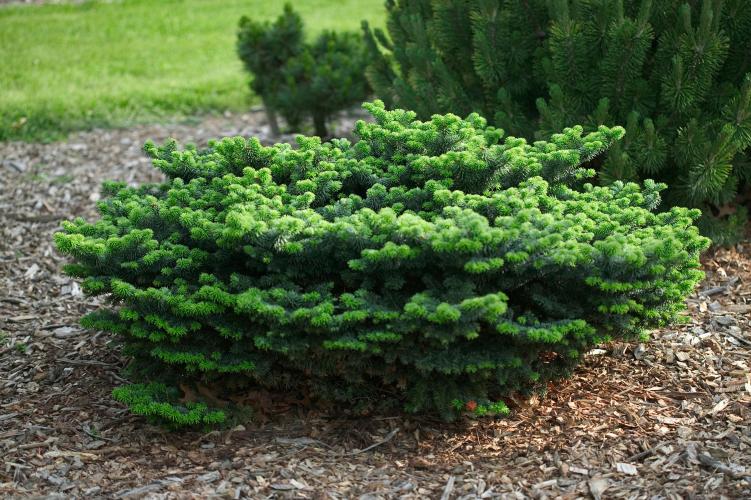
"Nana", Low ("Nana") - a dwarf form up to 50 cm high. Crown rounded, 2–2.5 m in diameter. Branches spreading, dense, growing horizontally. Needles short, dense, dark green, with two white-blue bands below; the middle and edge are lighter, yellow-green. Grows slowly. Shade-tolerant. Frost-hardy. Introduced into cultivation in 1850. Suitable for rock gardens and for container culture, for greening terraces and roofs. Recommended to plant in groups on lawns or as solitary specimens, in rockeries.
Other ornamental forms: glaucous (f. glauca) - with bluish needles; silvery (f. argentea) - with white tips to the needles; variegated (f. variegata) - with yellow-variegated needles; columnar (f. columnaris); prostrate (f. prostrata) - dwarf, with branches spreading along the ground.