
Deciduous shrubs
Veronica
(Veronica L.)
Synonyms: Beccabunga Hill, Cochlidiosperma (Rchb.) Rchb., Diplophyllum Lehm., Macrostemon Boriss., Oligospermum D.Y.Hong, Pseudolysimachion (W.D.J. Koch) Opiz., zmeyka, snake grass, Andreeva herb.
Veronica (Veronica L.) – a genus of plants from the Plantaginaceae family. It was first described in 1753 by Carl Linnaeus in "Species Plantarum 1: 9." According to B. N. Golovkin, the genus name was given in 1542 by the German botanist Leonhart Fuchs.
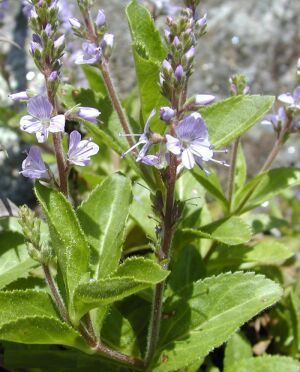
Occurs in nature in all parts of the world, but most often in regions with temperate and cold climates in Europe and Asia, mainly in the Mediterranean. In Australia, New Zealand and South America they mainly grow in shrub form.
They are perennial or annual herbs, less often subshrubs. Stems are erect or prostrate, solitary or branched, less often branched at the base. Stems are pubescent with soft simple hairs, stalked glandular hairs or glabrous, glandular-pubescent near the inflorescence. Stem height ranges from 2 cm to 150 cm. Creeping species also occur.
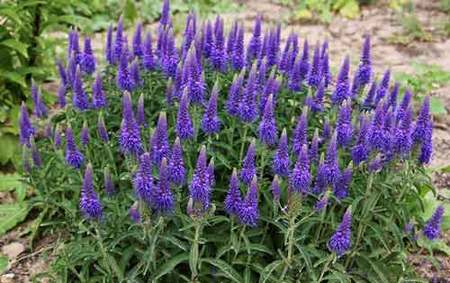
Leaves are opposite, less often alternate or verticillate in 3-9 whorls; some species may have both opposite and verticillate leaf arrangement. Basal leaves may be scale-like. Shapes may be oval, elliptical, ovate, obovate, ovate-triangular, oblong-ovate, lanceolate, narrowly lanceolate, ovate-lanceolate, ovate-rounded, linear-lanceolate, oblong, almost linear and cordate. Also encountered are pinnately divided into linear or filiform, less often narrowly lanceolate divergent lobes or twice pinnately divided with thin, almost filiform lobes, as well as palmate-lobed. Leaf margins are toothed, finely blunt-toothed, serrate-toothed, crenate, doubly serrate, with sparse teeth in the upper part and entire in the lower part. Petiole usually short, 1–1.5 mm long, rarely up to 13 mm; flattened and widened petioles or absent petioles occur. Sizes range from 2 mm to 15 cm in length; they are green, less often gray from pubescence.
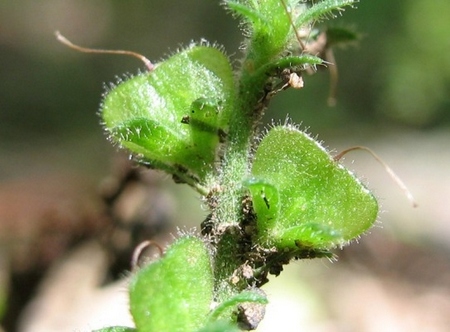
Flowers terminal, gathered in spike-like, umbel-like or panicle inflorescences of an open type, may be in leaf axils, less often only at the top. Pedicels long or short; in spike-like inflorescences flowers are sessile. Inflorescence density varies. Flowers small, bisexual, zygomorphic. Bracts entire, ciliate, narrow-linear, linear, erect, lanceolate, ovate-lanceolate, linear-lanceolate in shape. Perianth double. Calyx mostly divided into 5 elliptical, broad-lanceolate, lanceolate or linear-lanceolate ciliate lobes, one of which is narrower and shorter, underdeveloped, slightly wider than the others or 2 anterior lobes longer than the others, 2 median lobes twice, and the 5th three times shorter than the anterior ones; often it is divided into four ovate-lanceolate, lanceolate, elliptical acute short-ciliate or ciliate-edged lobes, glabrous, pubescent or glandular-pubescent. Corolla sympetalous, 4-lobed, wheel-shaped, pubescent at the throat, blue, lilac or violet, sometimes white, yellow or reddish; it is longer or shorter than the calyx. Lobes of the limb are obovate, broadly ovate, oblong-ovate, oval or rounded obtuse, ovate-lanceolate, lanceolate, elliptic, rhombic-lanceolate, linear-lanceolate acute. Perianth size varies from 3 to 18 mm in diameter. Stamens 2, attached to the corolla tube in the middle and positioned to the sides of the posterior petal. Stamen lengths vary. Gynoecium syncarpous. Ovary two-celled, with central placentation. Style 1, with capitate, rarely bilobed stigma, length from 7–8 to 0.1 mm.
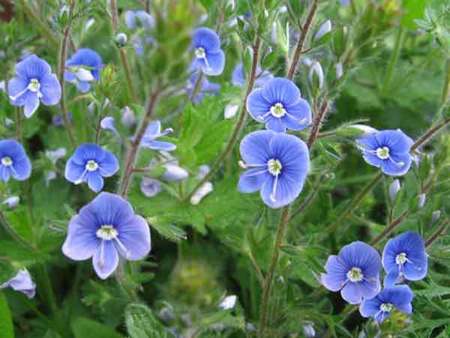
Fruit – a two-celled capsule, less often one-celled, obovate, round-reniform, rounded-elliptic, almost round; oblong, narrowed toward the apex; obcordate, heart-shaped, ob-triangular, usually with a small notch. Capsule pubescent, glabrous or with solitary hairs, glandular-hairy, long-haired. Opens along the septa or by the locules. Seeds medium-sized, ovoid or rounded, flat-convex, smooth or tuberculate, yellowish, from 0.5–0.7 mm to 2–3 mm long. Number of seeds per capsule – 2–3 pcs.
Species: comprises about 300 species. Some of them:
- Armenian speedwell- Veronica armena Boiss. et Huet
- Large speedwell- Veronica teucrium L.
- Branching or bushy speedwell- Veronica fruticans Jacq.
- Gentian-like speedwell- Veronica gentianoides Vahl
- Woody or runnering speedwell - Veronica surculosa Boiss. et Bal.
- Long-leaved speedwell - Pseudolysimachion longifolium
- Woodland speedwell - Veronica chamaedrys
- Spike speedwell - Veronica spicata L.
- Crimean speedwell - Veronica taurica
- Common speedwell- Veronica officinalis L.
- Threadlike speedwell - Veronica filiformis
- Prostrate speedwell - Veronica prostrata L.
- Gray speedwell - Pseudolysimachion incanum
- Siberian veronicastrum - Veronicastrum sibiricum
- Steller's speedwell - Veronica stelleri
- Thyme-leaved speedwell - Veronica serpyllifolia
- Broad-leaved speedwell - Veronica latifolia L.
- Schmidt's speedwell - Veronica schmidtiana
- Scree speedwell - Veronica schistosa
Hardiness zone: 3a (-29C).

Habitat: mesophytes, less often xerophytes; undemanding regarding soil composition and quality; sun-loving.
Care: practically does not require care. Cut back stems after flowering. Does not require winter shelter.
Pests: butterfly caterpillars, galls, mites, weevils.
Diseases: raspberry ring spot, mycorrhiza.
Propagation: by seeds and vegetatively. Seeds are sown in the ground in autumn. Seedlings appear in the 2nd year. For cuttings use the tips of growing shoots. Easily propagated by dividing the clump in early spring or in August. When transplanting, cut back the above-ground part.
Companions: primulas, geums, bellflowers, saxifrages, sedums, carnations, Dalmatian geranium.
Uses: used in rock gardens, retaining walls, for creating borders, mixed borders, flower beds; some species as groundcover plants or for decorating ponds.