
Deciduous trees
Liran, American Liriodendron
tulipifera L.
Synonyms: tulip tree, tulip Liriodendron, yellow poplar.
Liriodendron tulipifera (Liriodendron tulipifera L.) – a species of plants from the genus Liriodendron (Liriodendron) of the family Magnoliaceae. First described in 1753 by Carl Linnaeus in his Sp. Pl. 1: 535. In cultivation since 1688. In Greek, Liriodendron means lily-like tree.
Author Warburg1866
Naturally grows in the eastern part of North America. Found in rich forest stands, bluffs, low mountains and hills. Ascends to elevations of 0-1500 m above sea level.
Author A.Titov
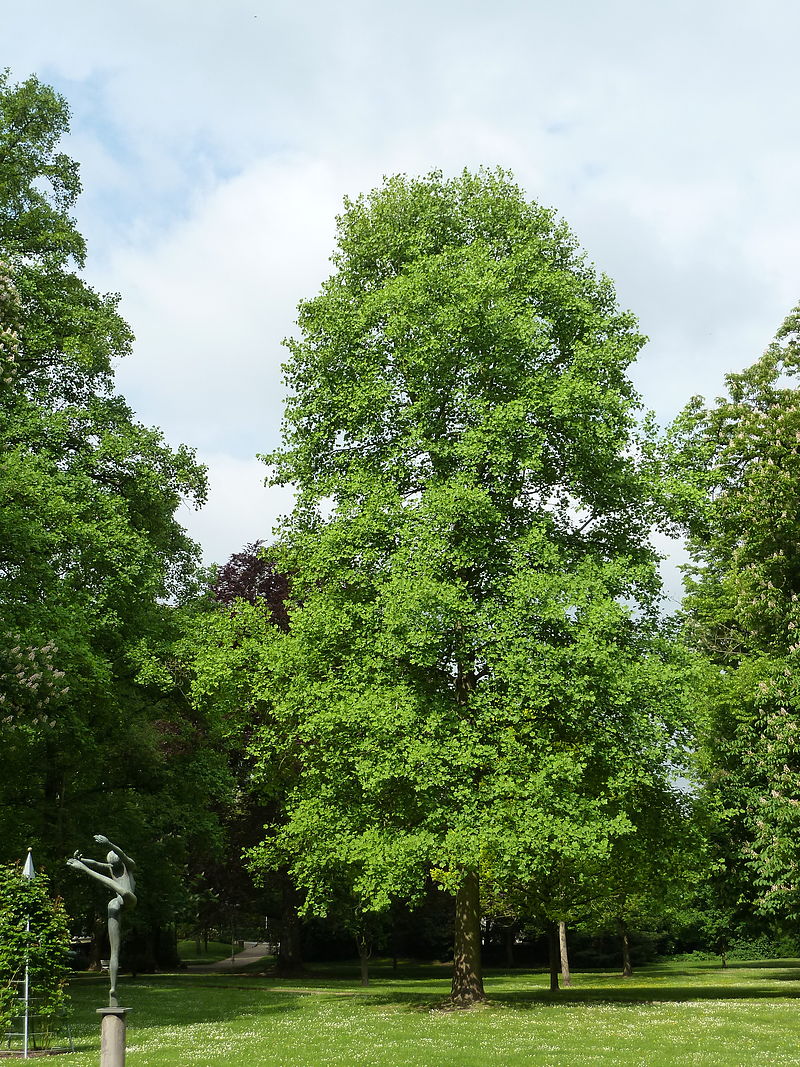
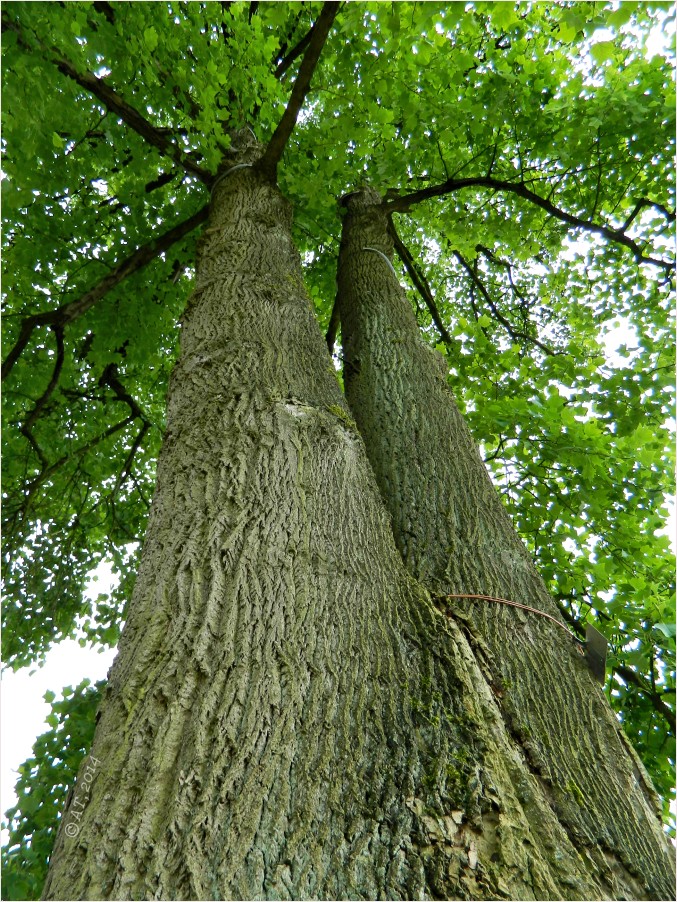
It is a deciduous, fast-growing large tree 25-36 (50) m tall. Crown high, pyramidal in youth, later becoming oval. Trunk massive, straight, 60-150 cm in diameter. Bark at first smooth, light gray-green, becoming uneven with age, with white diamond-shaped fissures. Branches brown, shiny or appearing waxy, with a slightly sweet pleasant aroma.
Author Yu.Borisova
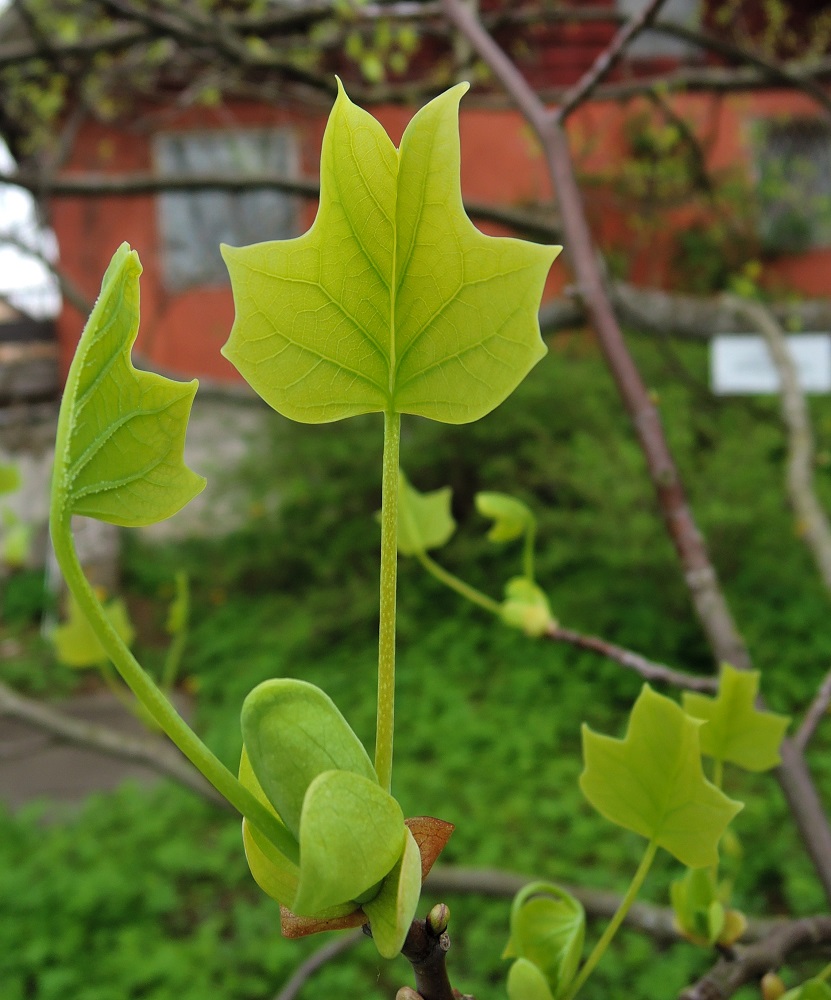
Leaves simple, alternate, 12–20 cm long and 12–18 cm wide, with pinnate venation, light green or green. In autumn leaves take on golden-yellow tones. Leaf shape lyrate, consisting of 4 lobes, with an obcordate, notched apex, resembling a tulip flower. Petiole long, 7-10 cm in length. Stipules large, clasping the twig. Buds elongated and valvate, shaped like a duck's bill.
Author alexlomas
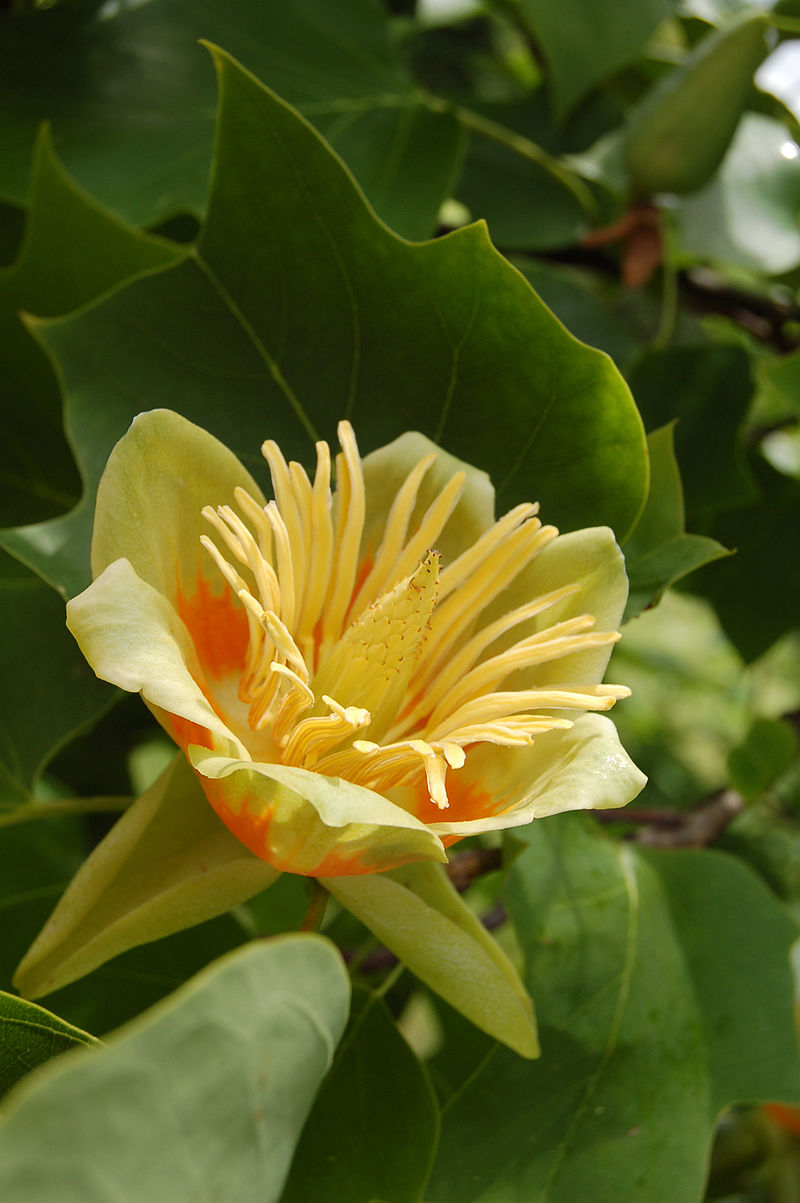
Flowers bisexual, resembling a tulip bud, up to 6 cm long and 2-5 cm wide, with a light cucumber scent. Petals pale green or yellow, more rarely white; corolla orange. Perianth strictly three-parted, consisting of three outward-reflexed segments and six forward-directed segments provided with nectaries, arranged in two whorls. Stamens and pistils numerous, arranged on an elongated axis. Flowers open singly, borne at the ends of branches. Blooms late May – mid-June.
Author T.Tillaev
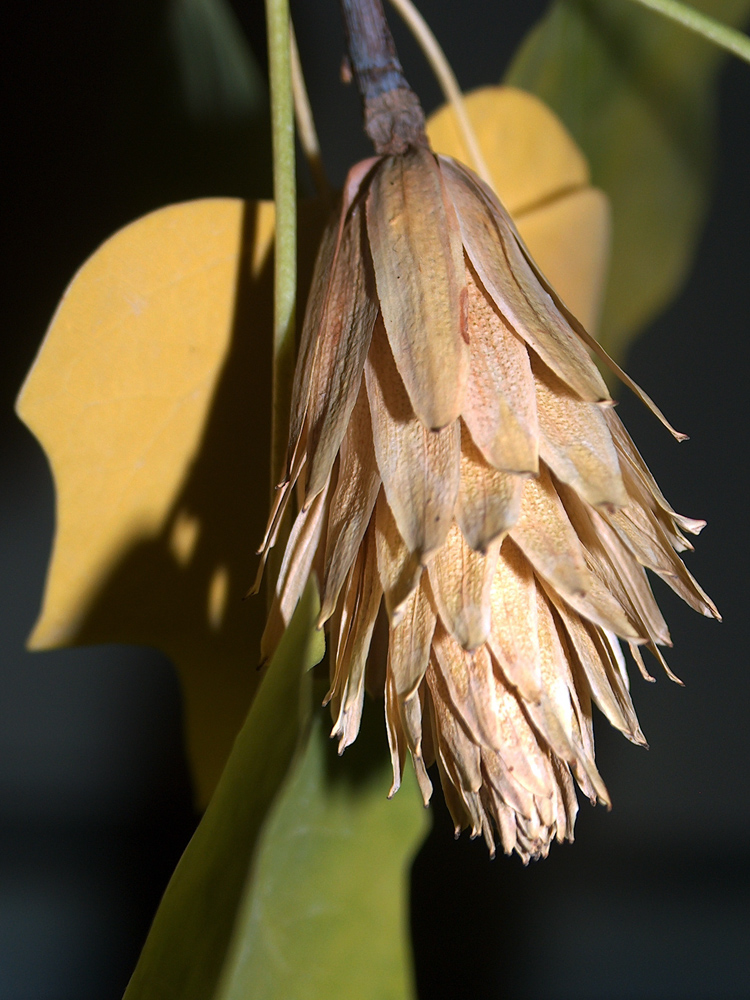
Fruits are elongated cone-like structures, up to 5 cm long and 2-3 cm wide, consisting of winged units and a base. The winged units (samaras) up to 4 cm long, with one wing and a quadrangular seed, which is attached at one end to the conical spike and at the other end to the wing. Fruits ripen in August-October and fall when ripe. Seeds are released in autumn or winter.
Varieties: var. chinense Hemsl., var. sinense Diels
Forms: pyramidal (f. Fastigiata), entire-leaved (f. Integrifolia), obtuse-lobed (f. Obtusiloba), golden-margined (f. aureo-marginata), mid-variegated (f. medio-picta).
Hybrids: L. tulipifera × L. chinense
Hardiness: 4b (-30°C)

Location: prefers deep, well-drained clay soil with a thick humus-rich surface layer. Tolerant of sandy soils, but susceptible to dry, hot areas and saline soils. Demanding regarding soil composition and organic content; requires light and moisture; poorly tolerates excess lime. Wind-resistant, little affected by smoke and soot.
Planting: planting is carried out in early spring, before leaf emergence, which is especially important for northern regions.
Care: requires soil fertilization.
Pruning: tolerates pruning well when young.
Diseases and pests: practically not affected.
Propagation: by seeds, layering, cuttings, grafting.
Uses: a nectar-producing (honey) tree. Highly ornamental, used in solitary and group plantings, in small groves, and in avenue and street row plantings.