
Deciduous shrubs
Golden honeysuckle
Tellmanniana Magyar
Synonyms: humpflower honeysuckle, golden-flowered honeysuckle, Lonicera chrysantha ssp. gibbiflora (Rupr.) Kitag., Lonicera gibbiflora (Rupr.) Dippel, Lonicera regeliana Petz. & G. Kirchn.
Golden honeysuckle (Tellmanniana Magyar) – a species of the genus Lonicera of the honeysuckle family (Lonicera). It occurs in the Far East, Eastern Siberia, and China, where it is common in river valleys, in forests and on mountain slopes. Cultivated since 1849.
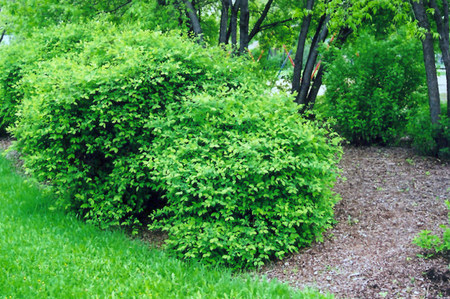
It is a tall deciduous upright or slightly arching shrub 2-4 (6) m high with a fairly dense crown, with thin shoots that are hollow inside. The plant is fast-growing. Bark gray. Young shoots are covered with dense small glands and numerous spreading bristly hairs, yellow-brown.
Root system superficial.
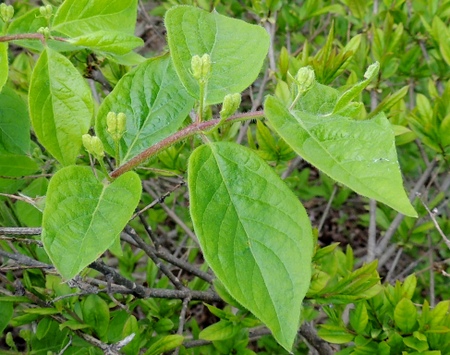
Leaves ovate or rhombic-lanceolate, simple, pointed, with a rounded or broadly cuneate base, up to 12 cm long and 3-5 cm wide, with stiff hairs beneath and ciliate margins, dark green.
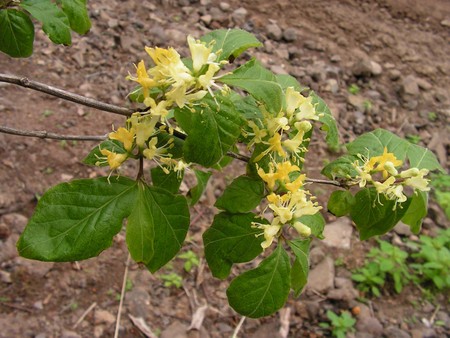
Flowers paired, borne on axillary flower stems 14-25 (10-40) cm long, golden-yellow, with a faint honey scent. Bracts linear, with free bracteoles, obovate or rounded. Corolla yellow, rounded, 14-19 mm long, sparsely hairy on the outside. Blooms in May-June for about 2 weeks.
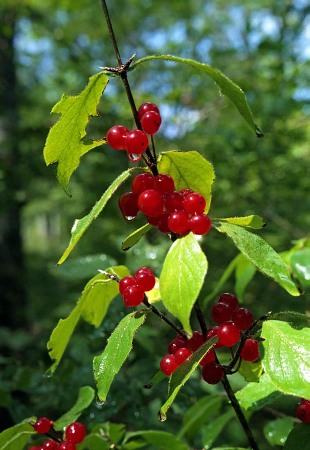
Fruits red, globose berries up to 8 mm in diameter, very decorative. Ripen in late August - early September and remain on the branches for a long time.
Hardiness zone: 3-7 (down to -50°C). Slight winter shoot freezing may occur, which then quickly recover. Flowers can withstand returning frosts down to -8°C.

Location: Light-loving, blooms poorly in shade. Undemanding to soil (tolerates a wide pH range from 3.9 to 7.7), but gives good yield on slightly acidic and neutral soils (pH 5.5-6.5). Prefers moisture but does not tolerate waterlogging.
Pruning: during the first 5-7 years perform only sanitary pruning; in subsequent years the crown becomes dense, so rejuvenation pruning is recommended in autumn after leaf fall or in spring in March-April. The aging part of the crown should be cut above the point of origin of large basal shoots by 30-50 cm. For fundamental rejuvenation of the crown severe pruning "to a stump" is applied at a height of 0.5 m above ground.
Planting: Transplants well at almost any age. Planting is recommended in late autumn. Plants with a closed root system can be planted from spring until late autumn. Recommended spacing between plants 1.5-2 m. Soil mix: topsoil, humus, peat or sand in a ratio of 3:1:1. Root collar at ground level. Planting hole depth 25-30 cm, diameter – 25 cm for 2-3 year old bushes; for 5-7 year olds the hole depth and diameter reach 50 cm. When planting you can add 5-7 kg of manure, 50-80 g of superphosphate and 40-50 g of potassium salt per bush. Drainage layer of crushed brick or gravel 5-7 cm thick. When planting, branches do not need to be cut; this is done in spring before strong bud break. For spring planting branches are pruned immediately.
Care: responsive to fertilization and watering. In the first 2 years it is recommended to feed with nitrogen in spring. Dissolve 30 g (matchbox) of urea or ammonium nitrate in 10 L of water and water 1-1.5 L per plant. Watering can be done over the leaves, providing both root and foliar feeding. Such feedings can be carried out from the beginning of vegetation once every 2 weeks until mid-June. With abundant mineral fertilization serial (reserve) buds may open, from which additional shoots appear, thickening the crown.
Diseases and pests: practically not affected by diseases or pests.
Propagation: when using stimulants rooting is 100%. For seed propagation it is recommended to perform cold stratification of seeds for 2 months.
Uses: A valuable nectar source. Ornamental due to its golden-yellow flowers, bright foliage and fruits. Used in group plantings.