
Flowering shrubs
Pearl lilac
Syringa × swegiflexa Hesse ex J.S.Pringle
Synonyms: сирень звегифлекса, сирень жозифлекса
Pearl lilac (Syringa × swegifflexa Hesse ex J.S.Pringle) – a species of deciduous shrubs in the olive family (Oleaceae). A hybrid between Syringa komarowii C.K.Schneid. × Syringa sweginzowii Koehne & Lingelsh., which was obtained at the Hesse nursery in the town of Vener (Germany) in 1935. It was first described in 1935 by J.S.Pringle.
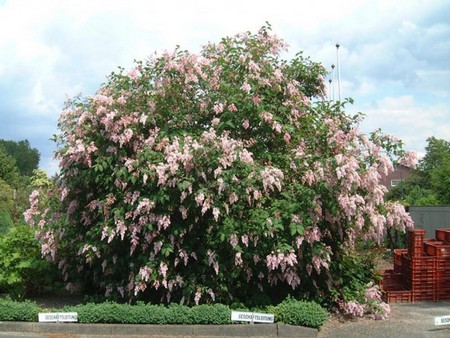
It is a large upright shrub up to 4 m in height and up to 3 m in width. The crown is funnel-shaped, branches archingly droop to the ground.
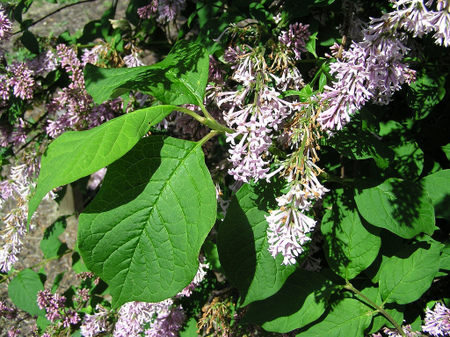
Leaves opposite, opening early, ovate-lanceolate, acute, up to 10 cm long, dark green above, gray-green beneath. In autumn they take on yellow tones.
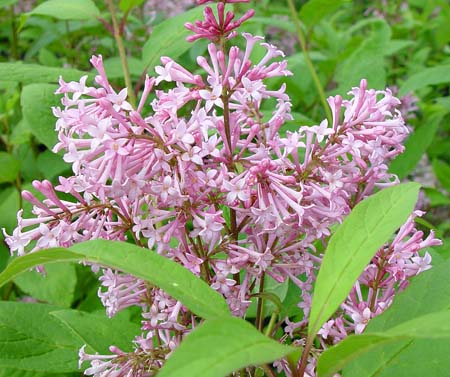
Flowers in large pendulous fragrant panicles up to 30 cm long; buds dark carmine, inflorescences dark pink. Blooms abundantly in June-July.
Varieties: 'James Mcfarland', 'Bellicent'
Hardiness zone: 4a (-34°C).

Location: prefers sites sheltered from strong winds with good lighting, but can also grow in partial shade. Tolerates waterlogging. Prefers moderately moist, fertile, structured, humus-rich soil with an impermeable soil horizon. Likes loamy soils and chernozems, with organic or mineral fertilizers. Recommended pH 6-7; on acidic soils liming is necessary. Moisture-loving, not drought-tolerant.
Planting: recommended at the end of August until the beginning of September. Shrubs transplanted with developing buds establish very poorly and practically do not produce growth in the first year after planting. It can also be planted in mid-July. The root collar after planting should be 3-4 cm above the soil. When planting in leaf soil add 15-20 kg of humus or compost and 200-300 g of wood ash.
Care: apply mineral fertilizers or an ash solution twice per season – over the snow and after flowering. Once a year also apply under each shrub 1 bucket of cow manure or poultry droppings, which should be covered with soil in a ring trench 20-30 cm deep at a distance of 50-60 cm from the trunk. The planting circle is loosened 3-4 times a year and in winter is covered with peat or leaves to a depth of up to 10 cm. Standard (trained single-stem) trees are recommended to be wrapped in burlap for the winter in the first 2-4 years after planting.
Pruning: to form the shrub leave the first pair of buds at a height of 12-15 cm; for standard tree formation remove buds on the trunk at a height of 50-80 cm, leaving only 5-6 upper pairs; above the last cut the shoot tip and in the top pair leave only 1 bud. In the 3rd-4th year after planting perform formative pruning, leaving 5-10 main skeletal branches that are the most regular and attractive, and shorten the main shoot. Formed shrubs are thinned in February-March. After flowering remove spent inflorescences. For bouquets it is recommended to cut up to 2/3 of the flowering shoots, which improves flowering.
Propagation: suckering is practically absent. Propagated by seeds, hardwood and softwood cuttings. To accelerate root formation cuttings can be dipped for 1 hour in warm water (38-39°C) and treated with a solution of Heteroauxin (150 mg/l). Seeds are sown in early spring or autumn after a 2-month stratification at 2-5°C.
Diseases: gray rot, powdery mildew, rust, wilt.
Pests: nematodes, spider mite, beet aphid, scale insects, bugs, snails and slugs, rodents (field vole, gray rat).
Conservation status: listed in the Red Data Book of Ukraine
Uses: used for decorating parks, squares, gardens, boulevards, and for greening industrial areas. Looks spectacular in solitary and group plantings, used for creating hedges, responds well to pruning and retains its shape for a long time.