
Flowering shrubs
Lilac
Syringa L.
Synonyms: sinel, buzok, yayderevo, yaydrevo
Lilac (Syringa L.) – a genus of deciduous shrubs from the olive family (Oleaceae). The name comes from the Greek «syrinx», which means a tube or a pipe (referring to the structure of the flower). By another version the name was given in honor of the nymph daughter of Zeus. The genus was first described by Carl Linnaeus in the year 153 in his «Species Plantarum» 1: 9. Introduced into cultivation in Europe in the 16th century. Lives up to 100 years.
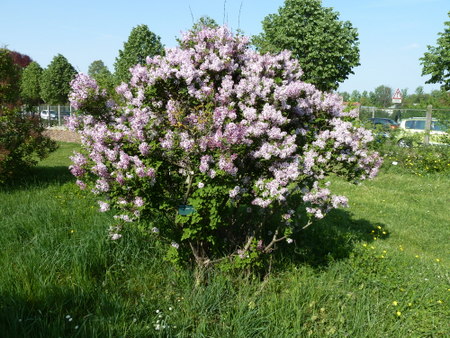
In nature it grows in Afghanistan, India, Japan, Kashmir, Korea, Nepal, Pakistan, Sikkim; Northeast Asia, Southeastern Europe (about 20 species); 16 species in China.
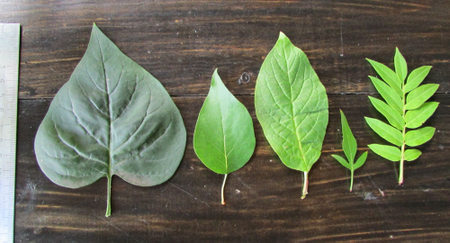
Photo of leaves of S. vulgaris, S. amurensis, S. komarovii, S. persica, S. pinnatifolia. Author S.Bulycheva
Represents a deciduous, more rarely evergreen shrub, sometimes a small tree. Leaves opposite, entire, more rarely pinnate or pinnately lobed, entire-margined, petiolate, more rarely sessile.
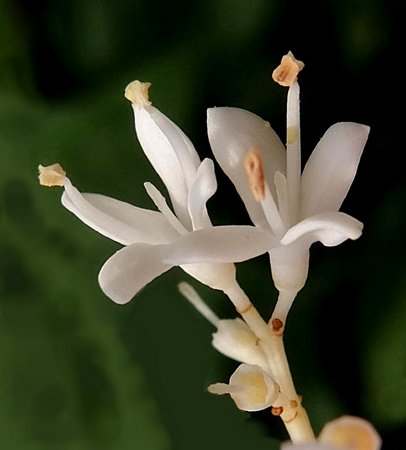
Photo of Amur lilac. Author P.Sheyenko
Flowers waxy, small, bisexual, often fragrant, bisexual, of various colors – white, lilac, cream, pink, purple or violet. Gathered in axillary or terminal paniculate or pyramidal inflorescences, which develop from buds laid on last year’s shoots, sometimes on the growth of the current year. The calyx is small, bell-shaped, 4-toothed, not falling off. The corolla is tubular or narrowly funnel-shaped. The corolla tube is cylindrical, much longer than the calyx, more rarely widening upwards, short and almost equal to the calyx in length. The limb is 0.6-1.2 cm in diameter. There are 4 lobes, they are more or less spreading. There are 2 stamens. Flowers depending on the species in April-June.
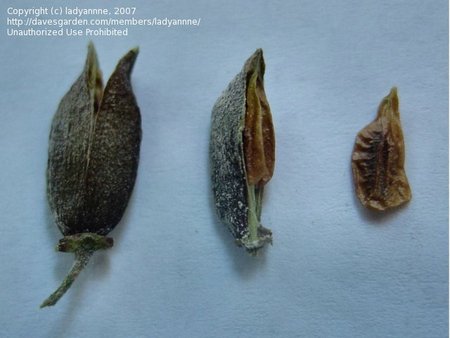
Fruits – leathery, oblong or spindle-shaped 2-celled capsules, opening with 2 valves, with 1-2 seeds in each cell.
Species:
- Syringa × chinensis Willd. — Chinese lilac
- Syringa emodi Wall. ex G.Don — Himalayan lilac
- Syringa × henryi C.K.Schneid. — Henry's lilac
- Syringa × josiflexa I.Preston ex J.S.Pringle — Josiflexa lilac
- Syringa josikaea J.Jacq. ex Rchb. — Hungarian lilac
- Syringa komarowii C.K.Schneid. — Komarov's lilac
- Syringa meyeri C.K.Schneid. — Meyer’s lilac
- Syringa oblata Lindl. — Broad-leaved lilac
- Syringa × persica L. — Persian lilac
- Syringa pinnatifolia Hemsl. — Pinnatifolia lilac
- Syringa pubescens Turcz. — Downy lilac
- Syringa × swegiflexa Hesse – Pearl lilac
- Syringa sweginzowii Koehne & Lingelsh. — Swegintzow's lilac
- Syringa tomentella Bureau & Franch. — Thin-hairy lilac
- Syringa villosa Vahl — Woolly lilac
- Syringa vulgaris L. — Common lilac (type species)
- Syringa wolfii C.K.Schneid. — Wolf's lilac
- Syringa yunnanensis Franch. — Yunnan lilac
Hardiness zone: 4a (-40°C).

Site: prefer places sheltered from strong winds with good lighting, but can grow in shade (does not flower). Does not like low, waterlogged or temporarily flooded in spring (autumn) places. Prefers moderately moist, fertile, structured, humus-rich soil, with an impermeable soil horizon. Likes loamy soil, chernozems, with organic or mineral fertilizers. Recommended pH 6-7; on acidic soils be sure to apply lime. Flower color depends on soil properties and acidity.
Planting: recommended to be carried out at the end of August and until the beginning of September. Shrubs transplanted with growing buds take very poorly and practically do not give growth in the first year after planting. It is also possible to plant in mid-July. The root collar after planting should be 3-4 cm above the soil surface. When planting in leaf soil add 15-20 kg of humus or compost and 200-300 g of wood ash.
Care: apply mineral fertilizers or ash solution 2 times per season – on the snow and after flowering. Once a year also apply under each shrub 1 bucket of cow manure or poultry manure, which must be covered with soil in a ring trench 20-30 cm deep at a distance of 50-60 cm from the trunk. The trunk circle is loosened 3-4 times a year and for winter is covered with peat or leaves to a layer of up to 10 cm. Standard trees in the first 2-4 years after planting are recommended to be wrapped for the winter with burlap.
Pruning: to form the bush it is necessary to leave the first pair of buds at a height of 12-15 cm; for forming standard trees on the trunk remove buds at a height of 50-80 cm, leaving only 5-6 upper pairs, cut off the top of the shoot above the last one and in the upper pair leave only 1 bud. In the 3-4th year after planting perform formative pruning, leaving 5-10 main most regular and beautiful branches and shorten the main shoot. Formed bushes are thinned in February-March. After flowering, spent inflorescences are cut off. For bouquets it is recommended to cut up to 2/3 of flowering shoots, which improves flowering.
Propagation: propagated by seeds, layering, cuttings, grafting. Seeds are used to propagate wild species. They are sown immediately after ripening in autumn or in spring after 2-month stratification at 2-5 °C. Common lilac is used as a rootstock.
Diseases: gray rot, powdery mildew, rust, wilt.
Pests: nematodes, spider mite, beet aphid, scale insects, bugs, slugs and snails, rodents (field mouse, brown rat).
Uses: used as a specimen or in small groups in well-visible places, in compositions with other trees or shrubs, for creating freely growing hedges, in spacious gardens, for creating dense thickets; low-growing species are planted at the back of flower beds or rock gardens. Used for cutting and forcing branches cut in autumn after formation of flower buds.