
Flowering shrubs
Hungarian lilac
Syringa josikaea
Synonyms: lilac (Carpathian), Hungarian lilac, East-Carpathian lilac, Syringa × henryi var. eximia Rehder, Syringa vincetoxifolia Baumg. ex Steud., Syringa josikaea var. zabelii Beissn., Schelle & Zabel
Hungarian lilac (Syringa josikaea J. Jacq. ex Rchb.) – a species of deciduous shrubs from the olive family (Oleaceae). The species was first found in 1830 in Hungary (Transylvania) by Baroness von Josika, an amateur botanist from Vienna, and sent to her friend, the Austrian botanist Josef Franz von Jacquin, who named the species after the baroness. In cultivation since 1830.
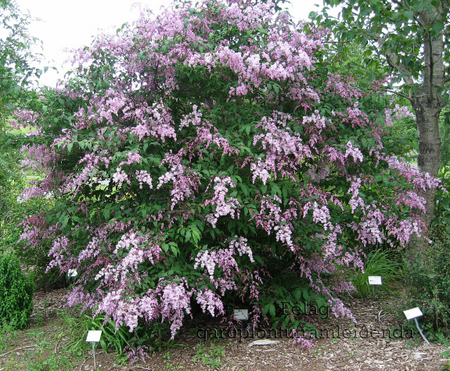
In nature it grows in the Eastern (Eastern Beskids, Polonynian Ridge, Ukraine) and Southern (Bigar Mountains, Romania) Carpathians. In Ukraine it occurs in the western part of the Ukrainian Carpathians, in the upper parts of the Uzh, Latorytsia, Rika, and Stryi river basins. It rises to altitudes of 400-750 m above sea level. It grows in marshy areas along riverbanks, near springs, in alder and willow thickets.
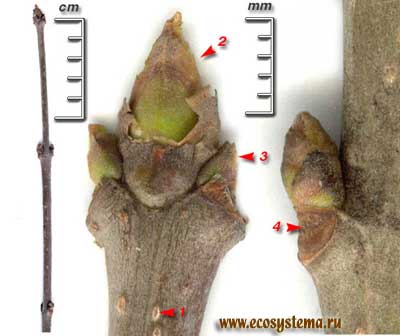
The plant is a shrub or small tree with a lush, pyramidal and dense crown, 3-4 m tall. It grows quickly, up to 40 cm per year in height and width. Lives up to 90 years. The growing season is 135-150 days. Branches are strong, erect, warty, dirty-gray in color, ribbed. Shoots are greenish-brown-gray, at first pubescent with short dark hairs, later glabrous, with a reddish-purple blush. Lenticels light, elongated, flat. Buds are ovate-pointed, brown or reddish-brown, densely and shortly pubescent. Shoots end with one bud larger than the lateral ones (8-12 mm long) and with 2 small lateral buds. Leaf scar large, vascular bundles merge into one continuous line. Pith wide, white, wood dark, layered.
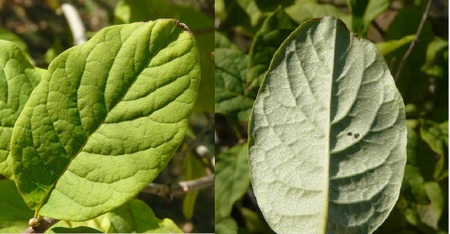
Leaves 5-13 cm long, oblong-elliptic in shape, base cuneate, shortly acute, leathery, glabrous and glossy above, dark green, beneath bluish-gray, slightly pubescent along the veins. Petioles up to 1.5 cm long, grooved, in autumn become red-purple.
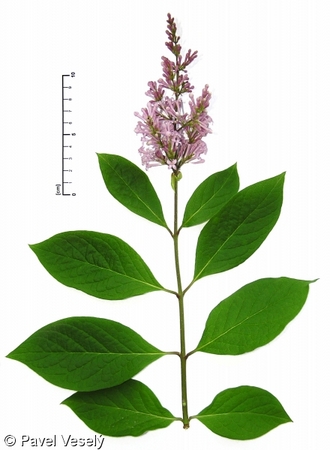
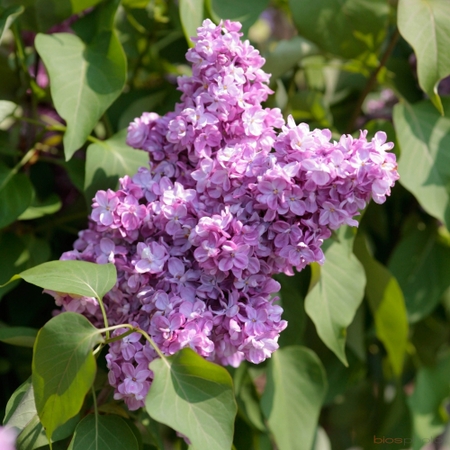
Panicles 10-20 cm long and 5-10 cm wide, erect, broad-pyramidal in shape, compound, arising from terminal buds located on current-year shoots. Paired branches of the inflorescence are arranged in clearly defined tiers. Flowers are densely or intensely lilac in color, strongly fragrant. Corolla 1-1.5 cm long and 0.6 cm in diameter, tube slightly expanding toward the top, the limb somewhat concave. Petals remain raised upward at the sides until the end of flowering and reflex after flowering. The calyx is covered with pubescence. Flowers abundantly, in late May or early June, for 20-25 days, 10-14 days later than common lilac. Easily cross-pollinates and sets a large number of seeds only when growing together with other species. Blooms in the 4th-5th year after planting.
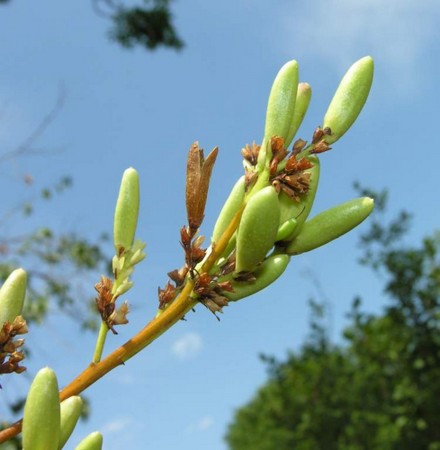
Fruits are capsules, 1.6 cm long, cylindrical, glabrous, reddish or reddish-brown. Fruits ripen in September-October and may remain on the shrubs until spring.
Forms:
- Pallida (f. pallida Jaeger) – pale lilac flowers
- Rubra (f. rubra Hort.) – reddish-violet flowers
- Monstrosa (f. monstrosa Jaeger) – white flowers
- Rosea (f. rosea Niemetz) – pink-violet flowers
Hybrids:
- Syringa josikaea х Syringa komarowii = S. Josiflexa
- Syringa josikaea J.Jacq. ex Rchb. × Syringa villosa Vahl = S. × henryi
- Syringa josikaea J.Jacq. ex Rchb. × Syringa villosa Vahl × Syringa sweginzowii Koehne & Lingelsh = S. × nanceiana
Hardiness zone: 4a (-34°C).

Location: prefers sites sheltered from strong winds with good lighting, but can grow in partial shade. Tolerates temporary waterlogging. Prefers moderately moist, fertile, structured, humus-rich soil with an impermeable soil horizon. Likes loamy soils, chernozems, with organic or mineral fertilizers. Recommended pH 6-7; on acidic soils liming is necessary. Moisture-loving, not drought-tolerant.
Planting: recommended at the end of August and until the beginning of September. Shrubs transplanted with developing buds take very poorly and practically do not produce growth in the first year after planting. Can also be planted in mid-July. The root collar after planting should be at the level of 3-4 cm above the soil. When planting in leaf soil add 15-20 kg of humus or compost and 200-300 g of wood ash.
Care: apply mineral fertilizers or ash solution twice per season – after snowmelt and after flowering. Once a year also apply under each shrub 1 bucket of cow manure or poultry manure, which should be covered with soil in a ring trench 20-30 cm deep at a distance of 50-60 cm from the trunk. The trunk circle is loosened 3-4 times a year and mulched with peat or leaves for the winter to a layer up to 10 cm. Standard trees in the first 2-4 years after planting are recommended to be wrapped with burlap for the winter.
Pruning: to form a shrub leave the first pair of buds at a height of 12-15 cm; for standard training on the stem remove buds at a height of 50-80 cm, leaving only the top 5-6 pairs, cut off the tip of the shoot above the last one and leave only 1 bud in the upper pair. In the 3rd-4th year after planting perform formative pruning, leaving 5-10 scaffold branches that are the most correct and attractive, and shorten the main shoot. Formed shrubs are thinned in February-March. After flowering remove faded inflorescences. For bouquets it is recommended to cut up to 2/3 of flowering shoots, which improves flowering.
Propagation: sucker formation is practically absent. Propagated by seed, hardwood and softwood cuttings. To accelerate root formation, cuttings can be dipped for 1 hour in warm water (38-39°C) and treated with a solution of Heteroauxin (150 mg/l). Seeds are sown in early spring or autumn, after 2 months of stratification at 2-5°C.
Diseases: gray mold, powdery mildew, rust, wilt.
Pests: nematodes, spider mite, beet aphid, scale insects, bugs, snails and slugs, rodents (field vole, gray rat).
Conservation status: included in the Red Book of Ukraine
Uses: used for decorating parks, squares, gardens, boulevards, and for greening industrial areas. Looks impressive in solitary and group plantings, used to create hedges, responds well to pruning and retains its shape for a long time.