
Flowering shrubs
Plum-leaved spirea
Spiraea prunifolia Sieb.et Zucc
Plum-leaved spirea (Spiraea prunifolia Sieb.et Zucc.) – a species of shrubs in the rose family (Rosaceae). It was first described by Philipp von Siebold and J.G. Zuccarini in 1840 in their book "Flora of Japan" (Fl. Jap. 1: 131, plate 70.). In cultivation since 1843.
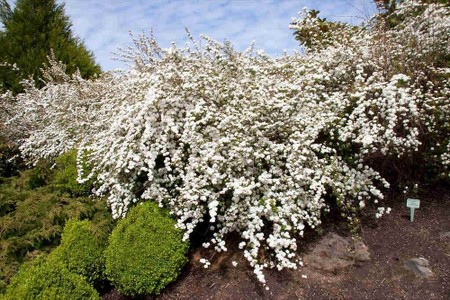
In the wild it occurs in East Asia - China (Anhui, Fujian, Guizhou, Guangdong, Henan, Hubei, Hunan, Jiangsu, Jiangxi, Shaanxi, Shandong, Sichuan, Tibet Autonomous Region, Taiwan), Japan (Zhejiang province), Korea. Found in thickets, on slopes, on steep cliffs, in dry sunny places. Grows up to 1500 m above sea level.
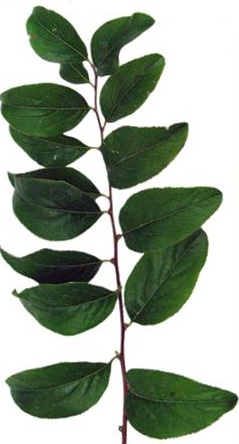
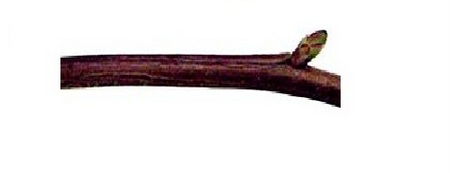
It is a deciduous shrub 2-2 m in height. The crown is rather dense, reaching 2-3 m in diameter, of irregular shape. Branches erect, numerous, arcuately curved at the tips, thin, brownish or reddish-brown. Shoots spreading or arcuate, thin, initially pubescent, later glabrous, yellowish-brown in color. Buds small, ovoid, with several scales, glabrous, with blunt apices.
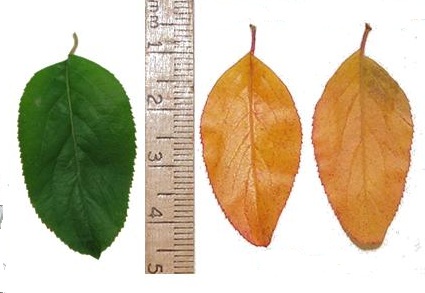
Leaves 1.5-3 × 0.7-1.4 cm, elliptic or ovate in shape, with a cuneate or rounded base and an obtuse or acute apex, finely serrate along the margin, at first pubescent above, later glabrous, glossy, shiny, intensely green, beneath pubescent with grayish hairs. Petioles 2-4 mm long, pubescent. In autumn they acquire orange and reddish-brown tones.
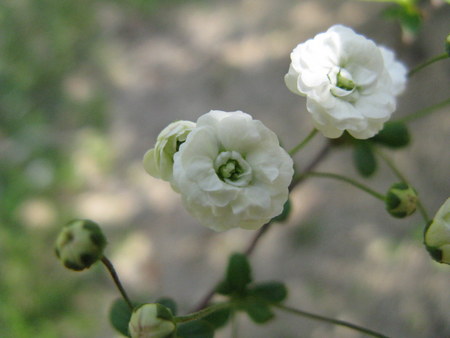
Spiraea prunifolia f. Plena.
Flowers 2-3 × 1.5-3 cm, simple or densely double, pure white, grouped 3-6 per sessile corymb arising from leaf axils and distributed along the length of the shoots. Pedicels up to 2 cm long, slightly pubescent in the upper part. Bracts leaflike, 4-7 × 3-5 mm, initially pubescent on both sides, later glabrous, apex finely serrate. Hypanthium campanulate, shorter than the sepals, glabrous or pubescent. Sepals triangular or ovate-triangular, 1.5-2 mm, shorter than the petals, apex acute. Petals white, obovate or rounded, longer than the sepals, glabrous. Stamens 20-25, they are 0.5 times longer than the petals. Flowers in April-May. Fruits – blunt follicles, 1.5-2 mm in diameter, glabrous or pubescent, opening along the adaxial suture.
Varieties:
- Spiraea prunifolia f. Plena.
- Spiraea prunifolia var. hupehensis (Rehder) Rehder
- Spiraea prunifolia var. prunifolia
- Spiraea prunifolia var. pseudoprunifolia (Hayata ex Nakai) H. L. Li
- Spiraea prunifolia var. simpliciflora (Nakai) Nakai
Cultivars: 'Bridalwreath'
Hardiness zone: 4a (-34°C).

Site: prefers open sunny locations with soil rich in organic matter. Tolerant of urban conditions. Tolerates heat well. Requires positions sheltered from north winds.
Planting: Planting hole size: 50x50 cm. Soil mix: turf or leaf soil, peat and sand in a ratio of 2:1:1. For planting a drainage layer of crushed brick and sand 15 cm thick is recommended. In group plantings the spacing between plants should be at least 1.5 m. Planting can be done in autumn (before the end of leaf fall) or in early spring, before the onset of vegetation.
Care: in hot periods it is recommended to water at a rate of 1 bucket per shrub twice a month. In the first years after planting it is recommended to loosen the soil in the root circle and mulch with a 7 cm layer of peat. It is preferable to cover the root system for the winter with dry leaves and wrap the shrub with kraft paper.
Pruning: tolerates clipping and pruning well, has good shoot-forming ability. In spring shoots are shortened to a length of 15-20 cm; in summer the spent flowering shoots are shortened. Once every 2-3 years a thinning of the crown is recommended, removing old and diseased shoots (shoot lifespan – 6 years). For rejuvenation of the shrubs all shoots should be cut to a height of 25-30 cm from the ground.
Propagation: rooting of summer cuttings 90%. Also propagated by semi-ripe cuttings and division of the shrub.
Diseases: practically unaffected.
Pests: spider mite (phosphamide (0.2) or carbofos (0.3%)), aphids (Pirimor (0.1)), rose tortrix, leaf miner.
Uses: one of the most striking Spiraea species, especially the double form (f. Plena). Used in solitary and group plantings, for creating compositions, and also for hedges.