
Flowering shrubs
Nippon spirea (Spiraea nipponica)
Spiraea nipponica Maxim.
Synonyms: Spiraea bracteata Zabel, Spiraea bracteata Hook.f., Spiraea dissomorpha Koidz., Spiraea ogawae Nakai, Spiraea nipponica f. typica Makino
Spiraea nipponica (Spiraea nipponica Maxim.) – a species of shrubs in the family Rosaceae. It was first described by the Russian botanist Carl Ivanovich Maximovich in 1886 in his work Bull. Acad. Imp. Sci. Saint-Pétersbourg, 40. In cultivation since 1882.
Occurs in the wild in Japan (Honshu and Shikoku islands).
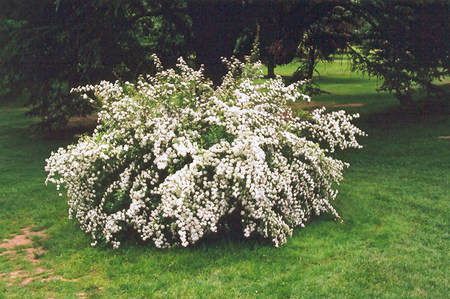
It is a deciduous shrub 1.5–2 m in height. Growth rate – medium. Crown spherical, dense, up to 2 m in diameter. Branches long, ascending from the base, then growing horizontally or arching and pendulous. Shoots glabrous, angled-striped up to 5-ribbed, at first reddish-brown with light lenticels, later becoming lighter at the base with dark streaks.
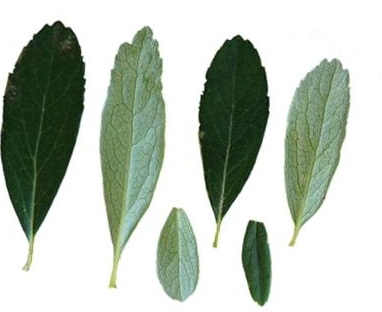
Leaves 1.5–3 (4.5) cm long, obovate to elliptic in shape, base cuneate, apex obtuse, with several rounded teeth near the tip or entire, glabrous on both sides, dark green above, glaucous beneath. Green coloration is retained until late autumn.
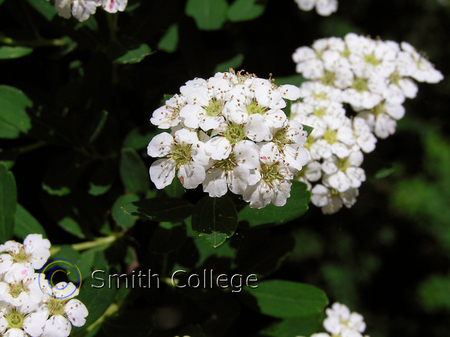
Flowers 0.8–0.9 cm in diameter, white, borne in dense, rounded or conical umbel-like panicles, 2.5–3 cm in diameter, growing at the tips of short leafy lateral shoots 3–7 cm long. Lateral shoots erect, formed on the upper side of the branches along their entire length. Buds purple. Flowers from May to June, 15–25 days.
Fruits from 4–5 years. Fruits – erect follicles, sparsely hairy, with styles bending at a right angle. Ripen in October.
Varieties:
- Spiraea nipponica f. rotundifolia (G.Nicholson) Makino (Spiraea media var. rotundifolia G.Nicholson)
- Spiraea nipponica var. tosaensis
- Spiraea nipponica var. nipponica
- Spiraea nipponica f. oblanceolata (Nakai) Ohwi
- Spiraea nipponica var. oblanceolata Nakai
- Spiraea nipponica var. ogawae (Nakai) T.Yamanaka
- Spiraea nipponica var. rotundifolia (G.Nicholson) Makino
- Spiraea nipponica var. nipponica
Cultivars: 'Snowmound' (AGM), 'Gerlve's Rainbow', 'Halward's Silver', 'White Carpet'.
Hardiness zone: 3b–8a (-34°C).

Location: prefers open sunny sites with soil rich in organic matter. Likes loam, but can grow in any garden soil (pH 5.6–7.8), tolerates calcareous soils. Resistant to urban conditions. Tolerates heat well. Requires protection from north winds.
Planting: Planting pit dimensions: 50x50 cm. Soil mix: sod or leaf soil, peat and sand in a ratio of 2:1:1. When planting, drainage of broken brick and sand is recommended, 15 cm layer. In group plantings maintain at least 1.5 m between plants. Planting can be done in autumn (before the end of leaf fall) or early spring, before the start of vegetation.
Care: during hot periods watering is recommended at the rate of 1 bucket per shrub twice a month. In the first years after planting loosen the soil in the root zone and mulch with a 7 cm layer of peat. It is preferable to cover the root system for winter with dry leaves and to wrap the shrub with kraft paper.
Pruning: tolerates clipping and pruning well, has good ability to produce new shoots. In spring shoots are shortened to 15–20 cm, in summer prune the already spent flowering shoots. Every 2–3 years thinning of the crown is recommended, removing old and diseased shoots (shoot lifespan – 6 years). To rejuvenate shrubs all shoots should be cut at a height of 25–30 cm from the ground.
Propagation: rooting of summer cuttings 100%. Seed germination 100%. Seeds sown in June give first seedlings in 12–14 days. Also propagated by division of the bush.
Diseases: practically not affected.
Pests: spider mite (phosphamide (0.2) or carbophos (0.3%)), aphids (pirimor (0.1)), rose tortrix, leaf miner.
Uses: effective as a solitary specimen, also used for creating hedges.