
Deciduous trees
Rowan
Sorbus L.
Rowan (Sórbus) – a genus of woody deciduous plants of the Rosaceae family. It includes more than 100 species. In nature it occurs in Europe, Western Asia, North America, the Caucasus, and reaches the far north. In mountains it rises to the very limit of vegetation, where it grows as a shrub. Introduced worldwide in temperate climates. Grows singly, not forming continuous thickets, in the second tier of coniferous trees or in the undergrowth, in mixed or deciduous forests, on forest edges and glades or among shrubs.
It is a small tree or shrub 5-10 m high and 4-6 m wide with one or several trunks. In the first 5-10 years after planting the plant is fast-growing, 50-80 cm per year; later the growth rate decreases to 20-30 cm per year. The crown in youth is ovate, later becoming wide, open-rounded or conical. Branches grow vertically upward and diverge from the trunk at an acute angle. Young shoots grow horizontally. Bark is dark gray, smooth when young, later becoming furrowed. Buds are felted-pubescent.
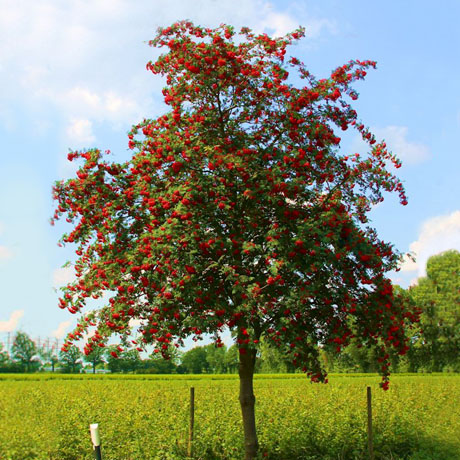
Common rowan
Lives 200-300 years.
The root system is very deep.
Leaves are odd-pinnate, composed of 19-23 almost sessile oblong leaflets, large, 14 cm long and 9 cm wide, broadly elliptic, acute or obtuse at the apex, sharply doubly serrate at the margin, leathery, white-woolly when unfolding. In summer dark green above, white-woolly beneath. In autumn they turn yellow.
Flowers white, numerous, gathered in dense corymb-like inflorescences that appear at the ends of branches, and have a strong characteristic scent. Calyx 5, petals white or pink 5, stamens 15-25. They appear immediately after leaf emergence – in late May to early June.
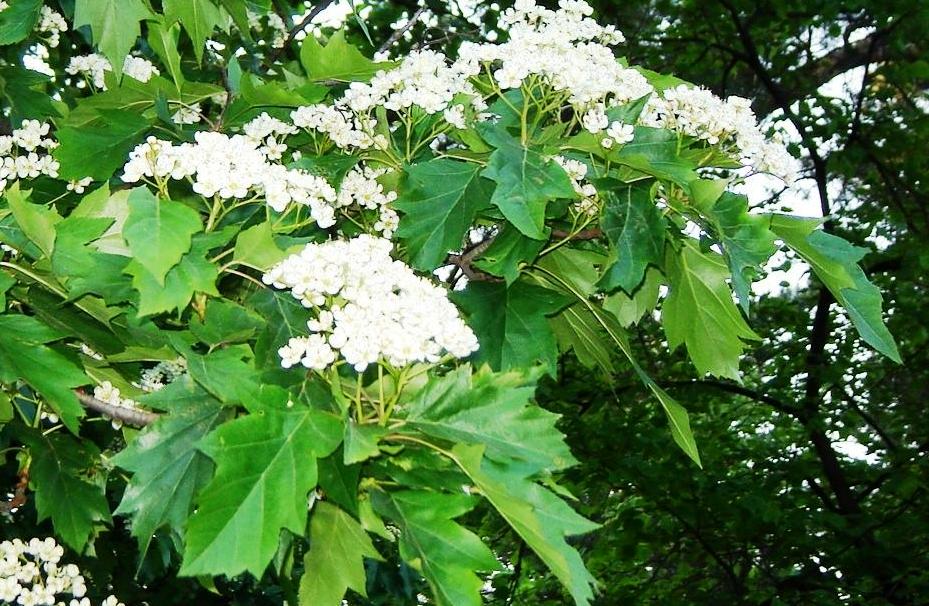
Sorbus sambucifolia
Begins to flower and fruit from 10 years of age, some cultivars from 4-5 years.
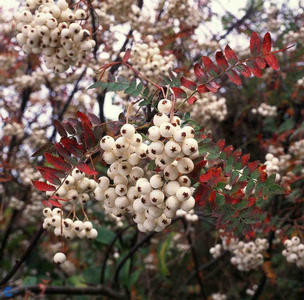
Koehne's rowan
Fruits – small oval or globose pomes up to 1.5 cm in diameter, bright red, orange-red, brown or white, juicy, edible but tasteless. Seeds small, rounded at the edge. Fruits persist on the tree for a long time.
Species: there are 2 subgenera: Sorbus L.: Eusorbus Kom and Hahnia Medic.
Most popular species of Sorbus L.: Eusorbus Kom:
- Sorbus domesfaca L. - domestic rowan
- Sorbus sambucifolia (Cham.et Schlecht.) M.Roem. - elder-leaved rowan
- Sorbus pohuaschanensis (Hance) Hedl. - Pohuaschan rowan
- Sorbus aucuparia L. - common rowan
- Sorbus sargenfaana Koehne - Sargent's rowan
- Sorbus koehneana Schneid. - Koehne's rowan
- Sorbus sibirica Hedl - Siberian rowan
- Sorbus amurensis Koehne - Amur rowan
- Sorbus serotina Koehne - late rowan
- Sorbus americana Marsh. - American rowan
- Sorbus tianschanica Rupr. - Tian Shan rowan
- Sorbus commixta Hedl. - mixed rowan
- Sorbus discolor (Maxim.) Hedl. - two-colored rowan
Most popular representatives of the subgenus Hahnia Medic.:
- Sorbus albovii Zinserl. - Albov's rowan
- Sorbus velutina (Albov) C.K.Schneid. - velvety rowan
- Sorbus intermedia (Ehrh.) Pers. (S.scandica Fr.) - intermediate rowan
- Sorbus aria (L.) Crantz - rowan aria or round-leaved rowan
- Sorbus torminalis (L.) Crantz - without planting
- Sorbus latifolia (Lam.) Pers. (S.aria 4 S.torminalis) - broad-leaved rowan
- Sorbus graeca (Spach) Lood. et Schauer. - Greek rowan
- Sorbus turcica Zinserl. - Turkish rowan
Hardiness zone: 3

Site / Exposure: Light-loving, but can grow in partial shade. Prefers warmth and is tolerant of high temperatures. Poorly tolerant of urban conditions; wind-resistant. Grows on almost all soils, from relatively dry to moist, prefers well-drained, relatively fertile substrates. Sensitive to salinity and prolonged severe drought. Does not tolerate alkaline soils. Optimal soil acidity – pH 6-6.5. Groundwater should be no closer than 2 m in depth.
Planting: planting hole size: 60x60x60 cm. Seedlings should not be planted deeply. Soil mixture consists of topsoil layer, 5 kg of peat-compost or humus, potassium fertilizer (100 g) and superphosphate (200 g). Acidic soils should be limed. Optimal planting period: autumn – from mid-September to early October, or early spring. Distance between vigorous trees should be at least 3-4 m, between weak-growing ones 1.5-2 m.
Care: does not require irrigation, but responds well to care. Starting from the 3rd year after planting it is recommended to apply organic fertilizers annually – half a bucket of humus or compost, 20 g of potassium sulfate, 50 g of superphosphate. In May ammonium nitrate can be applied in the amount of 15 g per 1 sq. m of the tree circle.
Pruning: to increase crown strength it is recommended to train main branches at obtuse angles. Pruning is carried out in early spring before bud swelling. On young trees shoots are slightly shortened to an outward bud and broken or excess shoots are removed. On fruiting rowans it is recommended to remove suckers and to carry out sanitary pruning. Shaping of fruiting plants depends on the fruiting habit. For cultivars that fruit on last year's growth, branches are recommended to be slightly shortened and thinned. With weak growth the tree needs rejuvenation pruning to 2-5 year old wood. Rowans that fruit on various types of formations have their semi-skeletal branches shortened, thinned and rejuvenated at ring branches. Shoots grow quickly and ripen well by winter.
Diseases and pests: few diseases and pests affect it. One of the main pests is the cherry slug sawfly. Since rowan leafs out one of the first in the garden, it often becomes a target for aphids, which then spread throughout the garden. To avoid this, it is recommended to spray rowan with the preparation «Aktara». During the growing season use the preparation «Fitoverm»).
Propagation: by seeds, grafting, cuttings, layering, root suckers. Cultivar plants are propagated by grafting. For seed propagation it is necessary to collect fruits at the beginning of browning, rub through a sieve, wash with water and dry. Seeds are stored in a moist state until autumn. Before ground freezes they are sown in small furrows located 15-18 cm apart, to a depth of 1-1.5 cm and covered with compost. For spring sowing seeds require stratification for 6-7 months at 0-1°C. In spring seeds are sown as early as possible in a sunny place with fertile soil. Layering is used when the plant has a bushy or low-stem form. In spring or autumn branches are bent to the ground, fixed with hooks, with the tip brought up and fixed vertically. The fixed part of the shoot at the soil should be ring-barked. By autumn adventitious roots will appear above the ring-barked spot. Digging out is recommended by the end of the second year. All grafting methods are available. The grafting technique is the same as for apple.
Uses: Considered a low-value fruit plant. Fruits can be used fresh, for making jams, kissels, jellies, pastilles, liqueurs, jellies, marmalade, as well as in soaked and pickled form. Fresh fruits have a bitter taste, but after the first frosts the bitterness disappears. Powder from dried fruits can be used as a pie filling. Fruits are widely used in folk medicine. Widely used in garden landscaping as it is decorative throughout the year, especially during flowering and autumn coloration. A good honey plant.