
Deciduous shrubs
Skimmia
Skimmia
Skimmia (Skimmia Thunb.) – a genus of evergreen broad-leaved plants in the Rutaceae family. It was first described in 1783 by the Swedish naturalist Carl Peter Thunberg in his "Nova Genera Plantarum 3: 57". In cultivation since 1893.
The range includes Japan, China, the Himalayas, Nepal, Korea, Vietnam, Pakistan, and the Philippine Islands. It grows in forests, less often as epiphytes on old cryptomeria trees.
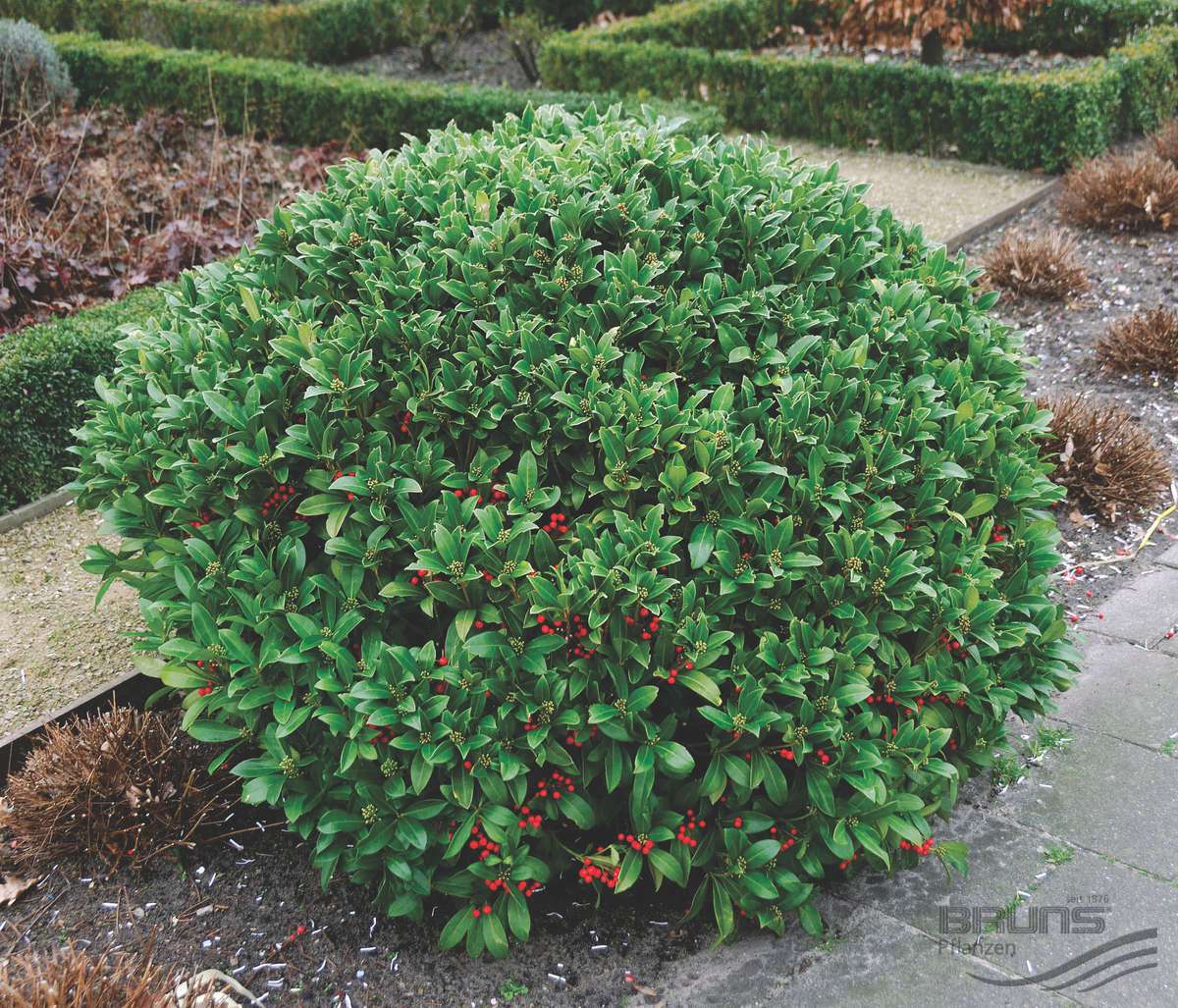
It is an evergreen shrub or small tree 2-15 m high. It grows slowly. The crown is dome-shaped, compact, and well-branched.
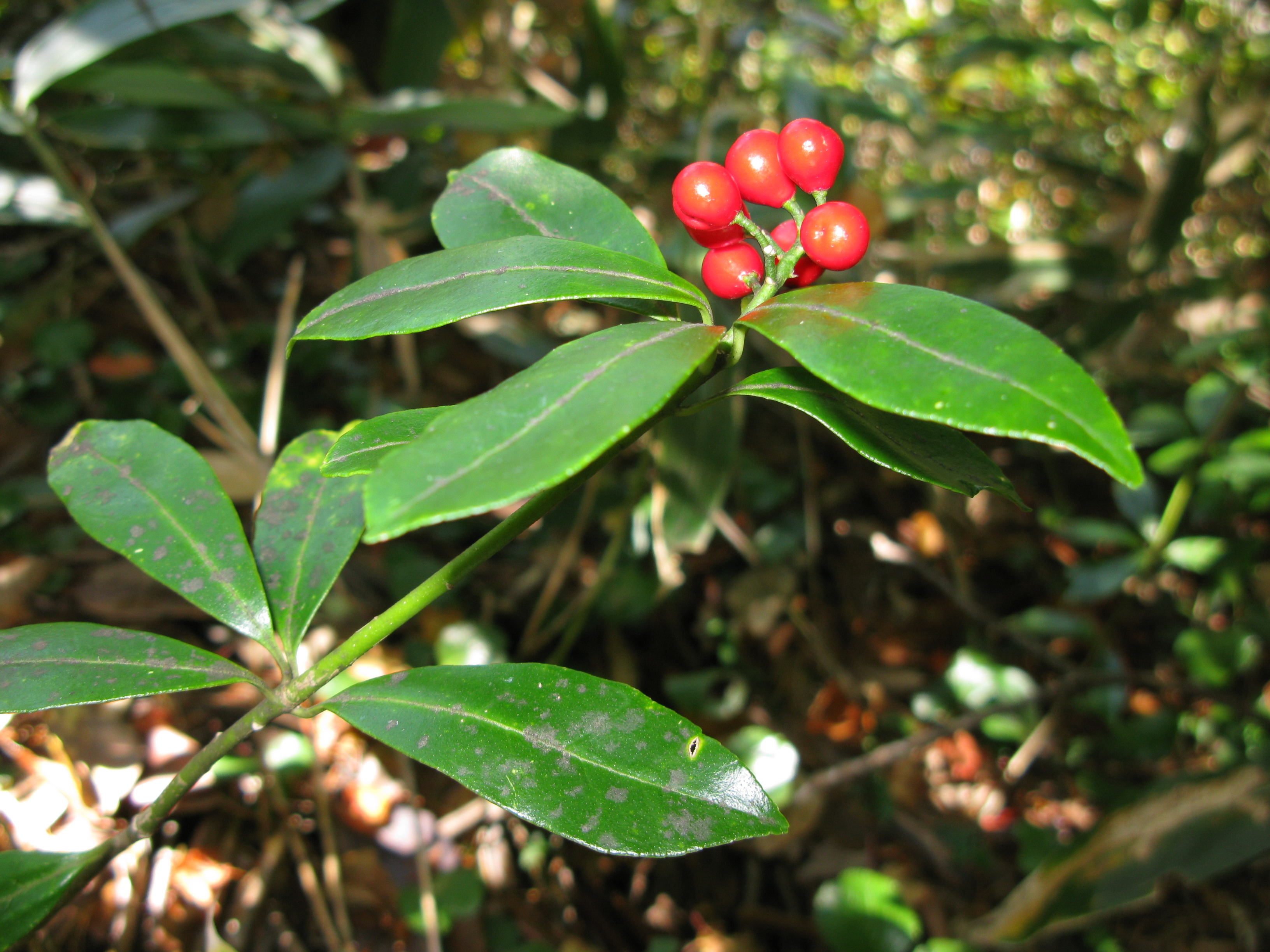
Leaves are leathery, lanceolate, thick, oblong-lanceolate, entire, 6-21 cm long and 2-5 cm wide, dark green above and pale green below, aromatic. Glands are clearly visible on the underside of the leaf.
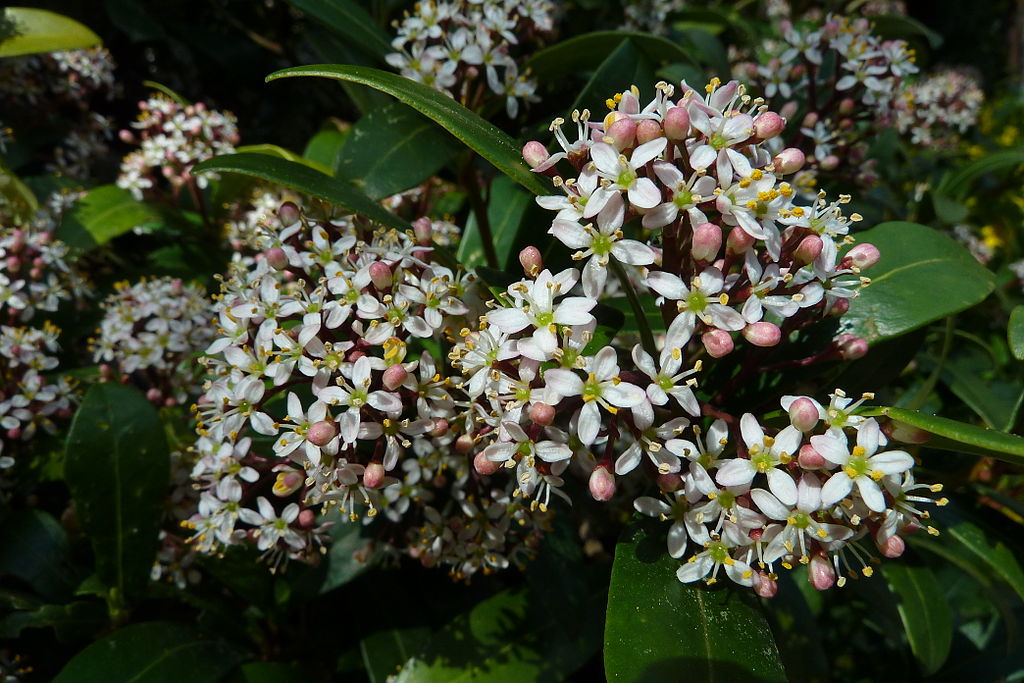
Skimmia japonica. Photo by Schnobby
The plant is monoecious. Flowers are small, with 4-7 pointed petals, 6-15 mm in diameter, white or ivory-colored, with a sweetish scent, gathered in dense panicles. 4-7 pointed petals. Male plants are larger and have more abundant flowers. One male specimen can act as a pollinator for 6 female plants. Flower buds are formed in autumn.
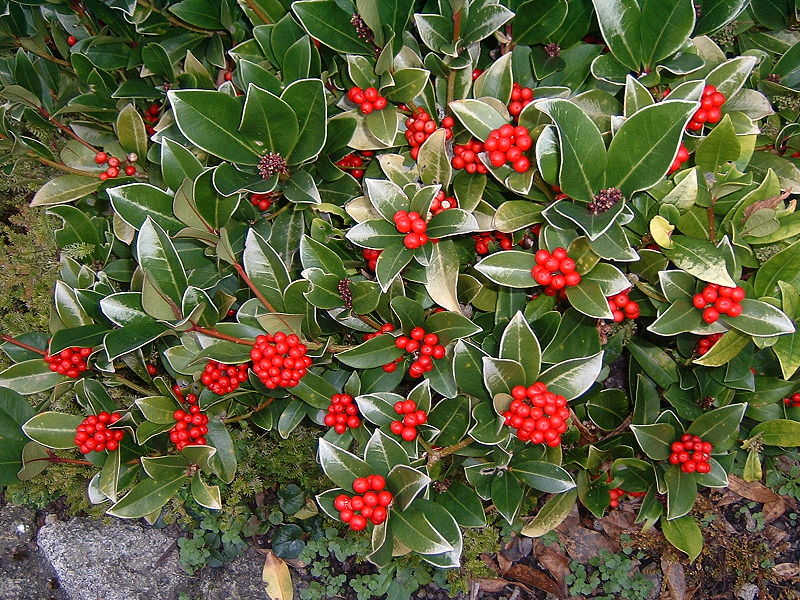
Photo by Musical Linguist
Fruits – drupes of red or black color, 6-12 mm in diameter, with a single seed. Fruits are inedible.
Subspecies: one subspecies is distinguished - Skimmia reevesiana sussp. reevesiana – a dwarf form.
Species: the genus includes 7 species:
- Skimmia anquetilia N.P.Taylor & Airy Shaw
- Skimmia arborescens T. Anderson ex Gamble – tree skimmia
- Skimmia japonica Thunb. – Skimmia japonica (type species)
- Skimmia laureola (DC.) Siebold & Zucc. ex Walp.
- Skimmia melanocarpa Rehder & E.H. Wilson
- Skimmia multinervia C.C. Huang
- Skimmia reevesiana (Fortune) Fortune – Skimmia Reevesa
- Skimmia repens Nakai – creeping skimmia
Hybrids: S. × confusa, S. × foremanii.
Cultivars: in horticulture Skimmia japonica is most often used. The most common cultivars are: "Magic Marlo", "Fructo Albo", "Fragrans", "Smits Spider", "Brocox King", "Brocox Rocket".
Hardiness zone: 7-8 (-15°C)

Soil: prefers moist, acidic, well-drained soils rich in humus. Tolerant of drought and air pollution. Does not tolerate lime. For potting mix, peat and loam with added sand can be used.
Transplanting: transplant in spring, selecting a pot according to the size of the plant's rootball.
Light: needs bright, diffused light; grows in partial shade but loses its decorative appeal. Does not tolerate direct sunlight, which quickly causes leaf scorch.
Temperature: in summer it is preferable to place outdoors in fresh air. In winter prefers cool conditions, with temperatures not exceeding 10°C.
Humidity: does not require additional humidification.
Watering: in spring-summer a constant moisture of the soil ball is necessary. In winter watering is minimal, especially with cool conditions.
Pruning: pruning can be done after flowering.
Fertilization: from April to September it is recommended to feed the plant every 2 months with a fertilizer for indoor flowering plants or for rhododendrons.
Diseases: powdery mildew, grape oidium, chlorosis.
Pests: aphids, scale insects, spider mites, Panonychus citri
Propagation: propagated by cuttings and seeds. Seeds require cold stratification before sowing; after that they are sown in a peat-sand substrate with pH 5-5.5 and kept in a cool room. Semi-ripe cuttings can be rooted from August to February. Before planting they are treated with rooting stimulants, planted in sand and kept at 18-22°C.
Uses: in Ukraine grown as a houseplant or container plant. It is used to decorate terraces, patios, and balconies. Can be planted outdoors for the summer.