
Conifers
Sequoiadendron giganteum, mammoth tree
Sequoiadendron Buchh.
Synonyms: Sequoiadendron giganteum, Wellingtonia, giant sequoia, big tree, mammoth tree, Wellingtonia Lindl.
Sequoiadendron (Sequoiadendron J.Buchholz) – a monotypic genus of evergreen coniferous plants in the cypress family (Cupressaceae). The first mention by Europeans was in 1833, in the journal of the explorer J. K. Leonard. It was first described in 1839 in the journal «American Journal of Botany 26(7): 536.» by the American botanist John Theodore Buchholz. The single species, Sequoiadendron giganteum or the mammoth tree, received its name due to its enormous size and the external resemblance of its branches to mammoth tusks. The English botanist John Lindley in December 1853 named the species Wellingtonia gigantea (in honor of Arthur Wellesley, the first Duke of Wellington, who died in 1852), not knowing that this name had already been used for another genus Meliosma (Meliosma Blume or Wellingtonia arnottiana) of the Sabiaceae family.
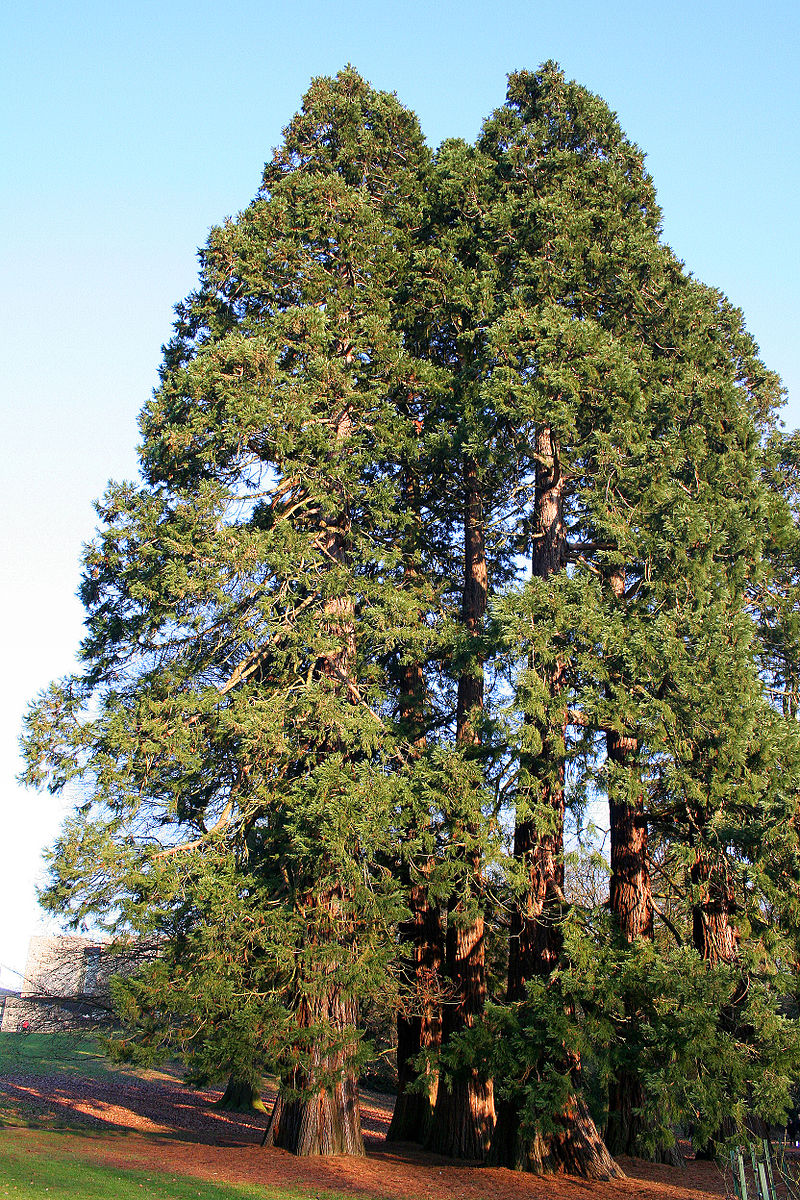
At the end of the Cretaceous period and in the Tertiary it was widely distributed in the Northern Hemisphere. Now only about 30 groves remain on the western slope of the Sierra Nevada in California at an altitude of 1500—2000 m above sea level and it numbers only 68 trees with a total planted area of 144.16 km². In Sequoia National Park the tree that grows is Sequoiadendron, not the sequoia. They do not grow in pure stands, only in small numbers in several areas. The northern two thirds of its range, from the American River in Placer south to the Kings River, contain only 8 groves. The remaining southern groves are concentrated between the Kings River and Deer Creek Groves in the southern part of Tulare County. Groves range in size from 12.4 km² with 20,000 trees, among which only six are living trees. Many are protected in Sequoia, Kings Canyon National Parks and in the Sequoia National Monument. As an ornamental plant it is cultivated in many countries of the world – in England, Germany, the Netherlands, Switzerland, Poland, Ukraine (Lviv, Transcarpathia, Mykolaiv, Nikitsky Botanical Garden, Odessa, Yalta), in Central Asia (with regular watering), on the Black Sea coast of the Caucasus and Transcaucasia.
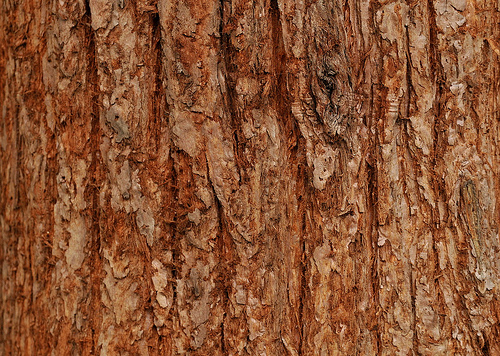
Sequoiadendron giganteum is the tallest tree in the world, reaching up to 100 m in height, with a trunk diameter of 10–12 m. The oldest sequoia has an age of 3200 years, determined by tree rings. The trunk is massive, straight, with a basal flare. In cultivation the tree reaches 30–40 m in height, with a crown diameter of 8–10 m. In youth it grows moderately fast, 10–20 cm per year. The crown is dense, conical; in young trees it is regular and low, later becoming spreading and high-raised. Branches are initially whorled, later irregular, powerful, strong, with age they are located only on the upper part of the trees curved downwards and raised at the ends. Young shoots are stiff, lignified, bare, greenish-gray. Bark is reddish or dark brown, thick, soft; on mature trees it is covered with deep furrows and peels off in fibers. Buds are bare, green, without scales.
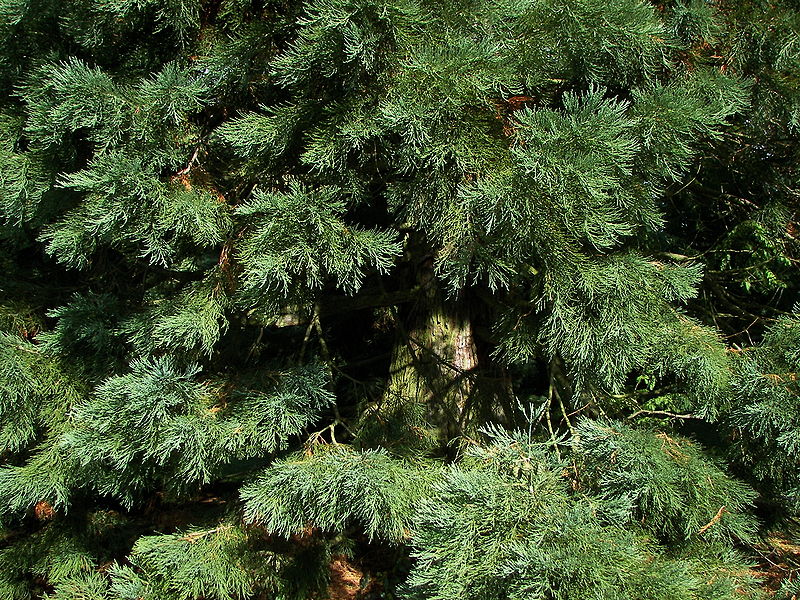
Needles are arranged spirally, set in 3 longitudinal rows, densely imbricate, tightly covering all shoots, 0.4–0.6 (1) cm long, awl-lanceolate or scale-like. The base of the needles is stem-clasping, the tip acute; above they are flat, below with a longitudinal groove; on the lower ends of shoots they are appressed, near the top somewhat spreading, dark green or bluish in color, rarely glossy, aromatic (when crushed they emit an anise scent), and remain on shoots for up to 4 years.
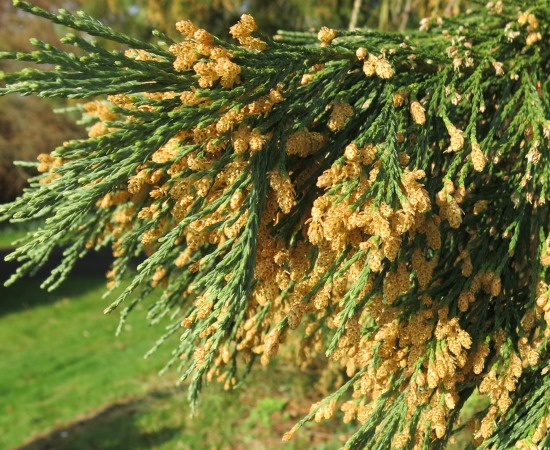
Flowers in late April – early May. Microstrobili grow singly at the ends of shoots, 4–6 mm long, yellowish-green, located in the axils of the foliage, and consist of numerous spirally arranged broadly ovate stamens with 2–5 anthers that open with a longitudinal split. Female cones are located at the tips of lateral shoots, consisting of 25–40 spirally arranged scales with 3–12 or more ovules, growing in 2 rows.
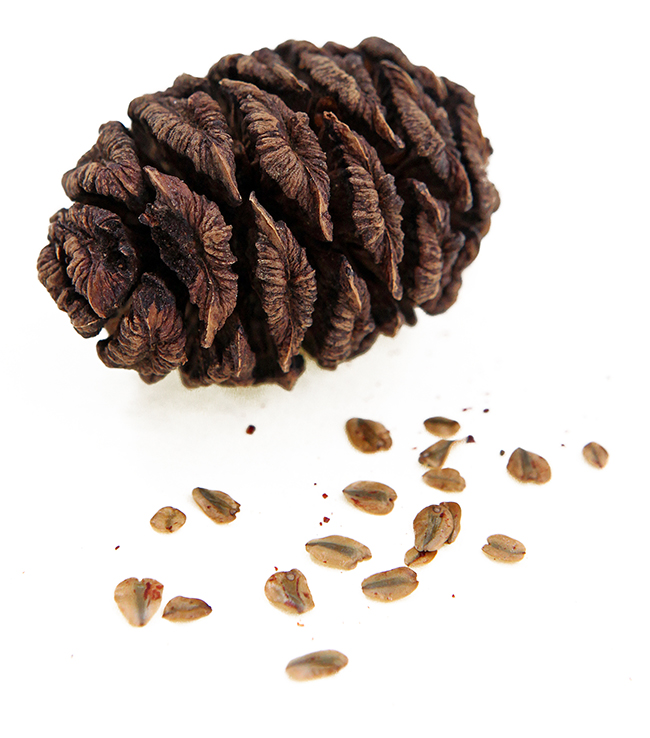
Cones are green, later darken and become reddish-brown; they are woody, solitary, growing at the tips of short branches. They mature by the end of the 2nd year. In the first year cones are erect, later pendulous, ovoid in shape, 5–8 cm long and 3–4.5 cm in diameter, blunt at both ends, and open at maturity. There are 25–40 seed-scales, 6–10 mm wide, woody, strong, with a depression in the middle. The shields of the scales are narrowly rhomboid, strongly wrinkled, the keel weak, with an apex, externally transversely elongated, up to 20 mm wide and 8 mm high. Scales are spirally arranged, finely toothed at the edges, wedge-shaped at the base, gradually transitioning to trapezoidal plates. Seeds are light yellow, up to 5 per scale, elliptical, strongly compressed, 3–6 mm long, narrowly winged. Wings are translucent, yellowish-ochre. It bears fruit from 20 years of age; cones remain on the tree for 8–12 years, while a large proportion of seeds retain viability. There are up to 230 seeds per cone.
Species: the genus includes only one relict species - Sequoiadendron giganteum (Lindl.) Bucch. (syn. Sequoia gigantea (Lindl.) Decne., Sequoia wellingtonia Seem., Wellingtonia gigantea Lindl., Wellingtonia pendula Carrière.).
Varieties: 'Cannibal', 'Barabits Requiem', 'Blauer Eichzwerg', 'Conrad Appel', 'Hazel Smith', 'Glaucum', 'Pygmaeum', 'Argentea Spicata', 'Bajojeka', 'Blue Iceberg', 'Bultinck Yellow', 'French Beauty', 'Greenpeace', 'Little Stan', 'Muller', 'Pendulum', 'Pevé Bonsai', 'Philip Curtis', 'Powder Blue', 'Variegatum', 'Von Martin', 'Argenteum', 'Compactum', 'Neuchatel', 'Glaucum Compactum', 'Albospica', 'Barts Green', 'Ayers Rock', 'Canibuc', 'Chief', 'Cream Tower', 'Curley Green', 'Desperado', 'Dolimore', 'Dutchman', 'Exceptionally Blue', 'Green Lightening', 'Green Stone', 'Highlander', 'Julian', 'Lacy Blue', 'Luzzi', 'Pete`s Fastigiate', 'Pierie', 'Pirat', 'Pyramidalis Glauca'.
Hardiness zone: 5b (-26°C)

Location: sun-loving, prefers a humid atmosphere, warm summer climate (optimal July temperature +25–30°). In nature it grows on residual granite and alluvial soils, requires good drainage, prefers in cultivation moist sandy loams or loams with pH 5.5 to 7.8. Can grow on calcareous soils but does not tolerate excessive moisture.
Planting: prepare the planting hole in advance. For heavy soil prepare drainage from broken bricks. Planting mix: turf or leaf soil with sand and clay in a ratio of 2:1:1. The root collar should be at ground level.
Indoor temperature: prefers moderate temperature. In winter not below 0, optimal +8–10°C. From late May to August it can be kept outdoors, shaded from the bright midday sun and protected from drafts. It tolerates hot air from radiators poorly.
Watering: abundant watering from spring to autumn, winter - moderate (at +8°C water once every 10 days, at +12–14°C – once every 5–7 days).
Air humidity: requires regular spraying in spring and summer. In winter in a warm room spray in the morning and evening.
Care: in the first 2 years after planting apply Kemira-Universal. In hot weather it needs watering and sprinkler irrigation twice a month.
Transplanting: Transplanting is done annually in April-May – the root ball is transferred from one pot to another and soil is added. Soil mix – turf soil, leaf mold, peat and sand in a ratio of 1:2:1:1.
Pruning: can be grown in bonsai style.
Diseases and pests: resistant to diseases and pests, but can be affected by root rot.
Propagation: mainly propagated by seeds, can also be by cuttings. Seed germination is low, 1–5%. Sow them in early spring indoors without stratification. They can be pre-soaked for 1–2 days, which increases germination. Seed soil mix: peat, leaf soil, sand and clay in equal parts. Use a container with good drainage. By autumn seedlings produce up to 6 branchlets and grow 8–10 cm in height. The first winter for seedlings should be spent in a greenhouse or a glazed balcony. In the second year a seedling reaches 20–30 cm in height. Plant out at 3–5 years of age.
Uses: an attractive ornamental tree with a pyramidal crown and bluish foliage. Used as solitary plantings in parks and large gardens, can be used to create alleys and groups. Can be grown as bonsai.