
Deciduous shrubs
Black elder
Sambucus nigra
Synonyms: Sambucus graveolens Willd., Sambucus peruviana Kunth, Sambucus nigra f. alba (Weston) Rehder, Sambucus nigra f. aurea (Sweet) Schwer., Sambucus nigra f. laciniata (L.) Zabel, Sambucus nigra f. pendula Dippel, бозняк, буз, самбук, бездерево.
Black elder (Sambucus nigra L.) – a species of the genus Sambucus (Sambucus) in the family Adoxaceae (Adoxaceae). The species was first described by Carl Linnaeus in 1753 in Sp. Pl. ed. 1 269.
The range extends to Macaronesia (the Azores and Madeira), North Africa (Algeria and Tunisia), the temperate zone of Asia (western and northern Iran, Turkey), almost all of Europe, the Caucasus (Armenia, Azerbaijan, Georgia), Ukraine, Moldova, Belarus. Introduced to New Zealand. Grows as an understory in deciduous and coniferous forests, can form thickets. Escapes cultivation and spreads along roads, in cemeteries, wastelands, and in settlements.
Автор В.Свириденко
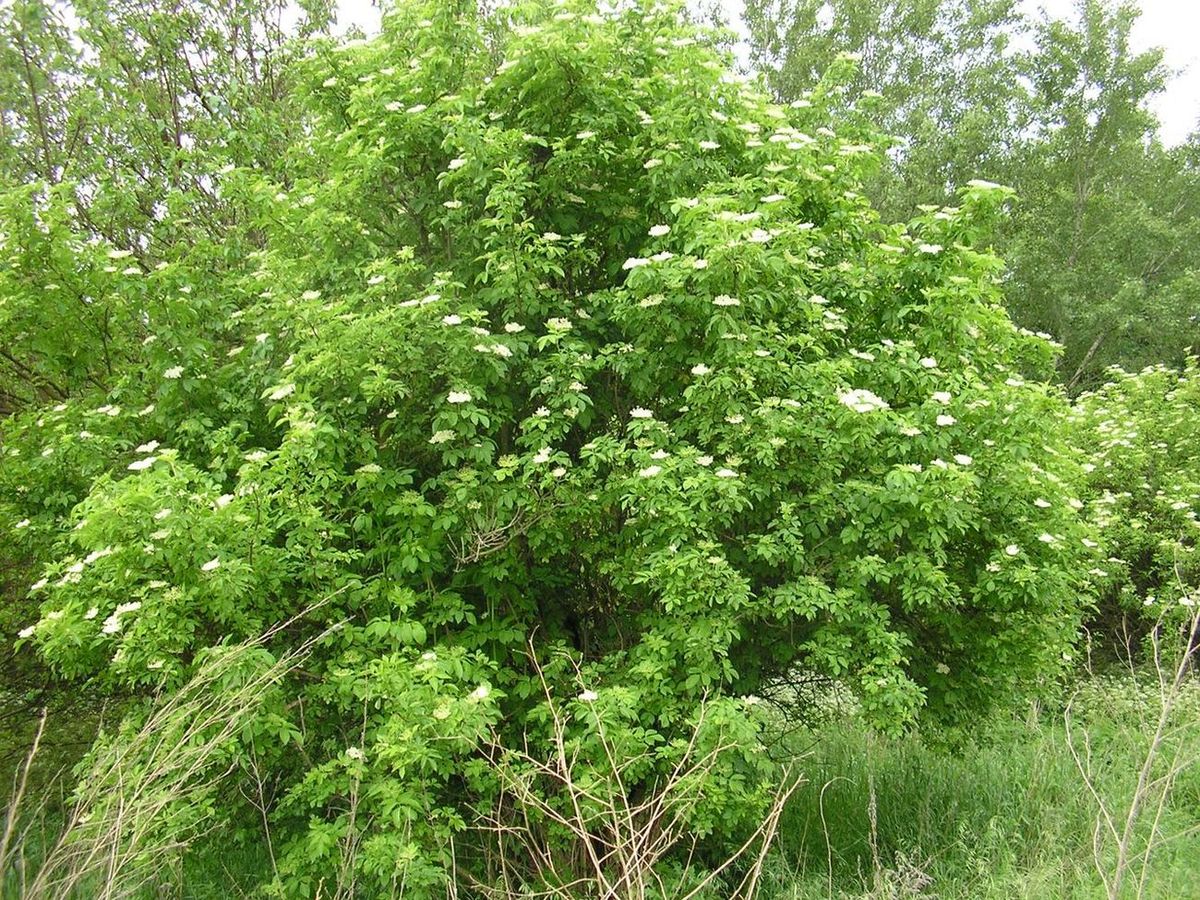
It is a deciduous shrub or small tree 2-6 (10) m high. Grows rapidly. Stems are branched, with a thin woody rind and a white soft porous pith. Young shoots glabrous, green, later becoming brownish-gray with numerous yellowish lenticels. Bark ash-gray, deeply longitudinally wrinkled, later fissuring.
Автор Т.Винокурова
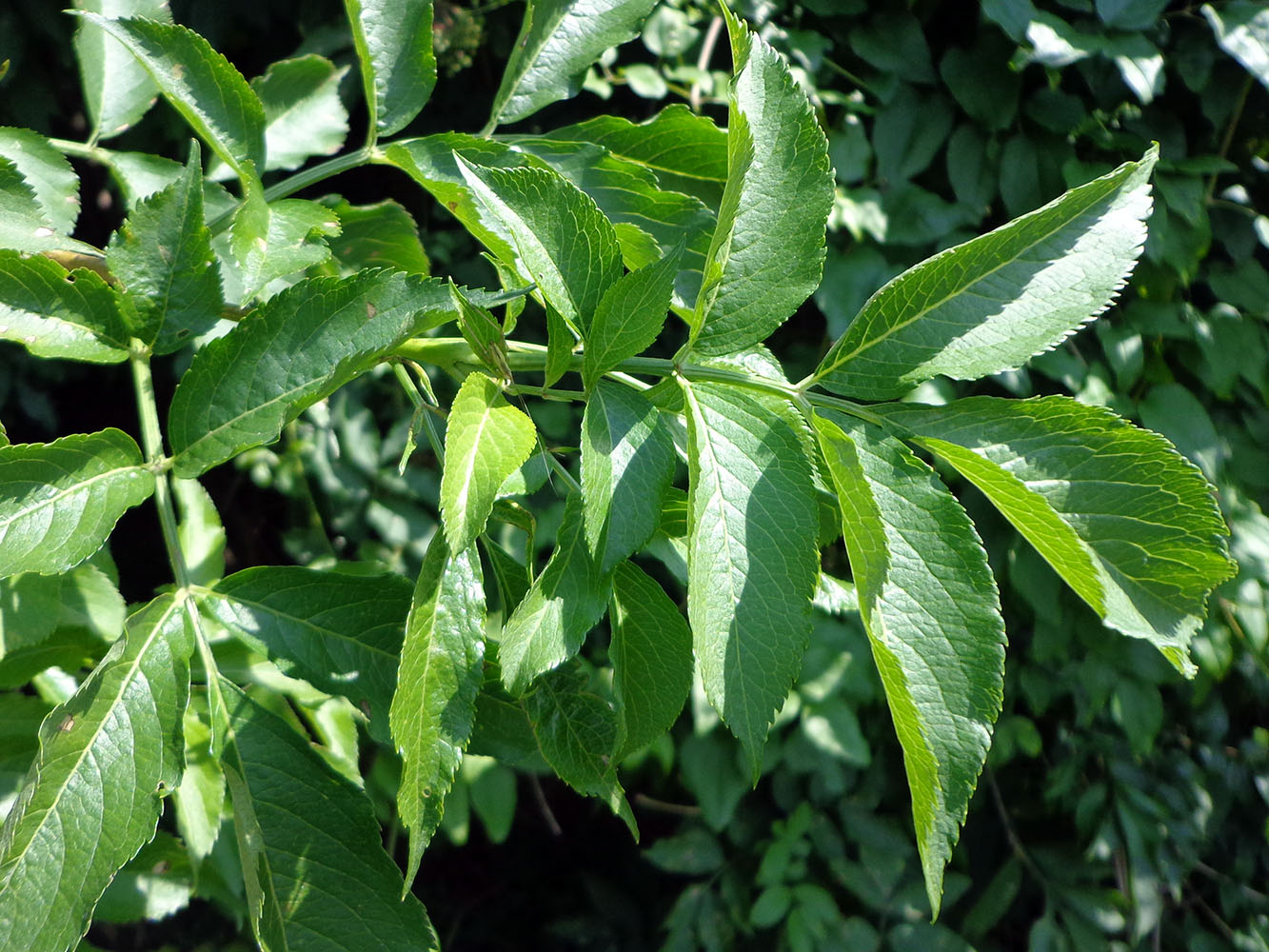
Leaves opposite, compound, imparipinnate, large, 10-30 cm long, consisting of 3-7 leaflets. Leaflets acuminate, oblong-ovate, 3-7 cm long and 1.5-4 cm wide, with a broadly cuneate base, coarsely and finely asymmetrically serrate margins, dark green above, paler beneath and pubescent on the veins. Petioles short. When crushed, the leaves emit an unpleasant odor.
Автор О.Гребенюк
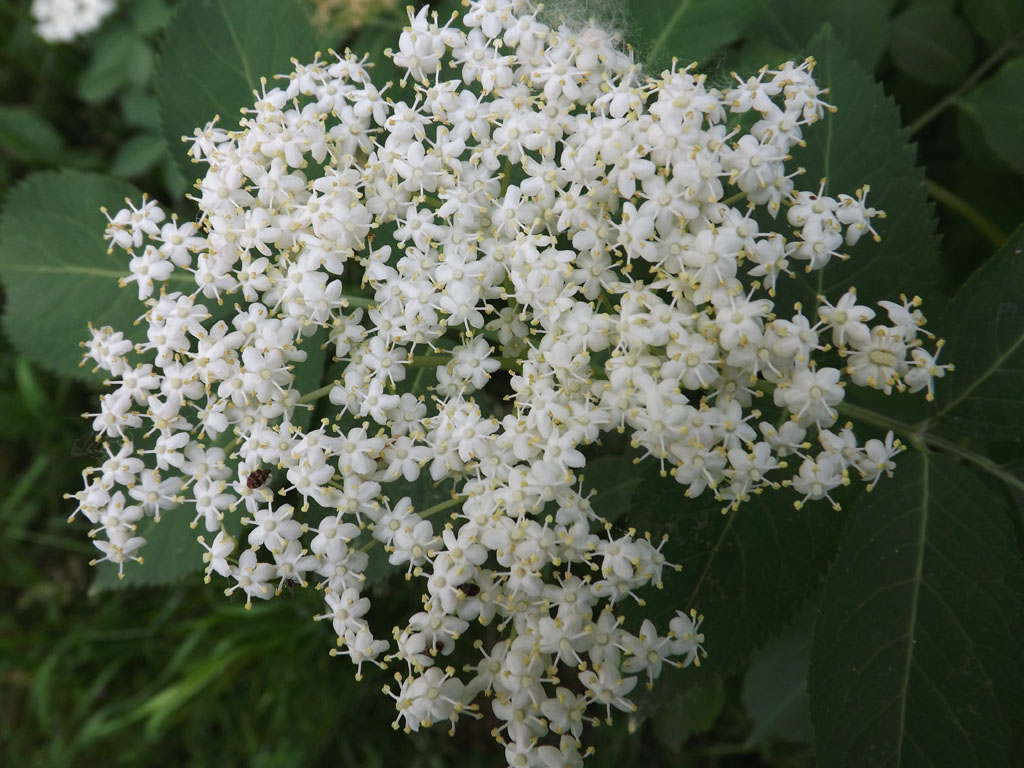
Flowers sessile or on pedicels, yellowish-white or white, with a characteristic aroma, 5-8 mm in diameter, consisting of 5 petals. Flowers are gathered in corymbose inflorescences 10-25 cm in diameter, pendulous after flowering. Calyx five-toothed, corolla wheel-shaped, made of 5 petals yellowish-white in color, fused at the base. Calyx teeth ovate, corolla creamy-white, 5-8 mm in diameter. Stamens 5, adnate to the corolla tube, with yellow anthers. Ovary semi-inferior, three-celled, with a short style and 3 hairy stigmas. Flowering can be observed in May-June, about 30 days.
Автор В.Свириденко
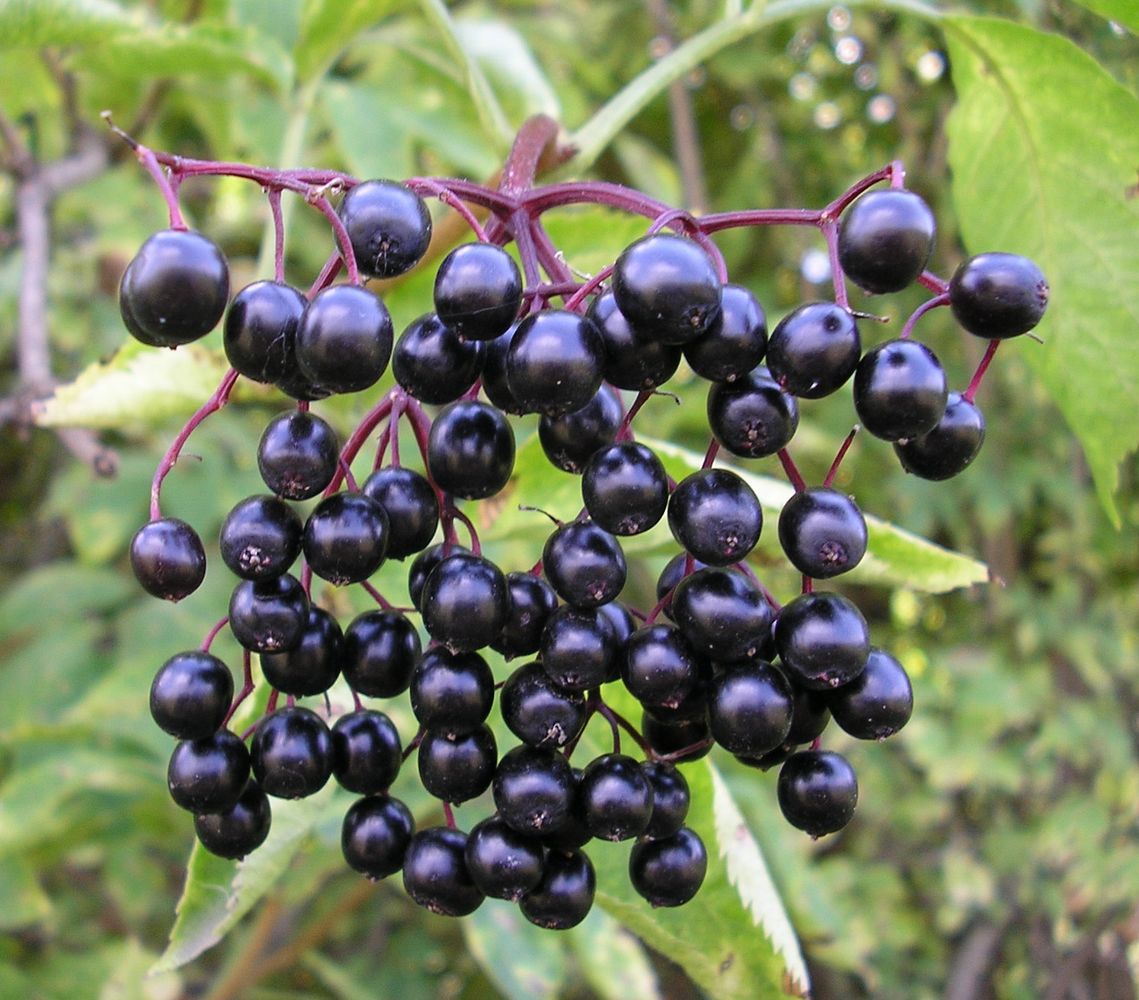
Fruits are juicy berry-like globose drupes black-violet in color, 5-7 mm in diameter, with 2-4 stones, gathered in drooping clusters on thin purple pedicels, shiny. Flesh red-violet, juicy, sweet-and-sour. Seeds brown, ovoid, transversely wrinkled. Fruits ripen in August - September and are covered with a waxy bloom, remaining on the bushes after leaf fall. Weight of 1000 "seeds" (stones) 2.0—4.1 g.
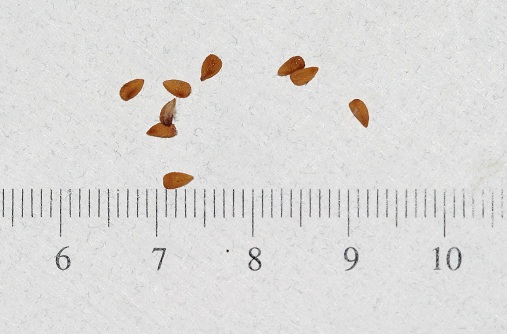
All parts of the plant are poisonous, except for the flowers, the skin and the flesh of ripe berries. Seeds are also poisonous.
Varieties:
- Sambucus nigra var. cerulea (Raf.) B.L.Turner (Sambucus cerulea Raf.)
- Sambucus nigra subsp. maderensis (Lowe) Bolli (Sambucus maderensis Lowe)
- Sambucus nigra subsp. palmensis (Link) Bolli (Sambucus palmensis Link)
- Sambucus nigra f. aurea
- Sambucus nigra f. pyramidalis
- Sambucus nigra f. pendula
- Sambucus nigra f. nana
- Sambucus nigra f. aureo-variegata
- Sambucus nigra f. albo-variegata
- Sambucus nigra f. pulverulenta
- Sambucus nigra f. porphyrophylla 'Gerda' ('Black Beauty')
- Sambucus nigra f. laciniata
Cultivars:Thundercloud, Eva (Black Lace Elderberry), Linearis, Luteovariegata, Guincho Purple, Purpurea, Marginata, Pulverulenta.
Hardiness zone: 4a (-29°C)

Location: grows in any position, but fruits well in open sunny sites. Not demanding to soil, grows on any soil, even poorly drained. Very hardy and tolerant to smoke and gas.
Planting: it is recommended to plant a 1-2 year old seedling in mild weather in spring or autumn. When planting a trunk, it needs to be tied to a stake.
Care: in hot and dry weather needs watering, as well as mulching the soil with well-rotted manure or compost. In spring, with slow or weak growth, a balanced mineral fertilizer can be applied.
Pruning: after planting it is recommended to cut weak and damaged shoots, and also shorten the main branches to 10 cm to a strong outward-facing bud. In subsequent years it is necessary to remove dead and crown-thickening branches. In maturity it is necessary annually to remove about a quarter of old branches to the base and unnecessary basal shoots. After cutting, wounds should be well sealed with garden pitch
Diseases and pests: resistant to diseases and pests. May be affected by aphids (for this the plant is treated with carbophos in early spring).
Propagation: Propagated by seeds (after 4 months of stratification and sowing in the ground in spring or autumn), by layering and cuttings. Mainly propagated by cuttings – for this in spring a cutting 25-30 cm long is cut from a well-developed one-year shoot and planted in open ground to a depth of 10-15 cm. In July semi-woody cuttings 20-30 cm long can be cut and planted to a depth of 5 cm in a cold frame at a spacing of 20—30 cm from each other. In autumn of the following year cuttings can be planted in their permanent place.
Uses: grown in gardens and parks. Ornamental for its decorative leaves, lacy inflorescences with fragrant flowers, and shiny black fruits. Flowers and berries are used in medicine. Berries are used for making jams and preserves. A good nectar source for bees.