
Deciduous trees
Salix udensis 'Sekka'
Salix udensis Sekka
Synonyms: Salix 'Setsuka', ива удинская секка, ива секка, ива удская секка, ива японская секка, драконовое дерево, Japanese Fantail willow, Dragon willow
Salix udensis Sekka (Salix udensis Sekka) – a striking cultivar of Salix udensis, its decorative male clone. Native to Japan. The cultivar was introduced to Europe in the 1950s and became popular there.
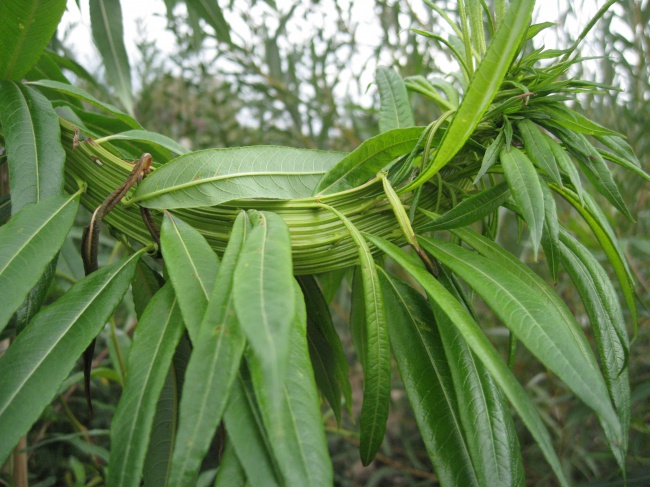
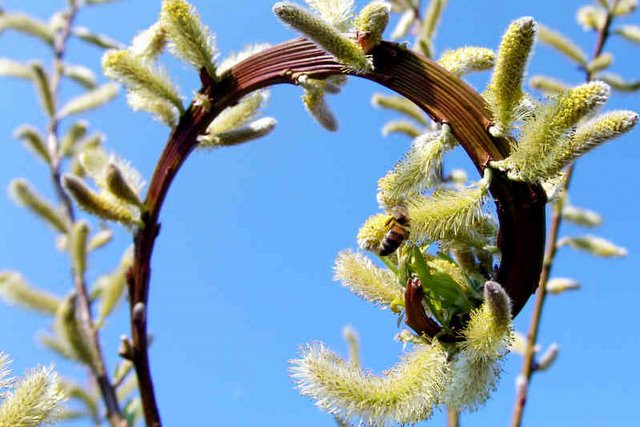
It is a deciduous shrub 2-3 m in height. The crown is rounded, spreading. Shoots are fasciated, asymmetrically branched, grow vertically, the branch tips are twisted into a flat and large curl. Branches can reach 5 cm in width. Bark is reddish-brown.
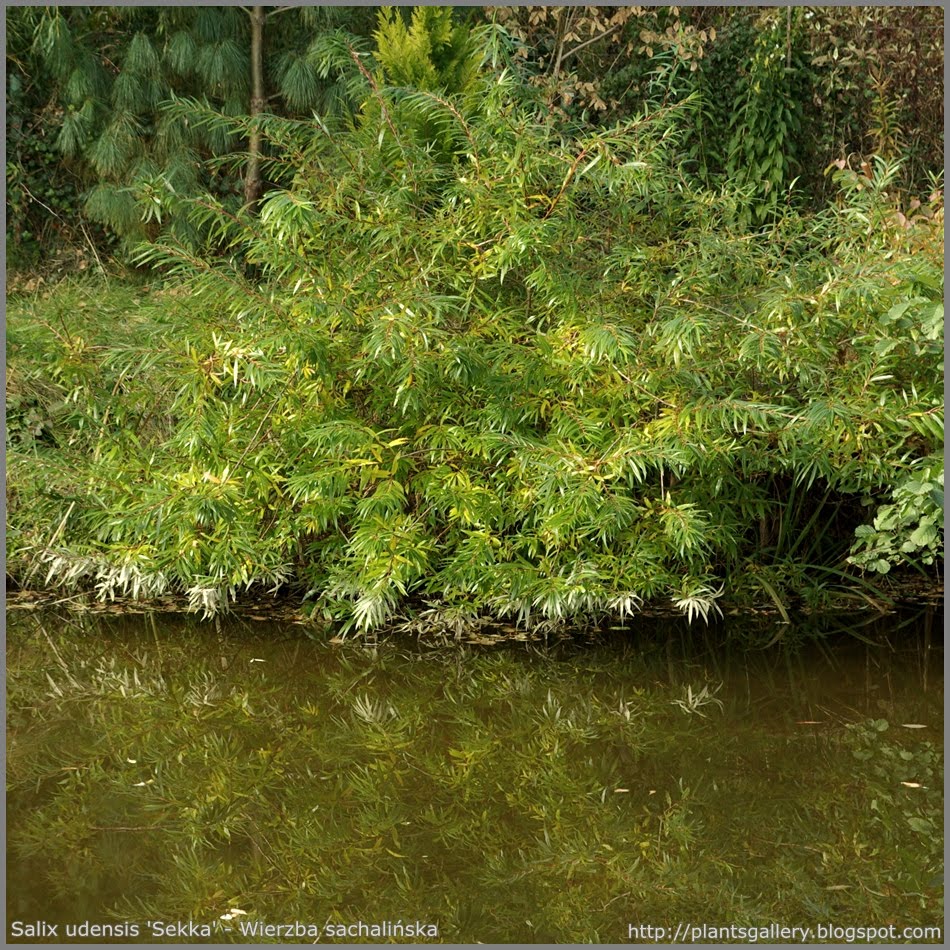
Leaves alternate, narrowly lanceolate, 10-15 cm long, bright or dark green above, glossy, silvery-green beneath. In autumn the leaves acquire yellowish tones.
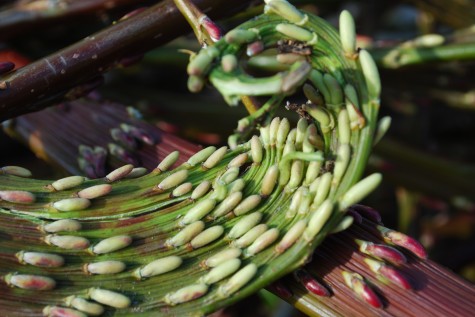
Flowers in April. Male catkins are densely arranged on the shoots, up to 5 cm long, silvery, with yellow stamens.
Hardiness zone: 4b-8(-29°C). In most parts of Ukraine shoots may suffer some frost damage, but recover quickly.

Location: light-loving, but tolerates partial shade. Grows well in urban conditions. Not demanding regarding growing conditions. Needs a site protected from strong winds.
Soil: not demanding, grows on any sufficiently moist soil with good drainage. Prefers fertile soil, although it can grow on poor and dry soils.
Planting: Planting is best carried out in spring before budburst. When establishing a 'willow stand' (clumps of willow) it is recommended to cultivate the soil in autumn to a depth of 30-80 cm, depending on its fertility and dryness. The top organic layer should be turned upside down. Recommended spacing between seedlings should be at least 0.6-2 m, depending on the species. Planting depth – 40-70 cm. Transplanting is recommended up to 3-4 years old. On heavy soils drainage with gravel or sand in a layer of 20-30 cm is recommended.
Pruning: tolerates trimming and pruning well.
Care: practically requires no care.
Propagation: propagated by summer and hardwood cuttings.
Pests: longhorn beetles, willow leaf beetle (Lochmaea caprea), Crepidodera aurata, sawfly larvae (Trichiosoma sibiricum), lepidopteran caterpillars (Acleris cristana, Teleiodes notatella, etc.).
Diseases: affected by fungal diseases – fungi of the genera Melampsora, Rhytisma, Erysiphe, Phytophthora ramorum.
Uses: widely used for creating ikebana, in floral compositions, for flower arranging and creating winter gardens. Serves as a good background for small trees or shrubs, as well as ornamental grasses and flowering perennials, especially in larger landscapes.