
Deciduous trees
Silver Creeping Willow
Salix Repens argentea
Synonyms: Salix repens L. var. argentea (Sm.) Wimm. & Grab., Salix repens L. ssp. argentea (Sm.) E.G. & A. Camus, Salix repens L. ssp. arenaria (L.) Hiitonen, Salix arenaria L.
Salix repens – a form of the species Creeping Willow of the genus Willow (Salix L.) of the family Salicaceae. Occurs throughout most of Europe and into northern Asia. Found on sand dunes, in wet places and river floodplains.
It is a small shrub 0.3-0.5 m in height and up to 1 m in width. Grows slowly. Shoots thin, very flexible, gray-green, covered with silky hairs, later becoming brownish-black.
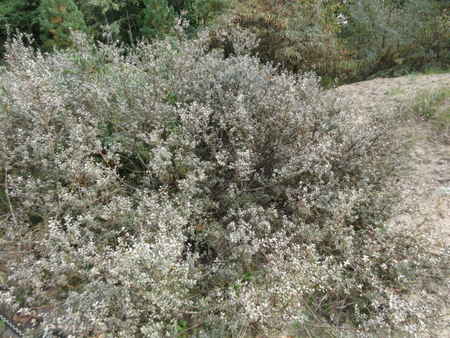
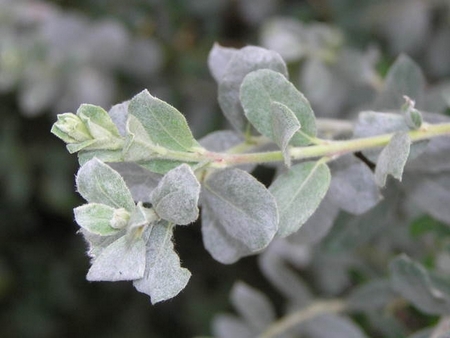
Leaves small, oval or elliptical in shape, when unfolding covered with white-silvery silky glossy pubescence, later becoming grayish. In autumn they turn pale yellow.
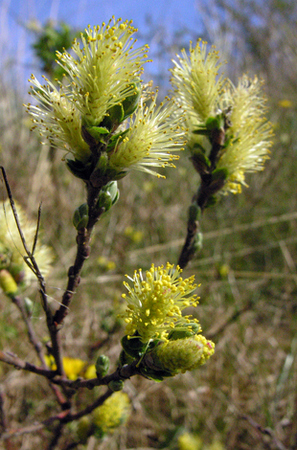
Flowers in late April – early May, before the leaves unfold. Male catkins small, silvery, later yellow, fragrant.
Hardiness zone: 5b (-23°С)

Location: light-loving, very moisture-loving, requires drainage. Undemanding and very hardy, tolerates urban conditions well. Does not tolerate dry air and high temperatures.
Soil: prefers fresh, moist, humus-rich soil, from slightly acidic to alkaline, sandy or sandy-loam.
Planting: Best planted in spring before bud break. The topsoil layer should be turned upside down. Recommended spacing between seedlings should be no less than 0.6-2 m, depending on the variety. Planting depth – 40-70 cm. Transplanting is recommended up to 3-4 years. On heavy soils drainage of crushed stone or sand in a layer of 20-30 cm is recommended.
Pruning: sanitary pruning is recommended.
Care: practically requires no maintenance.
Propagation: easily propagated by cuttings
Pests: Cecidomya saliciperda, Cecidomya salicis, Tortrix (Helias) Chlorana, Agrotis vallugera, Bombyx Salicis, Curculio crux, Phratora vulgarissima, Phratora vitellinae, Galer ucacapreae, Galer lincola, Arvicola terrestris. The flowers and leaves can be eaten by reindeer.
Diseases: affected by fungal diseases – fungi of the genera Melampsora, Rhytisma, Erysiphe.
Uses: used in solitary and group plantings, for decorating rock gardens, rockeries, single-species groups on large areas. Can be grown on balconies in containers, in courtyards (patios). Can be grown in standard form.