
Deciduous trees
Purple willow 'Nana'
Salix purpurea 'Nana'
Synonyms: 'Gracilis', var. Gracilis, krasnoloz, spherical purple willow
Purple willow Nana (Salix purpurea 'Nana') – a popular cultivar of the species Purple willow of the genus Willow Willow (Salix L.) of the family Salicaceae (Salicaceae).
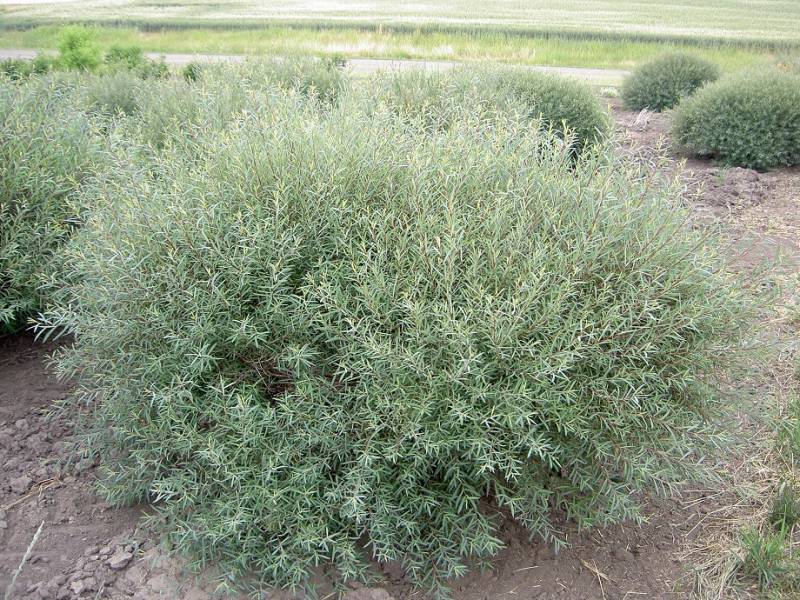
It is a small shrub with a broad, semi‑rounded crown. It reaches 1.5 m in height and 1.5–2 m in diameter. Shoots are thinner than those of the species Purple willow, glabrous, brown with a reddish tint and a glaucous bloom. Growth is slow, 20–30 cm per year.
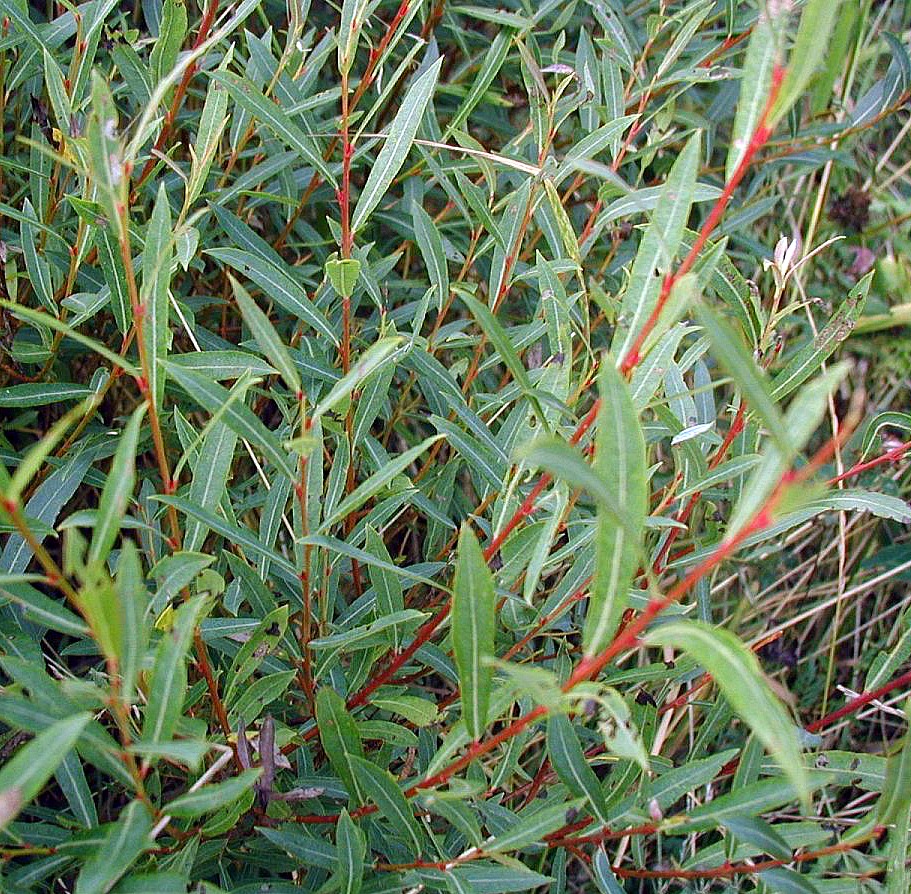
Leaves are nearly oppositely arranged, 3–8 cm long and 0.8 cm wide, almost sessile, linear‑obovate, acute, with a serrated margin and a pointed apex, bluish‑grey or silvery‑green, smooth above, glaucous beneath.
Blooms in April–May, at the same time as leaf emergence, sometimes after it. Flowering is of little ornamental value. Catkins are sessile, oppositely arranged, dense, grayish‑white; male up to 4 cm long, female 2–2.5 cm. Stamens 2, fused, with hairy filaments and a 4‑loculed purple anther.
Hardiness zone: 5b (-23°C)

Location: light‑loving but shade‑tolerant, very moisture‑loving, requires drainage. Undemanding and very hardy, tolerates urban conditions well.
Soil: grows well on sandy soils, also grows on calcareous soils.
Planting: It is best to plant in spring before budbreak. When establishing a "willow plantation" (stands of willow) it is recommended to work the soil in autumn to a depth of 30–80 cm, depending on its fertility and dryness. The top vegetative layer should be turned down. The recommended spacing between seedlings should be at least 0.6–2 m, depending on the species. Planting depth – 40–70 cm. Transplanting is recommended up to 3–4 years. On heavy soils, drainage of crushed stone or sand with a layer of 20–30 cm is recommended.
Pruning: tolerates trimming and pruning better than other species; pruning is recommended in early spring.
Care: practically requires no maintenance.
Propagation: by cuttings and seeds. Seeds lose viability after 10 days. Winter cuttings hardly root; green cuttings treated with Kornevin root at 100%. Pests: Cecidomya saliciperda, Cecidomya salicis, Tortrix (Helias) Chlorana, Agrotis vallugera, Bombyx Salicis, Curculio crux, Phratora vulgarissima, Phratora vitellinae, Galer ucacapreae, Galer lincola, Arvicola terrestris.
Diseases: affected by fungal diseases – fungi from the genera Melampsora, Rhytisma, Erysiphe.
Uses: used in solitary and group plantings, for decorating and stabilizing shorelines, in tree‑and‑shrub groups, on flooded sites, for creating low clipped hedges and garden forms. Can be grown as a standard (trained to a stem).