
Deciduous shrubs
Blackberry, raspberry
Rubus L.
A complex genus that includes more than 300 (600) species. Distributed mainly in the Northern Hemisphere.
Plants of the genus have deciduous, long-lived underground stems, on which herbaceous spiny shoots (turions) are formed annually, from the leaf axils of which short generative shoots grow. Flowers and fruits appear on these shoots. After the fruits ripen the shoot dies in the second (third) year, leaving a bud from which the shoot is renewed the following year.
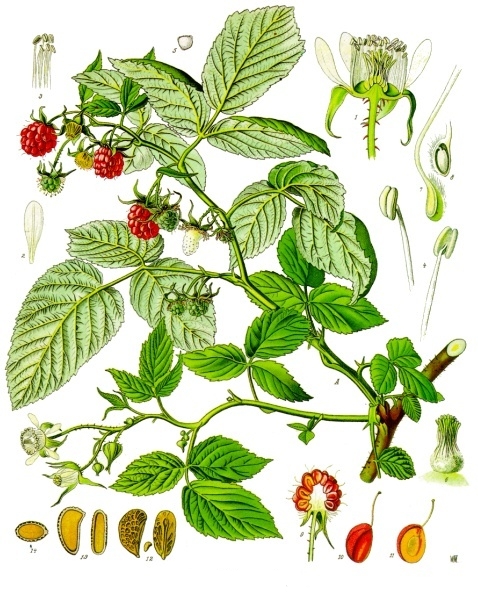
Common raspberry «Köhler’s Medizinal-Pflanzen», 1887
Flowers are bisexual, rarely unisexual. Flowers are solitary or arranged in axillary or terminal inflorescences, large, pink or white.
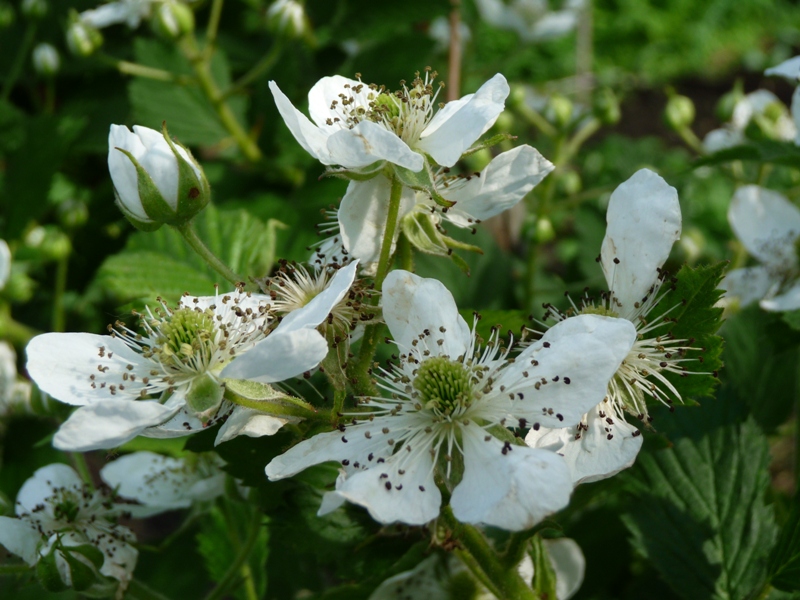
Blackberry flowers
Fruits – aggregate drupes, red, black or yellow, often edible.
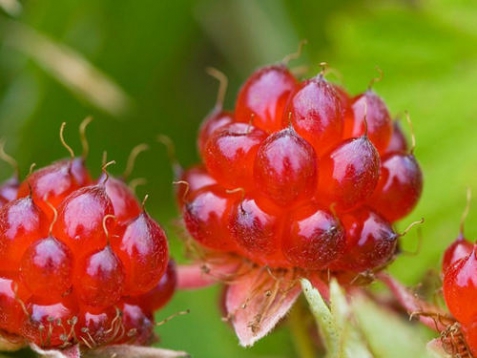
Fruits (aggregate drupes)
The genus is divided into 15 subgenera: Anoplobatus (Focke) - Malinoklen, Chamaebatus (Focke), Chamaemorus (Hill) Focke, Comaropsis (Focke) Focke, Cylactis (Raf.) Focke, Cyclobatus Holub, Dalibardastrum Focke, Diemenicus A.R.Bean, Idaeobatus (Focke) Focke — Raspberry, ×Idaeorubus Holub — Raspberry-blackberry, Lampobatus (Focke) Focke, Malachobatus (Focke) Focke, Micranthobatus (Fritsch) Kalkman, Orobatus (Focke) Focke, Rubus — Blackberry
Representative species: Rubus arcticus — arctic raspberry, or cloudberry, Rubus armeniacus — Armenian, or Himalayan blackberry, Rubus caesius — dewberry, Rubus chamaemorus — cloudberry, Rubus glaucus — mora, Rubus idaeus — common raspberry, or woodland raspberry, Rubus laciniatus — cutleaf blackberry, Rubus nessensis — kumanika, Rubus niveus — Mysore raspberry, Rubus odoratus — flowering raspberry, Rubus plicatus — pleated blackberry, Rubus rosifolius — roseleaf raspberry, Rubus sachalinensis — Sakhalin raspberry, Rubus saxatilis — stone bramble
Hardiness: most members of the genus are highly frost-hardy (zone 4).

Location: members of the genus are not demanding about soils. They grow on any soil in sunny or shady locations. With sufficient moisture they tolerate loose soil well.
Planting: most Rubus species tolerate transplantation well. Only one species – cloudberry – has rather low establishment in garden plots.
Pruning: most species flower on last year's shoots, so it is important to remember that they should not be pruned.
Propagation: by green and lignified root suckers, root cuttings with buds, and by rooted shoot tips.
Uses: The berries are consumed fresh, used for making jam, marinades, sweets, mors (fruit drink), and for candying. Some species are widely used in medicine.