
Deciduous shrubs
Common raspberry
Rubus idaeus L.
Common raspberry (Latin Rúbus idáeus) – a deciduous subshrub, a species of the genus Rubus (Rúbus) of the family Rosaceae (Rosaceae). It is distributed in Europe, North America, and Siberia. It grows on riverbanks, in clearings, in forests, and is also cultivated in gardens. More than 120 species of raspberries are known. Hardiness zone 3.
A deciduous erect shrub up to 2 m high; the stem is initially felted, in the lower part sometimes slightly thorny or stiff-bristled, often also covered with a bloom. Stems are erect. Young shoots are green with a glaucous bloom, herbaceous, succulent, at first felted, later covered with fine thorns or stiff-bristled. Second-year shoots are brown, woody, and die after fruiting. New shoots grow from the same root the following year.
The root system is superficial, winding, woody, located in the arable zone (30-40 cm) within a radius of 30-60 cm. The depth of root penetration depends on soil type: in sandy soils – 100-150 cm, in clay soils – 40-60 cm. The bulk of the roots lies at a depth of 10-30 cm. Forms root suckers.
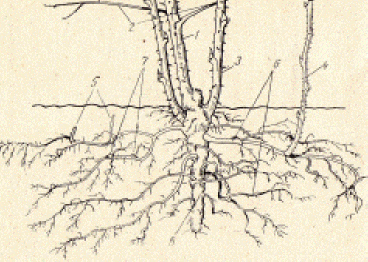
1) fruiting shoot
2) lateral branches
3) replacement shoot
4) sucker
5) etiolated suckers
6) roots
7) buds on roots
8) rhizome
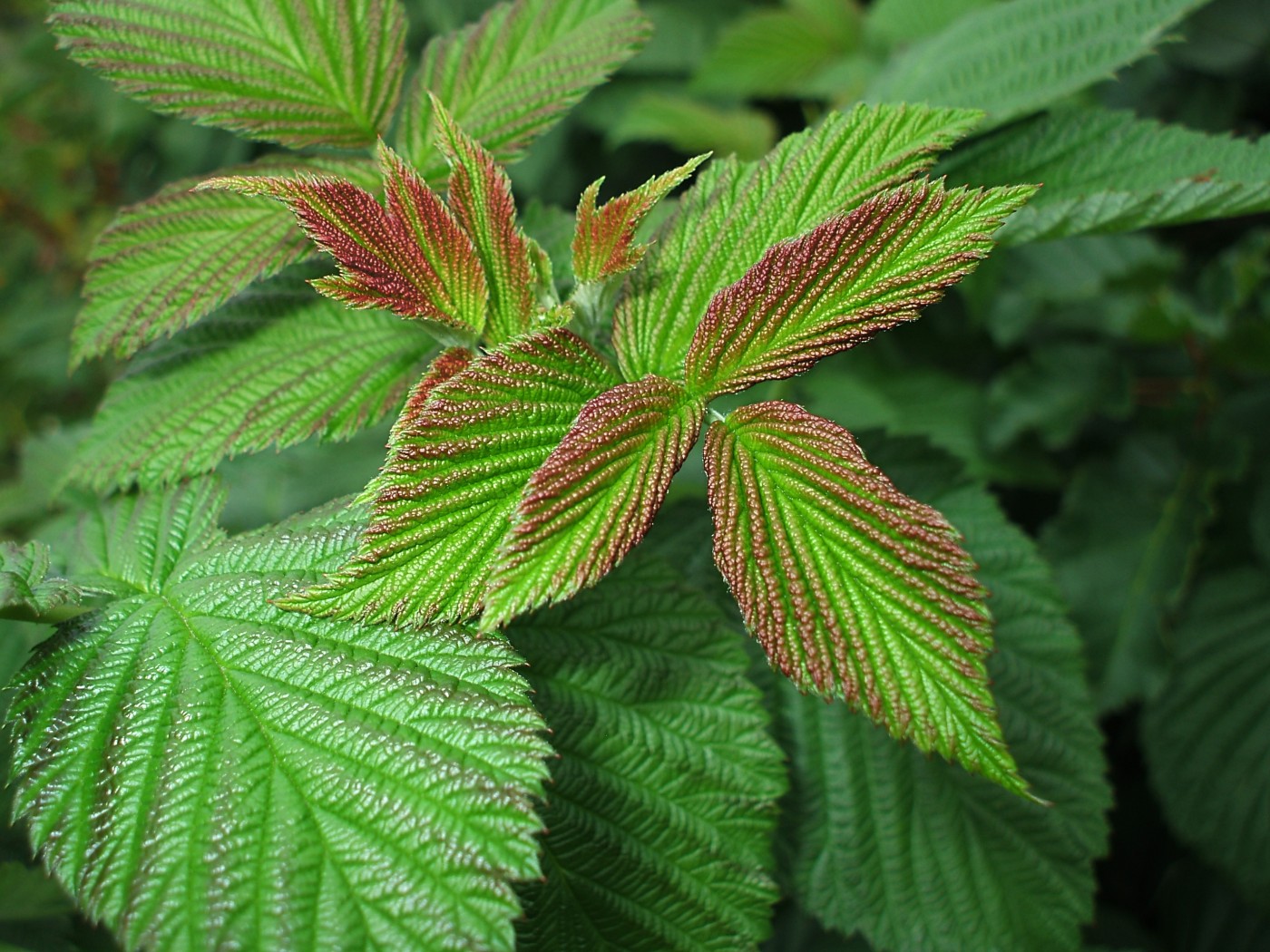
Leaves pinnate, oval, 3-5 lobed, 5-10 cm long, coarsely doubly serrate, dark green and pubescent above, whitish beneath, more or less white-felted.
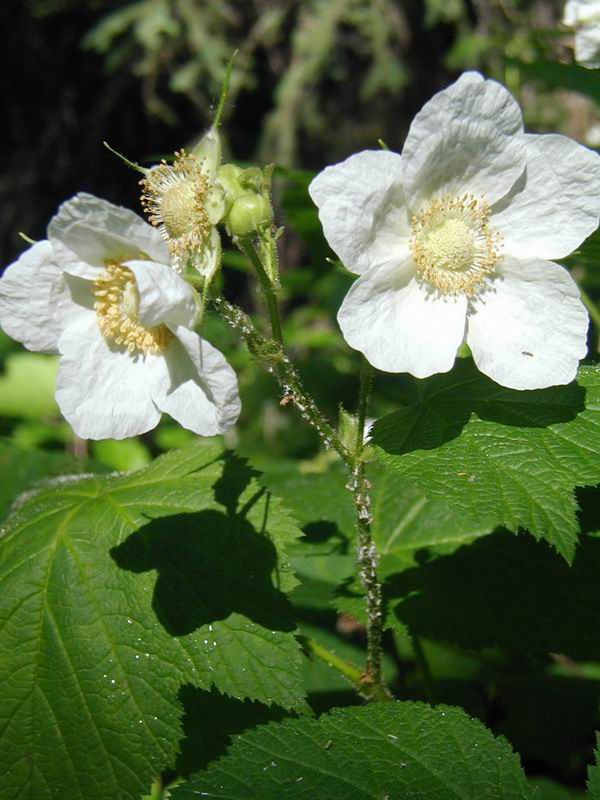
Flowers small (up to 1 cm in diameter), white, in short axillary and terminal slightly prickly racemes, flowering from May to July; petals shorter than the sepals. A good nectar source.
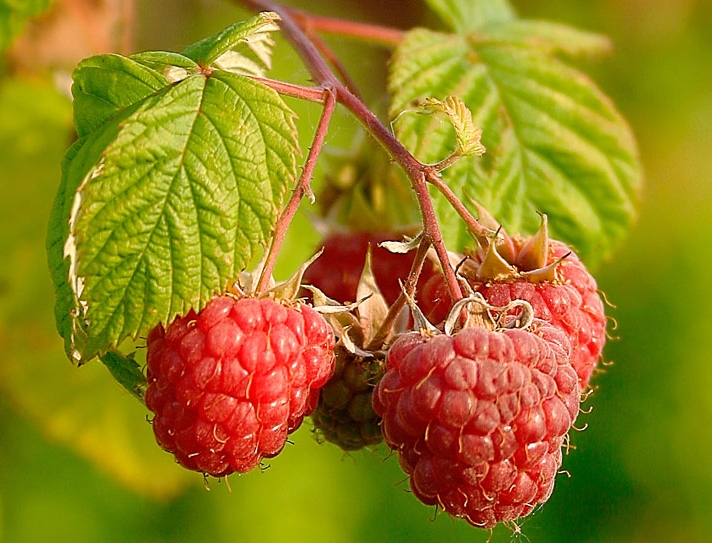
Fruits hemispherical or more globular, from pink to purple (yellow and black varieties occur), pubescent, sweet hairy drupes. Fruits appear in the second year.
Cultivars: Arbat, Generalissimus, Gusar, Yellow Giant, Maria, Lyubetovskaya, Krepysh, Polyana, Morning Dew. remontant – Bryansk Wonder, Golden Domes, Unattainable, Polana, Paradise Delight, Morning Dew, Monomakh's Hat, Heracles, Brusilovskaya, Yaroslavna.

Location: prefers open, well-warmed sites sheltered from cold winds. Grows well on fertile, neutral soils (pH 5.5-6). Preferably planted on moisture-retaining but well-drained loam soils (groundwater should lie at a depth of at least 1.5 m). On sandy and sandy-loam soils annual application of organic fertilizer and regular moderate watering are necessary.
Planting: raspberries are planted in spring before bud break (with spring planting raspberries require regular watering for 2 weeks). In autumn seedlings are planted from mid-September to mid-October. Planting scheme 2x0.5 m. Planting holes are dug 0.4x0.4x0.5 m. Seedlings should not be planted too deep; after planting it is necessary to prune shoots to 30 cm above the ground.
Diseases and pests: Diseases – Didymella (purple stem blotch, cane blight), witch's broom, infectious chlorosis, leaf curl, mosaic. Pests – raspberry clearwing, stem fly, shoot gall midge, strawberry-raspberry weevil, raspberry beetle, prodoxid moth and bud moth, leaf and raspberry aphids, nut weevil, stem fly, spider mite.
Care: requires regular weeding and mulching of the soil. Responds well to potassium and nitrogen fertilizers. In the second year after planting apply organic fertilizer – 1 bucket of compost or humus per 1 cubic m, 25 g of double superphosphate, 20 g of potassium sulfate. In early June, with weak growth, top-dress with manure infusion (5:1) or poultry manure infusion (12:1) at a rate of 1 bucket per 5 plants. In autumn requires a deep watering. Support is necessary; a trellis is best used.
Pruning of raspberries is carried out in spring, when it is possible to identify the overwintered one-year shoots. Pruning shoots by 10-15 cm stimulates the formation of new fruiting branches. Per linear meter of row, leave 10-15 strong shoots 1.5 m high, growing 15-20 cm apart. Thinning is done in early spring, but if done in summer when stems have reached only 20-25 cm, the remaining stems develop better. To speed ripening of a young shoot, pinch the tip in mid-August. Winter protection is necessary – stems are bent down and tied in the last days of autumn before frosts. This should not be done on frosty days, as the stems can freeze and break.
Propagation: propagated by root cuttings, rooted shoot tips, green and hardwood root suckers. Many shoots grow from the rhizomes each year, which can be used for propagation the following year. For this they are dug up while they have not reached a height of 15-20 cm and transplanted to a new site. Root cuttings can be an effective method: roots at least 0.5 cm thick are cut into pieces 20 cm long and planted in specially prepared furrows.
Uses: raspberry fruits are used fresh, canned and frozen; jam, liqueurs, jelly, marmalade, juices, wine and tinctures are made. Widely used in medicine. Leaves are used as a tea substitute. Suitable as a pioneer plant, for embankments and slopes, and for planting under other plants.