
Deciduous shrubs
Currant
Ribes L.
Synonyms: Botrycarpum A.Rich., Botryocarpium Spach, Calobotrya Spach, Cerophyllum Spach, Chrysobotrya Spach, Coreosma Spach, Grossularia Mill., Liebichia Opiz, Rebis Spach, Ribesium Medik., Rolsonia Rchb., gooseberry
Currant (Ribes L.) – a genus of shrubs in the family Grossulariaceae of the order Saxifragales (dicotyledonous flowering plants). The genus was first classified by Carl Linnaeus in 1753 in Species Plantarum 1: 200. The genus name is thought to come from the Arabic "ribas" – the name of a Rheum species growing in Palestine (Rheum ribes). In 711, the Arabs who conquered Spain called the red currant by this name because of the sour berries. It spread in Russia beginning in the 11th century, and in Europe from the 16th century. Distributed in Europe, North America, and Asia.
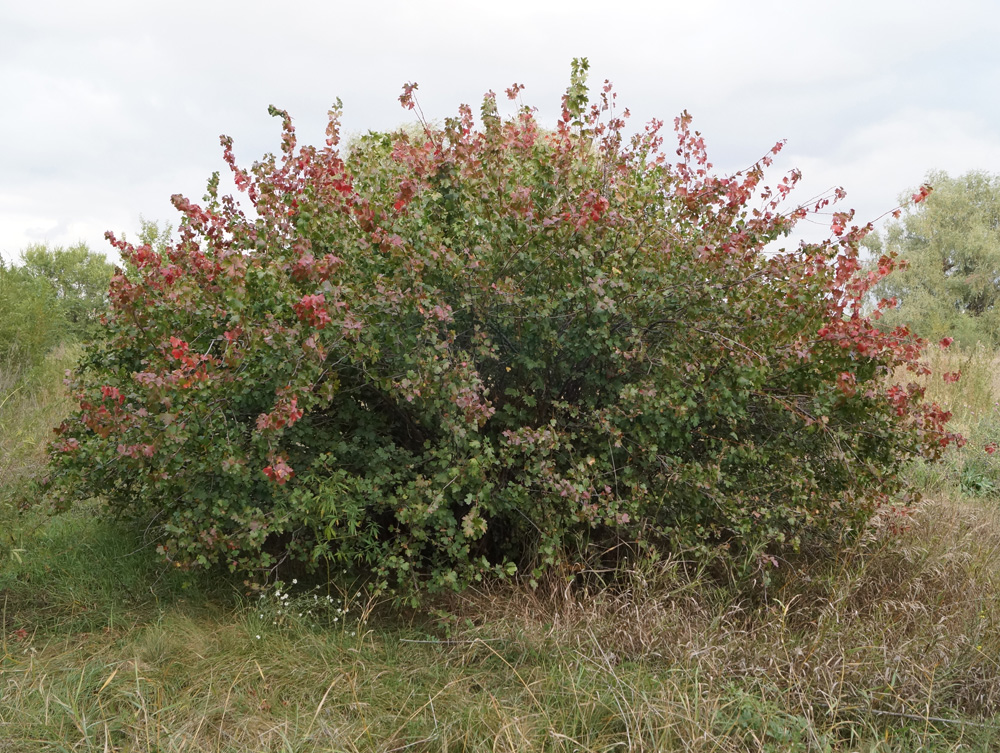
Ribes aureum. Photo T. Rib
Members of the genus are deciduous, less commonly evergreen, shrubs. Perennial underground stems annually produce vegetative shoots, which branch the following year and become reproductive. Stem lifespan is 4–8 years. Some stems are covered with spines, prickles or bristles. Spines are small cork outgrowths, growing 1–3 (5) per node of stems beneath leaf bases; smaller spines cover the rest of the stems. Stems are often covered with simple or glandular hairs.
Leaves are alternate, mostly palmately lobed or palmately divided, cut into three to five (seven) lobes, with toothed or crenate margins, often glandular, especially on the underside of the leaf. No stipules.
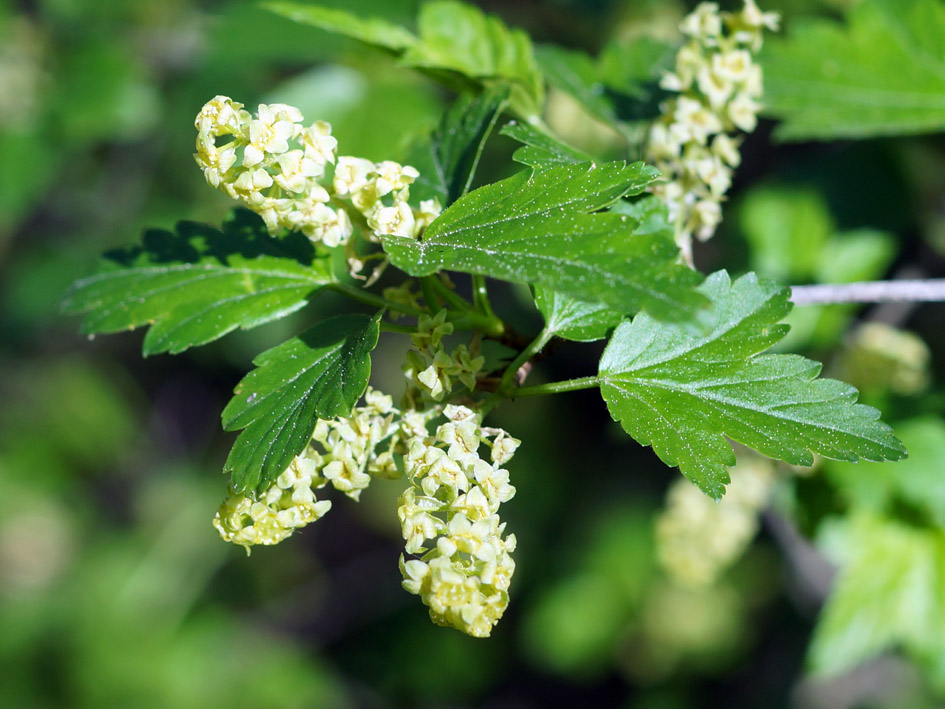
Ribes alpinum. Photo G. Chulanova
Flowers are arranged in racemes, small, up to 0.8 cm in diameter, green or greenish-white, solitary within few-flowered or many-flowered, erect or nodding racemes. Pedicels with bracteoles. Flowers are 5-merous, more rarely 4-merous, actinomorphic, bisexual, more rarely unisexual. Calyx 5-parted, more rarely 4-parted, divided nearly to the base, often petal-colored. Sepals are spreading, more rarely reflexed, considerably larger than the petals. Petals free, very small, often scale-like. Stamens 4 or 5, alternating with the petals. Gynoecium formed from 2 carpels. Ovary 1-loculed, inferior. Styles 2. Flowers in April–May.
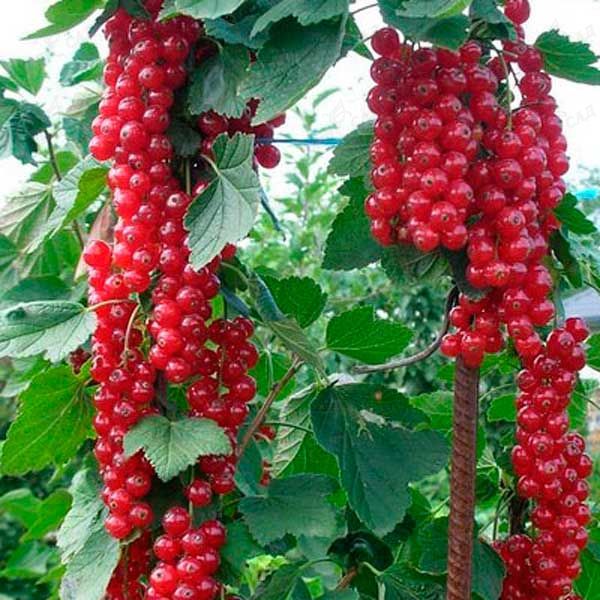
Fruits – juicy, many-seeded, with a dried calyx at the top; in currants they are globose and smooth, in gooseberries broadly ovoid, glandular-hairy or bristly. Fruiting in August.
Species:
- Ribes aciculare Sm. — spiny gooseberry
- Ribes alpinum L. — alpine currant
- Ribes altissimum Turcz. ex Pojark. — tall currant, or chernokislitsa
- Ribes amarum McClatchie — bitter currant
- Ribes americanum Mill. — American currant
- Ribes aureum Pursh — golden currant, or buffalo currant
- Ribes bracteosum Douglas — bracted currant
- Ribes burejense F.Schmidt — Bureya gooseberry
- Ribes cereum Douglas — wax currant
- Ribes cucullatum Hook. & Arn. — hooded currant
- Ribes diacanthum Pall. — two-spined currant
- Ribes dikuscha Fisch. ex Turcz. — dikuscha currant, or Aldan grape
- Ribes fasciculatum Siebold & Zucc. — clustered currant
- Ribes fontaneum Bochkarn. — spring currant
- Ribes fragrans Pall. — fragrant currant
- Ribes gayanum (Spach) Steud. — Gaya currant
- Ribes glaciale Wall. — glacial currant
- Ribes glandulosum Grauer — glandular currant
- Ribes heterotrichum C.A.Mey. — variably-haired currant
- Ribes horridum Rupr. — bristly currant
- Ribes janczewskii Pojark. — Janczewski's currant
- Ribes komarovii Pojark. — Komarov's currant
- Ribes lacustre (Pers.) Poir. — lake currant
- Ribes latifolium Jancz. — broad-leaved currant
- Ribes laurifolium Jancz. — laurel-leaved currant
- Ribes malvifolium Pojark. — mallow-leaved currant
- Ribes mandschuricum (Maxim.) Kom. — Manchurian currant
- Ribes meyeri Maxim. — Meyer’s currant
- Ribes multiflorum Kit. ex Schult. — many-flowered currant
- Ribes nigrum L. — black currant
- Ribes niveum Lindl. — white currant
- Ribes orientale Desf. — eastern currant
- Ribes palczewskii (Jancz.) Pojark. — Palczewski’s currant
- Ribes pauciflorum Turcz. ex Pojark. — few-flowered currant
- Ribes petraeum Wulfen — rock currant
- Ribes procumbens Pall. — moss currant, or prostrate currant
- Ribes pulchellum Turcz. — pretty currant
- Ribes rubrum L. (type species) — red currant
- Ribes sachalinense (F.Schmidt) Nakai — Sakhalin currant
- Ribes sanguineum Pursh — blood-red currant
- Ribes saxatile Pall. — stone currant
- Ribes triste Pall. — sad currant
- Ribes ussuriense Jancz. — Ussuri currant
- Ribes uva-crispa L. — common gooseberry, or curly currant.
Hardiness zone: 4a

Location / Site: shade-tolerant, moisture-loving, but does not tolerate waterlogging and overwatering. Does not like heavy, clay soil; the groundwater level should not exceed 75 cm below the soil surface. Not demanding to soil fertility, grows well on any garden soil. Prefers slightly acidic, well-drained, sandy or light to medium loam soils. Preferably planted in an open, well-lit location.
Planting: planting is carried out in August. For this, beds or trenches are dug and bushes are planted at a distance of no less than m from each other (otherwise bushes will shade each other and the berries will be small). The soil mix consists of soil and manure. After planting in dry weather, plants are watered at a rate of 1 bucket per bush.
Pruning: tolerates trimming well, suitable for forming hedges and borders. Needs thinning (removal of old stems). Pruning is done in spring: young shoots are shortened by 5–6 buds and old ones are removed. Each bush should consist of 10–15 stems. Old branches are removed because large berries grow on 3–5-year-old stems.
Propagation: propagated mainly vegetatively (division of the bush, grafting, green cuttings, vertical or horizontal layering) or by seed. For vertical layering, bushes are heavily pruned almost to soil level in spring; in July young shoots are earthened. In autumn young shoots are planted in a nursery. For horizontal layering, rooted shoots are left until next spring, then bent down, earthened and separated from the parent plant in autumn. For growing in standard (single-stem) form, plants are grafted onto golden currant. With seed propagation, seeds are sown immediately after collection or in spring after 2–4 months of stratification. After sowing, in the first year plants grow to a height of 20–40 cm.
Diseases and pests: powdery mildew, rust, aphids, mites, sawflies, clearwing moths.
Uses: attractive for their habit, foliage and ornamental fruits; some species have attractive decorative flowers. Used for solitary and group plantings on lawns, for creating borders, edges, free-growing and clipped hedges. Low-growing forms look effective on rock gardens and as groundcover under deciduous trees. Fruits of some species are eaten and used for making compotes, jams, jellies, pastilles, marmalade, or for freezing. A melliferous (honey) plant.