
Fruit trees
Pear
Pyrus L.
Pear (lat. Pýrus) - a genus of fruit trees that belongs to the family Rosaceae. The name "hruša" first appears in sources in the 12th century; before that the name "dula" from the Polish word "dula" was used.
Pears were first cultivated in Greece as early as 1000 BC.
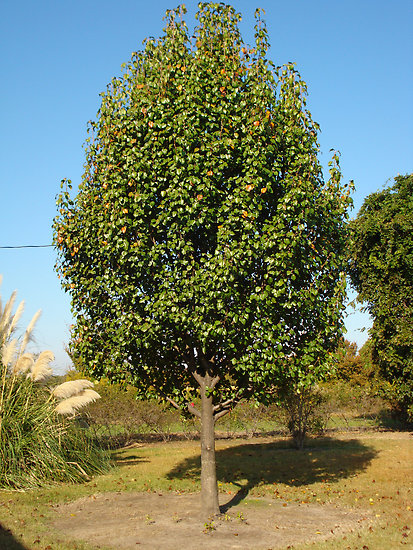
Pear – a deciduous tree of medium height (5-6 m) and 5 m in diameter with a pyramidal or rounded dense crown. Branches are thin, drooping, with spines; young shoots have a white-woolly pubescence. The root system is deep, vertical, sparsely branched, and the horizontal roots - parallel to the soil - are strongly branched.
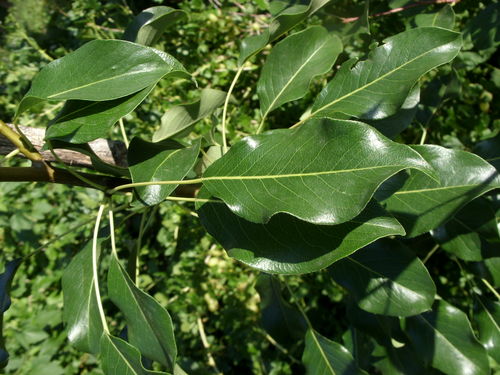
Leaves are narrow-lanceolate, silvery, dark green; the underside of the leaf is bluish-green, turning gray-green by autumn, up to 2.5-10 cm long with a width of 1 cm, arranged spirally, shortly acuminate.
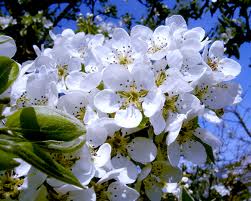
Blooms in April-May; flowers are small, 3 cm in diameter, white, five-petaled, 3-9 in umbel-like inflorescences.
Buds are vegetative and generative. Vegetative buds are smaller and sharper; generative buds are larger and blunter.
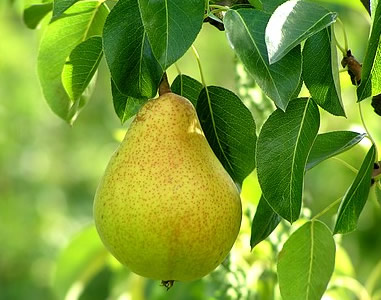
Fruits are elongated, widening in the lower part. There are also cultivars with round fruits. The fruit cavities have a dense lining (nutreplodnik).
Chemical composition of the fruits. Pear contains a large number of substances necessary for humans: proteins, carbohydrates, fats, organic acids (contains more folic acid than currants), starch, enzymes, tannins, flavonoids and phytoncides, essential oils. Low in calories, high in vitamins – A, C, E, PP, H, K, B-group vitamins, beta-carotene. Minerals: magnesium, sodium, calcium, chlorine, sulfur, phosphorus, iron, zinc, iodine, phosphorus and many others.
Varieties: more than 5,000 varieties are known, propagated by seeds and cuttings. The most well-known: Lyubimitsa Klappa, Lada, Nektarnaya, Chizhovskaya, Bere Moskovskaya, Otradnenskaya.
Hardiness zone: 5

Planting: plant seedlings preferably in spring, but autumn is also possible. Pear seedlings generally have a poorly developed root system, so for the first 2 years the pear practically does not grow. The soil from the hole should be mixed with organic and mineral-potassium fertilizers. Fill the mixture to the edge of the hole. The root collar should be left 3 cm above ground level.
Diseases and pests: the most common diseases are scab, fruit rot, sooty mold, rust, powdery mildew, pear gall mite.
Uses: fruits are used fresh, for canning and for drying. The wood is used for small crafts.