
Fruit trees
Callery Pear 'Chanticleer'
Pyrus calleryana Chanticleer
Synonyms: Cleveland Select, Chinese pear Chanticleer, urban pear Chanticleer, Select, StonChanticleere Hill, Glen’s Form, wild Chinese pear Chanticleer.
\r\nCallery pear Bradford (Pyrus calleryana Bradford) – one of the best cultivars of Callery pear currently available in cultivation. The cultivar was discovered in 1950 on the streets of Cleveland (Ohio). Commercially introduced by the Scanlon nursery in the USA in 1959. Plant patent PP2,489 was issued on 23.03.1965.
\r\n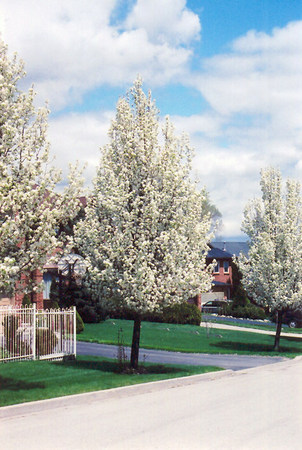
It is a small tree reaching 11 m in height and 6 m in width. Crown dense, narrow, conical, in maturity more open, pyramidal. Shoots without thorns. Bark when young smooth, with numerous lenticels, light brown to reddish-brown, later becoming grayish-brown with longitudinal fissures.
\r\n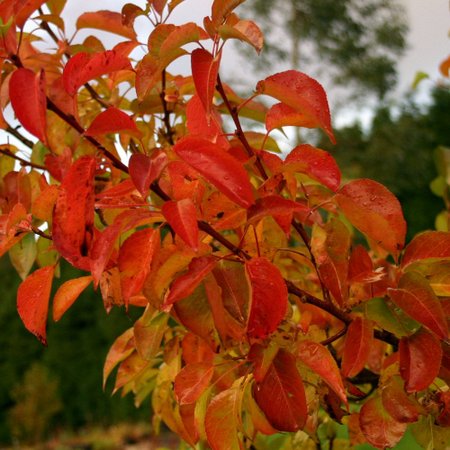
Leaves rounded or ovate, 8-12 cm long and 8 cm wide, glossy, dark green. In autumn they become yellow-red-crimson, which appears in November, and they fall after the first frosts.
\r\n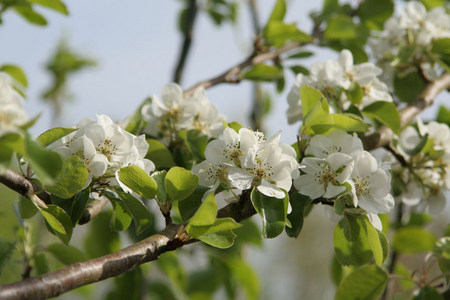
Pollination is cross. Blooms abundantly in April–May, before leafing. Flowers white, five-petaled, gathered in corymb-like inflorescences, with an unpleasant scent. Abundance of flowering depends on the region of growth.
\r\n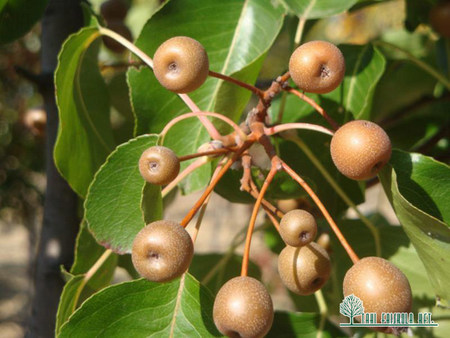
Fruits are of little ornamental value, up to 12 mm in diameter, light brown in color, inedible.
\r\n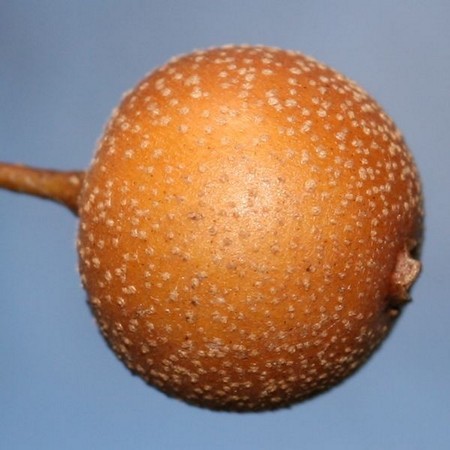
Hardiness zone 5a. Less susceptible to early frosts than other Callery pears.
\r\n
Location: grows well in sunny positions but can also tolerate partial shade. Prefers moist, well-drained fertile soil. However it can grow on any soil, including acidic or alkaline. Optimal pH level >7.5. Resistant to urban conditions, heat and drought, not harmed by limited space. Susceptible to windthrow, and may also be damaged during heavy snowfall. Can tolerate short-term flooding.
\r\nPruning: the crown is less prone to windthrow and breakage from ice than other members of the species. Sanitary pruning in early spring is recommended.
\r\nPlanting: planting is best done in autumn.
\r\nDiseases and pests: resistance to diseases and pests is very high. Quite rarely affected by bacterial fire blight.
\r\nPropagation: propagated by cuttings and seeds
\r\nUses: Ornamental due to its attractive narrow crown and abundant flowering. Used in solitary plantings, as a specimen, a small street or shade tree. Looks good in groups and avenues.
\r\n