
Fruit trees
Callery pear 'Bradford'
Pyrus calleryana Bradford
Synonyms: Kellery Bradford, Urban Bradford, Chinese Bradford pear, Callery pear Bradford
Callery pear 'Bradford' (Pyrus calleryana Bradford) – a cultivar of Callery pear. It was obtained by selection at the U.S. Plant Introduction Station (Glenn Dale, Maryland, USA). It was introduced into Europe in 1908.
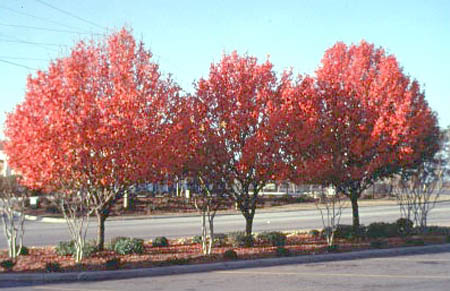
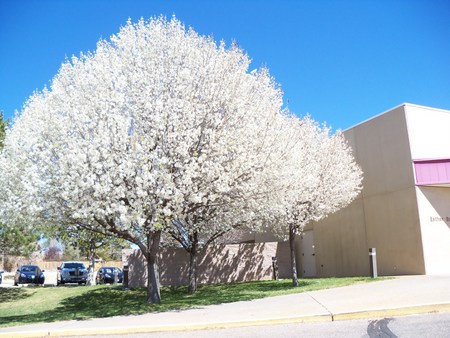
It is a tall tree up to 12 m in height and 9 m in diameter. Growth rate is moderate when young, later accelerating. Crown dense, pyramidal, symmetrical, widening with age. Branches are arranged vertically, close to each other. Bark dark gray-brown, smooth, becoming fissured with age. Lifespan up to 25 years. Thorn-like shoots of the wild form are absent.
Leaves glossy, broadly oval, dark green, with a slightly crenate margin, borne on long petioles. In autumn they turn orange-red, yellowish-red or purple.
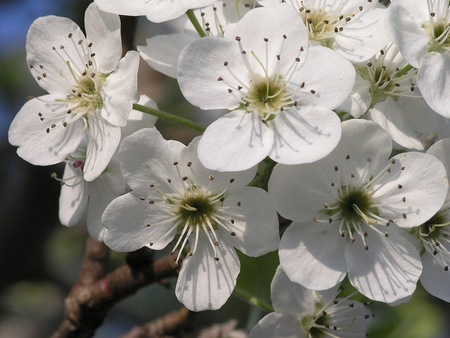
Blooms abundantly in late March to early April. Flowers cream-white, small, five-petaled, arranged in corymb-like inflorescences. Fruits are of little ornamental value, up to 1.5 cm in diameter, light brown, inedible, and remain firm until the first frosts.
Hardiness zone 5a. Flowers may be damaged by early frosts.

Location: grows well in sunny positions but can also tolerate partial shade. Prefers moist, well-drained fertile soil. However, it can grow on any soil, including acidic or alkaline. Optimal pH level >7.5. Resistant to urban conditions and drought, not affected by limited space. Susceptible to wind damage and can also be harmed during heavy snowfalls. Can tolerate short-term flooding.
Pruning: requires formative pruning to reduce susceptibility to wind damage and to thin the crown.
Planting: planting is best carried out in autumn.
Pests and diseases: resistance to pests and diseases is very high. Quite rarely affected by fire blight.
Propagation: propagated by cuttings.
Uses: used as a rootstock for pears Comice, Bosc, Seckel and Nashi. Also widely used as a pollen donor in pollen gardens and in breeding programs to develop pears resistant to fire blight. The wood has a very beautiful grain. It is used to make wind instruments and veneer for furniture. In landscape design it is used in solitary and group plantings and for creating avenues.