
Fruit trees
Peach
Prunus L.
Peach (lat. Prúnus pérsicas – Persian plum) - a fast-growing medium-sized deciduous tree of the Rose family (Rosaceae), subgenus Almond, 3-5 m tall with a rounded crown. It is widespread in warm areas of Eurasia with a temperate climate and in America. The root system is close to the surface, most of it at a depth of 20-50 cm.
Leaves long, lanceolate with a serrated margin.
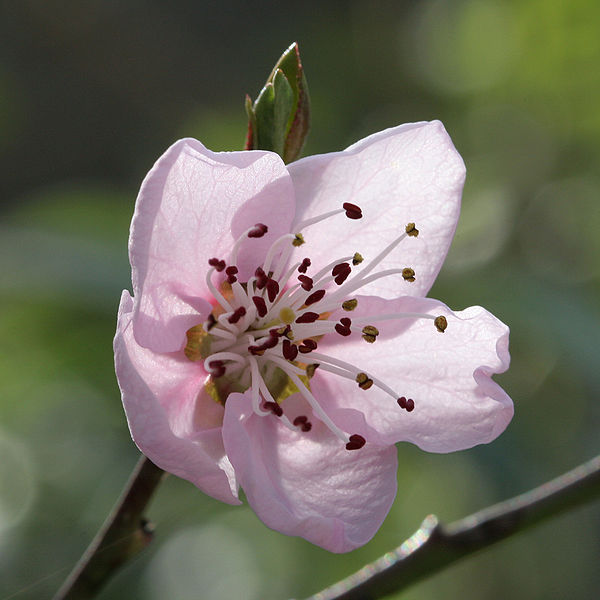
Blooms before the leaves unfold; flowers nearly sessile, pink or red. Flowers are more frost-hardy than those of the apricot. Large flowers occur in early-ripening peach varieties, medium and small flowers in later ones.
The peach is self-fertile, but gives the best yields when planted with other varieties.
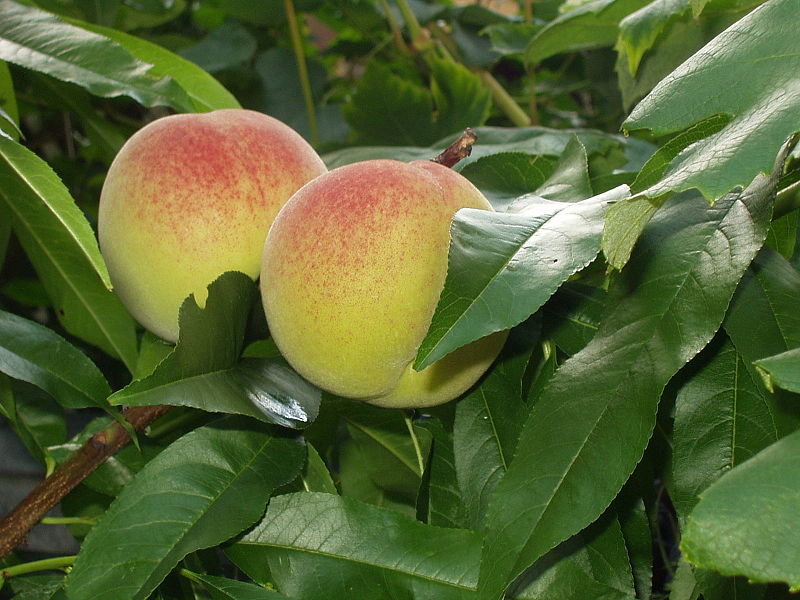
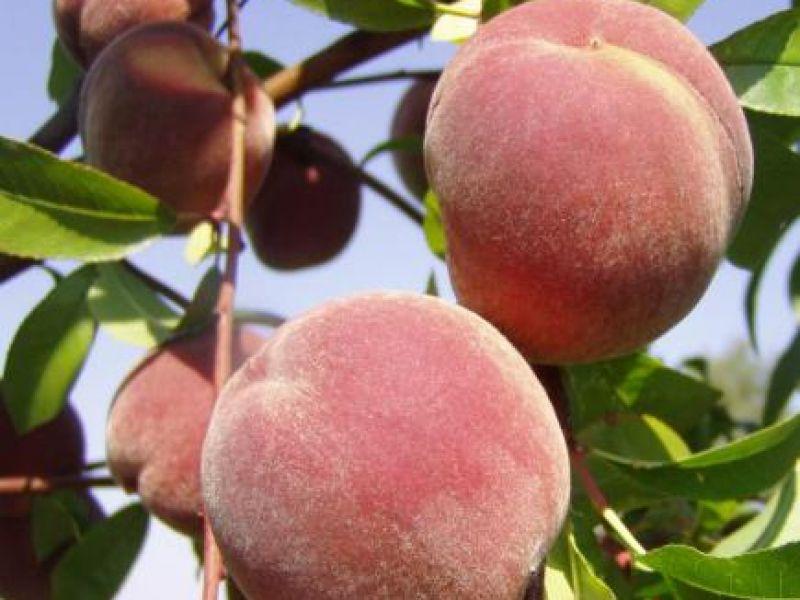
Fruits grow on mixed shoots, on fruiting or bouquet spurs. Begins to bear fruit in the 2nd–3rd year. The useful life of the tree is short – 12–15 years. Fruit shape ranges from flat to oblong-elliptical, often with a groove on one side. Skin velvety or smooth (nectarine), yellow-green, yellow, yellow-red or red. Flesh juicy, fibrous, sweet, yellow, whitish, yellow-red or red. Stone large, with deep grooves. Average fruit weight about 200 g, sometimes 400–500 g. Fruits ripen from mid-June to early October. Fruits will be tastier if picked 2–3 days before full ripeness and stored for a short time.
Not frost-hardy. Not recommended to grow in locations where the temperature drops below -23 degrees Celsius. Has increased drought and heat tolerance.
Varieties: Гринсборо, Днепровский, Киевский ранний, Княже злато, Редхевен, Лесостепной, Солнечный, Фаворит Моретини, Памяти Шевченка, Донецкий желтый, Подарок Киева, Золотая Москва, Памяти Родионова, Вайн Голд, Харнас, Веллинг, Вардени, Сказка, Флемин Фьюри, Топ свит.

Location: heat-loving, requires sunny and sheltered from wind locations. Requires moderate watering, especially during fruit set and ripening. Prefers light, loamy and sandy loam calcareous soils with moderate moisture.
Planting: planting is recommended in spring, but can also be done in autumn (in which case mulching the trunk circle and mounding to a height of 20-30 cm is necessary). The planting hole should be at least 0.7x0.7 m, planted on a 4x4 m scheme. 10 kg of well-rotted manure and 150 g of superphosphate are mixed with soil and used to backfill the seedling with its roots spread out. The trunk circle should be compacted to the edges, well watered (4-5 buckets) and mulched with a layer of compost to a depth of 8-10 cm.
Diseases and pests: diseases – powdery mildew, leaf curl, clasterosporiosis, fruit rot, moniliasis (brown rot), Cytospora dieback of shoots and branches. Pests – plum and oriental fruit moths, fruit striped moth, large and green peach aphids, fruit and spider mites.
Care: requires moderate watering and formative pruning. To improve yield, the improved vase pruning method is used. After planting the seedling, all lateral branches should be removed. Leave 3-4 scaffold branches spaced 10-20 cm apart. The leader should be cut at the base of the upper lateral branch. In the second year, shorten first-order branches if they are longer than 50 cm or change their growth direction. In subsequent years pruning should be directed toward fruiting. Rejuvenation pruning is carried out from bud swell to the beginning of flowering. If frost damage occurs, pruning is done after the appearance of water sprouts on trunks and branches.
Propagation: seedlings are grafted onto a variety of rootstocks. For dry, sandy and chernozem soils, apricot rootstocks have proven best; for wet acidic soils – cherry plum (alycha), blackthorn (sloe) and plum rootstocks.
Uses: fruits are consumed fresh, used for canning, making liqueur, marmalade and juice. Peach oil is obtained from the seeds.