
Fruit trees
Plum
Prunus L.
A well-known garden plant familiar from childhood. At the same time, it is one of the most sought-after trees on plots. Such a tree does not require meticulous care and produces fruit almost every year. However, cold winters are enemies of the plum harvest, and fruit buds can freeze because of frost. Do not rush to saw down a plum if it does not give a satisfactory yield. Perhaps after some time plum varieties will begin to bear fruit. Thus, plum varieties are very diverse in taste, color and ripening time. It is important not to make a mistake when choosing a variety.
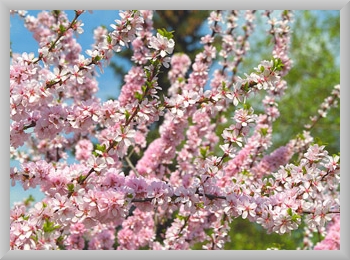
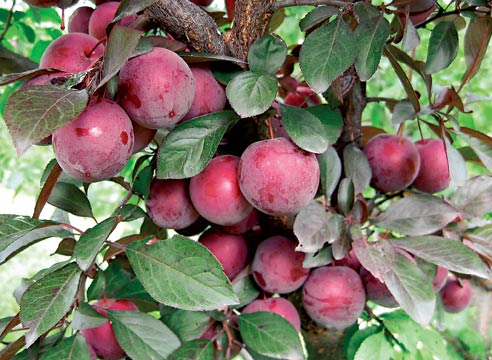
The Chinese plum appeared in our gardens about 10 years ago. It is native to China and is sometimes called Japanese. This plum grows in Russia (the Ussuri krai) and, accordingly, in China. It has beautiful elongated leaves, the tree itself is very compact and does not grow over 2 m. It blooms in spring, producing bright numerous flowers. It's not surprising that in Japan there is even a Day for admiring the plum tree. The plum, like currant, is very productive; its large colorful fruits (purple, red, yellow) hang on branches that often cannot withstand the weight and break off, falling to the ground. With a large harvest the tree should be supported.
The early-bearing or Russian plum is the most popular variety. It has even more advantages and rarely suffers from diseases. This tree bears red fruits whose skin tastes slightly bitter. In turn, yellow plums are always sweet and fragrant. The variety «златоскифов» is very large and tasty. The «Дынная» plum tastes like melon. «Сеянец ракеты» is an unusually frost-hardy variety. «Июльская роза» is a variety that bears fruit in July. In general, plums are quite undemanding. Amateur gardeners classify the Ruth Gershteter variety as an early one; its fruits ripen in early July. These are medium and large fruits, ideal for making juices and compotes.
Late plum varieties, in order of ripening, include: Ренклод Альтана (has large fruits, resistant to drought and diseases), Изобилие and София-2 (ripen in August, have large fruits, resistant to diseases), Нансийская мирабель (ripens in August, suitable for making compotes). When pruning plums you need to consider two main points: the desired growth form you intend to give the plum, and reducing the risk of disease infection (gummosis or white rot). To reduce the risk of disease, it is advisable to prune the plum tree in spring or summer, that is, when the air temperature is stable.
This approach has a beneficial effect on the wounds inflicted on trees during the pruning procedure. Cuts should be as neat as possible so that the wood is not damaged. It is recommended to treat cut or saw sites with garden pitch, and to burn diseased and dried branches.
A genus that includes about 200 species, most of which are found in temperate zones. These are deciduous trees or shrubs; evergreen cherry laurels are an exception.