
Deciduous trees
Almond
Prunus dulcis (Mill.) D.A.Webb.
Synonyms: Amygdalus communis L., Amygdalus dulcis Mill., Amygdalus fragilis Borkh., Druparia amygdalus Clairv., Prunus amygdalus Batsch, Prunus communis (L.) Arcang., badam
Almond (Prunus dulcis (Mill.) D.A.Webb.) – a species of the subgenus Almond (Amygdalus) of the genus Plum (Prunus) in the family Rosaceae. The species was first described by the Irish botanist David Ellardis Webb in his «Feddes Repertorium. Zeitschrift für Botanische Taxonomie und Geobotanik. Berlin 74: 24.» in 1967.
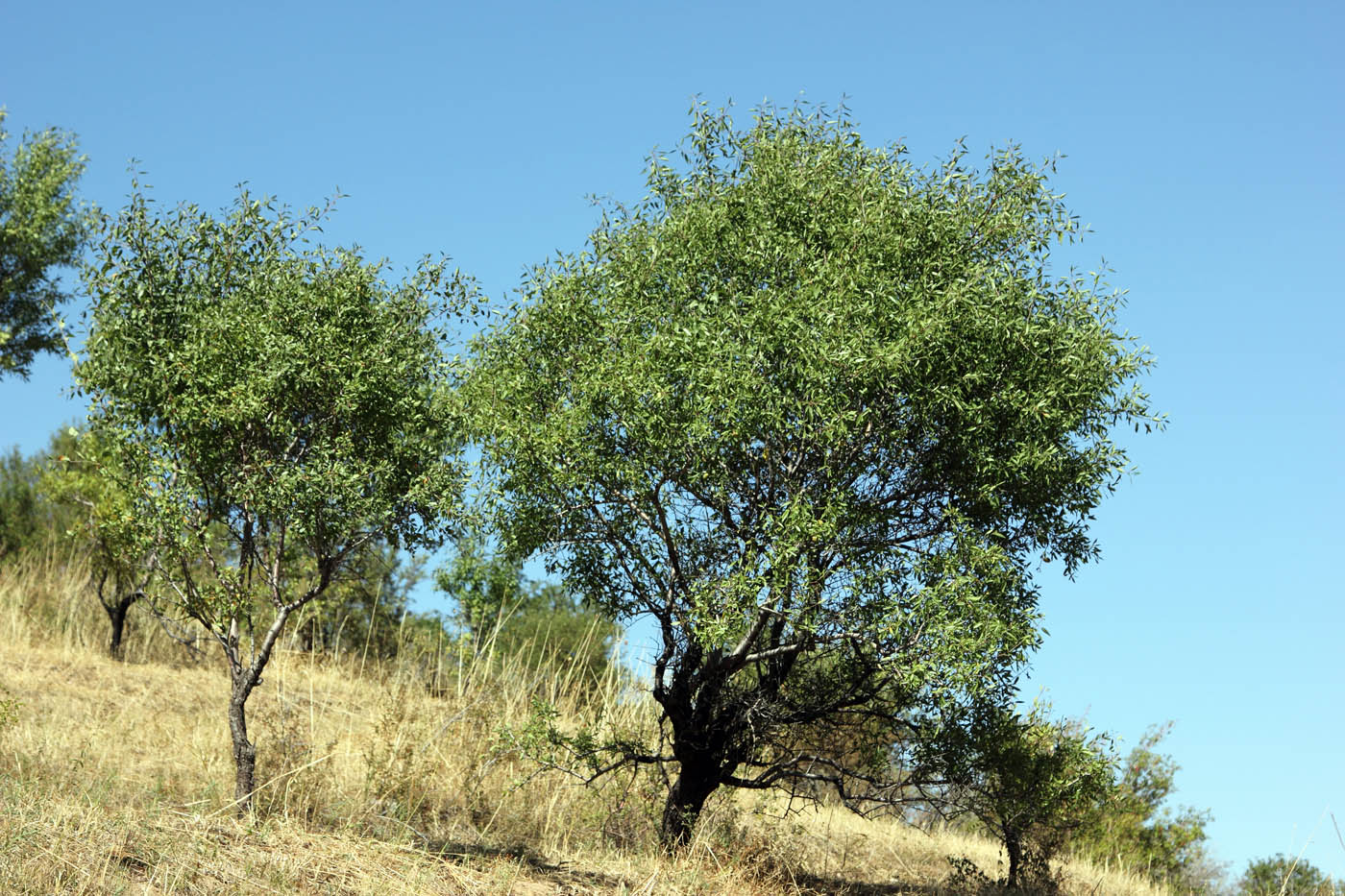
Photo A. Gaziev
In nature it is found in Western Asia, including the Mediterranean and Central Asia. It is cultivated in China, the USA (California), Central Asia, the Mediterranean, Kopet Dag, the Western Tien Shan, Crimea, the Caucasus, Tajikistan, Slovakia, and the Czech Republic. Grows on rocky and shingly slopes in small groups of 3-4 individuals, spaced 5-7 m apart. In the mountains it rises to 800-1600 m above sea level.
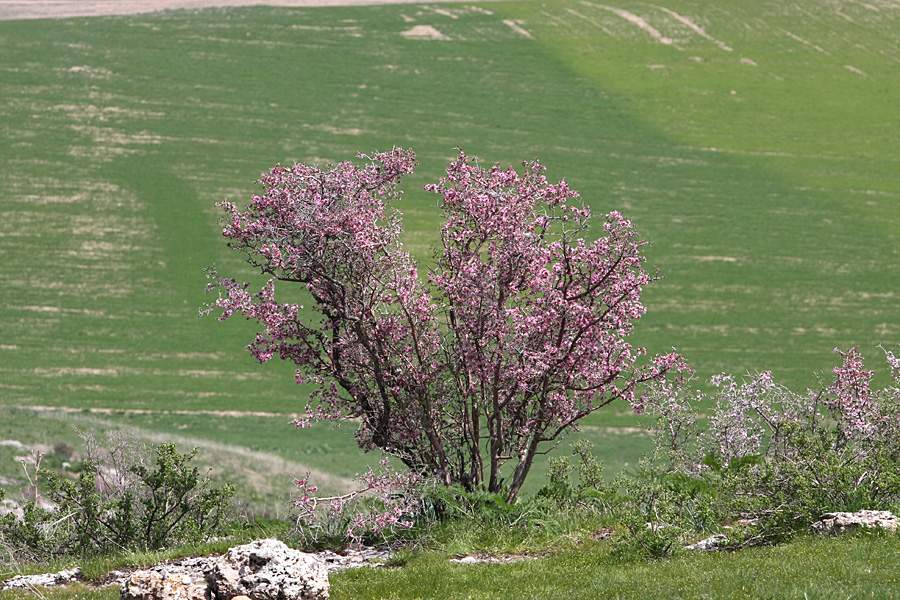
Photo E. Davkaev
It is a branched shrub or small tree 4-6 m high. Lives up to 130 years. Shoots of two types: elongated vegetative and shortened generative. The trunk of the tree can reach 30 cm in diameter. Young shoots are initially green, later acquiring a purple tint. Branches gray.
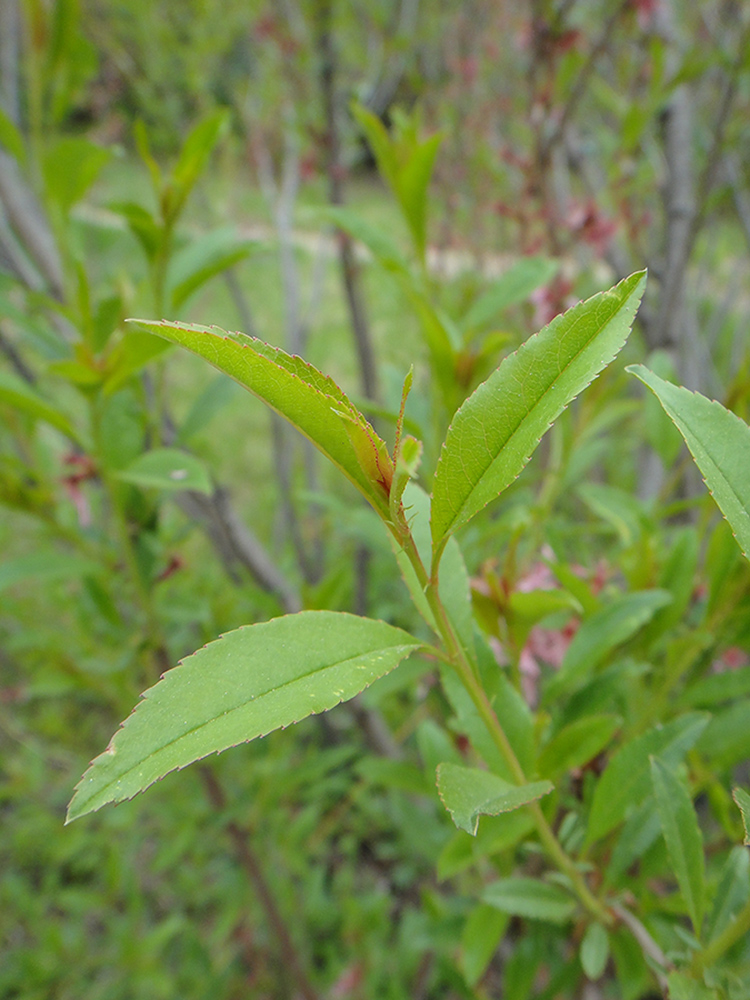
Photo E. Bayandina
Leaves alternate, simple, lanceolate, petiolate, serrated at the margin, apex long and pointed, 7.5-20 cm long. Petiole up to 2.5 cm long.
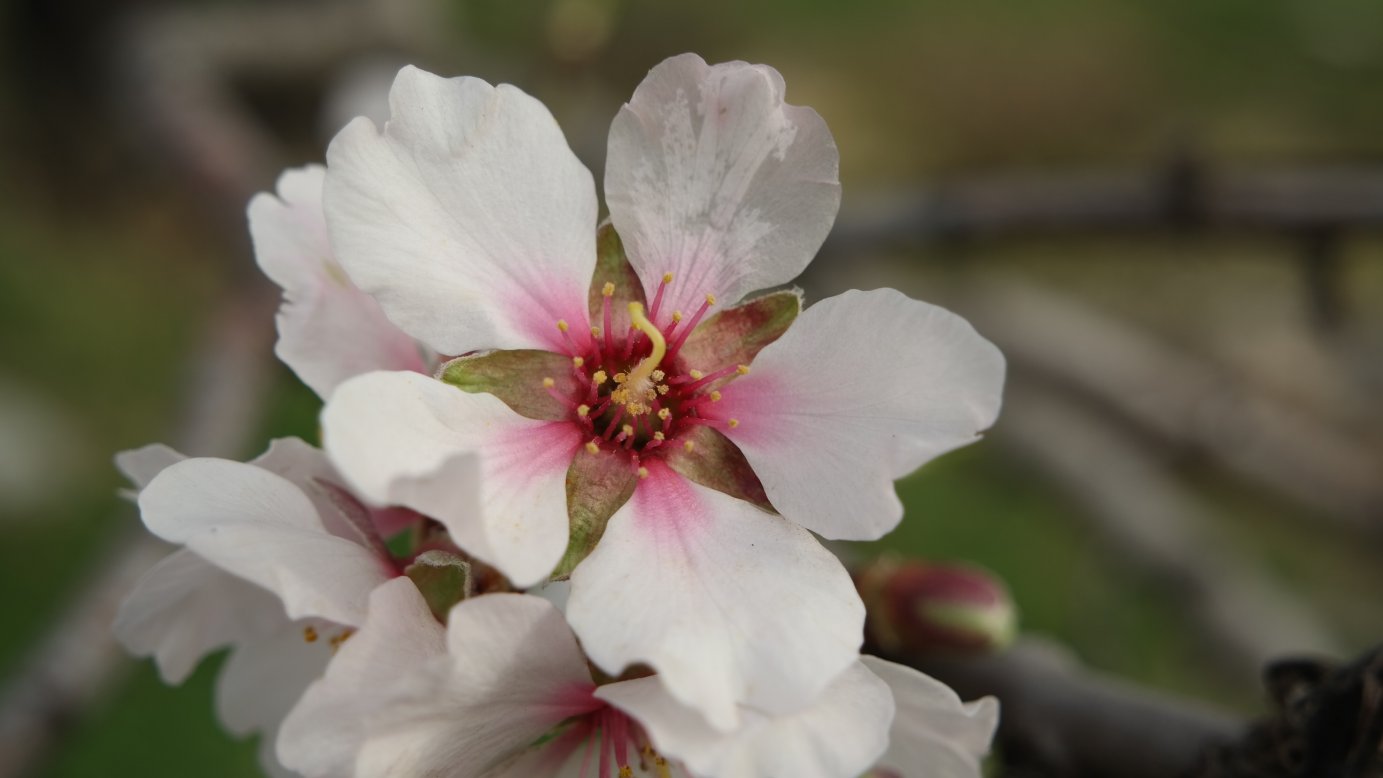
Photo L. Saplitskaya
Flowers borne singly, up to 2.5 cm in diameter, with 5 petals; they are white or light pink. Stamens numerous, pistil 1. Calyx cup-shaped, with fused sepals, corolla pink or red. Blooms in March-April (in some places in February).
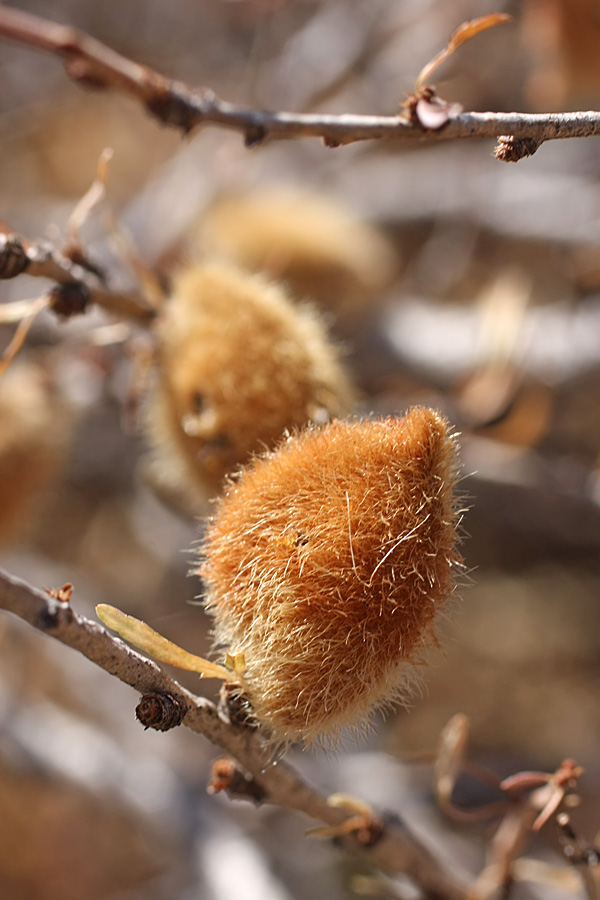
Photo E. Davkaev
Fruits – dry, velvety-pubescent drupes with a single stone. The pericarp is leathery, fleshy, inedible, green. The dry mesocarp easily separates from the stone. The kernels are covered with small pits, less often grooves, 2.5-3.5 cm long and weighing 1-5 g. Begins fruiting in the 3rd year after planting; yields from 4-5 years, for 30-50 years. Fruits ripen in June-July. Yield 4-5 kg per tree.
Varieties:
- Prunus dulcis var. amara — bitter almond
- Prunus dulcis var. dulcis — sweet almond
Subspecies: includes about 40 subspecies.
Hardiness zone: 4a (-25°C)

Location: Choose a sunny site sheltered from strong cold winds. Not demanding to soil, but grows best on fertile, loose, light-textured soil with good drainage. Does not tolerate heavy, acidic, clayey waterlogged soils with shallow groundwater.
Planting: Planting is recommended in autumn or a warm winter. To obtain a crop it is necessary to plant 3-4 almond varieties. Planting hole size: depth 50 cm, diameter 50-70 cm. Before planting add organic fertilizer with superphosphate (5-6 kg of well-rotted manure and 0.5 kg of superphosphate). After planting water the seedling (10-15 L per plant).
Care: In dry periods requires additional watering – 10-15 L per plant. Loosen the soil to a depth of 8-10 cm. In May - the first half of June you can apply 150-200 g of ammonium nitrate under each plant during watering. If growth is weakened, mineral fertilizers can be applied as top dressings per plant: nitrogen - 0.1 kg, phosphorus - 0.2 kg, potassium - 0.1 kg.
Pruning: Requires crown thinning. Form the crown in the 2nd year after planting. Determine the height of the trunk (stem) and cut all shoots below this height flush to the ring. From shoots located above the first branch form the crown using the alternate-leader system. The second scaffold branch is formed from a shoot directed opposite to the first and located 10-20 cm above it; the third scaffold branch is formed from a shoot located 10-20 cm above the second and growing perpendicular to the lower two branches, i.e. occupying the space between them. The fourth is from a shoot that departs from the trunk opposite the third branch and is located 10-20 cm above it. All other shoots growing between the selected scaffold branches are cut flush to the ring. For forming scaffold branches choose the most developed shoots, which is why the vertical spacing of 10-20 cm is specified (within this range the most suitable shoots can be chosen). If unsuccessful in the first year to produce scaffold branches, cut the central leader to a height of 50-60 cm above the last scaffold branch. In subsequent years the crown should be thinned.
Propagation: by seeds, root suckers, stump shoots. To preserve cultivar characteristics use budding of a vegetative bud onto a rootstock. Bitter almond is used as rootstock. Sow seeds in furrows 8-10 cm deep at 10-12 cm apart. Distance between furrows 45-50 cm. Seeds germinate the following year in April. When seedlings grow to 50-60 cm in height, cut the lower lateral branches at 10-12 cm from the soil with secateurs flush to the ring. By mid-July the stem thickness reaches 0.8-1 cm. One-year almond seedlings are budded with a vegetative bud cut with a shield from a one-year shoot of the selected cultivar. Budding is carried out in cool times of the day: early morning or after 16:00. To avoid moisture loss all leaves from cut shoots are removed, leaving petioles up to 1 cm long.
Diseases: gray rot, moniliosis and rust.
Pests: leafroller, plum fruit moth, aphids and plum bark beetle.
Uses: early-spring melliferous plant. Used as a drought-tolerant rootstock for peaches and apricots. Decorative soil-protecting plant. Seeds are used for food.