
Fruit trees
Double-flowered Bird Cherry
Prunus avium 'Plena'
Synonyms: Prunus avium 'Grandiflora', Prunus 'Avium Flore Plena', Double White Cherry, Double flowered Wild Cherry, 'Multiplex'
Double-flowered bird cherry – a beautiful form of bird cherry (sweet cherry) from the family Rosaceae. It has been cultivated for more than 200 years. The form was awarded the Royal Horticultural Society's prestigious Award of Garden Merit (AGM).
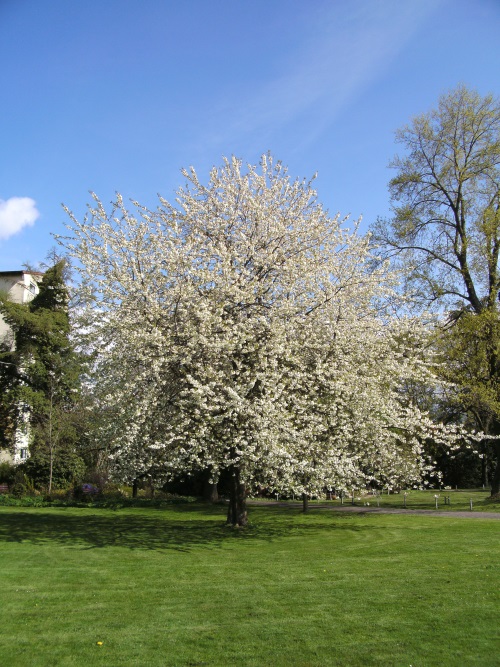
It is a small tree 8-15 m in height and 4-6 m in width. Crown rounded, closed. Bark glossy, brown-red, smooth when young, later becoming ring-fissured with horizontal lenticel markings. Branches are slightly pendulous. Flower buds spherical.
Root system shallow, with strong main roots.
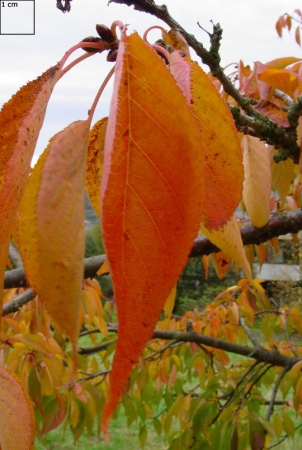
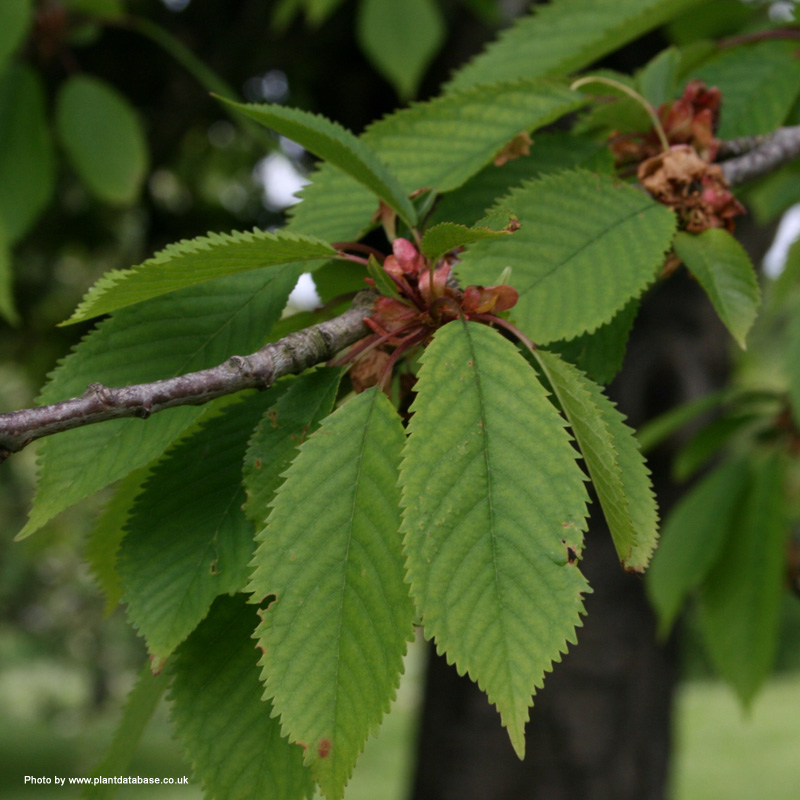
Leaves alternate, broadly elliptic, with a slightly serrated margin, up to 15 cm long, glossy, reddish-brown when unfolding, green in summer, turning yellow-orange or crimson in autumn.
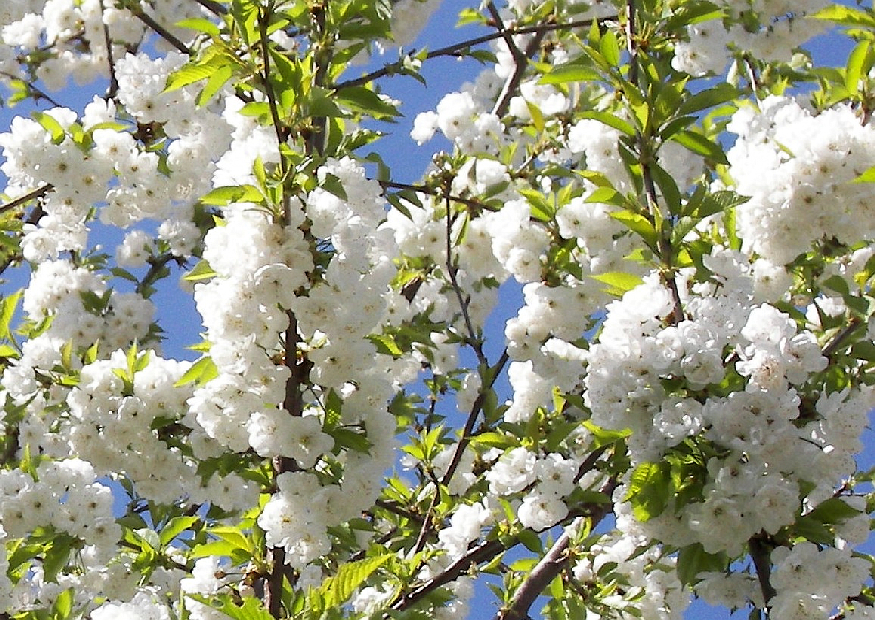
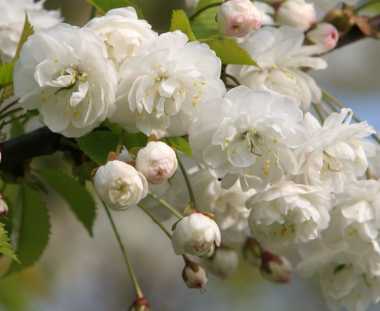
Blooms profusely in April-May. Flowers snow-white, double, resembling small roses, 2-3 cm in diameter, borne 2-5 together in pendent inflorescences. Flowers appear together with the leaves. Blooms about a week longer than bird cherry. Does not bear fruit.
Hardiness zone: zone 5b (-25°C)

Location: can grow in sun and shade. Prefers neutral or slightly alkaline, fertile soil with good drainage. Resistant to urban
Planting: planting is recommended in spring. Before planting, the soil should be improved. The planting site should be dug to a spade depth and fertilizers added: manure or compost at 8-10 kg/m², superphosphate - 150-200 g, potassium fertilizers – 100 g or compound fertilizers – 150-200 g/m². Recommended soil reaction pH 6.5-7. It is also recommended to add fertilizers into the planting hole – 10 kg of humus, non-acid peat or well-rotted compost, and 500 g of ash. The hole should be dug and prepared 2 weeks before planting.
Pruning: from 2-3 years old pruning is necessary – remove suckers, lower branches to form the trunk, shorten the leader by redirecting to a lateral branch, and thin the crown. Pruning is carried out in early spring before bud swell.
Care: Care consists of regular pruning. In spring and autumn it is necessary to whitewash the trunks and the bases of the main branches. In autumn it is recommended to cover the trunks with fir boughs or other material to protect against rodents.
Diseases: coccomycosis, clasterosporiosis, moniliosis, brown spot, cherry shoot moth, gummosis, dwarfing, false polypore, mosaic disease, ring mosaic, dieback of branches, scab, sulfur-yellow bracket, Stecklenberg virosis.
Pests: brown fruit mite, cherry sawfly, cherry slug sawfly, cherry shoot borer, yellow plum sawfly, cambial borer, western bark beetle, gypsy moth, striped fruit moth.
Propagation: propagated by root or green cuttings
Uses: used for creating avenues, in parks, and also as a specimen tree on lawns.