
Conifers
Oriental spruce Aureospikata
Picea orientalis Aureospicata
Oriental spruce Aureospikata – one of the most ornamental cultivars of oriental spruce. The form was awarded the Royal Horticultural Society's prestigious Award of Garden Merit (AGM) in 1993. It was obtained in the nursery of H.A. Hesse in Wernher-von-Ems or in the nursery of P. Smith near Hamburg (Germany). In cultivation since 1873. According to some sources it arose in the Karlsruhe nursery (Germany) in 1890.
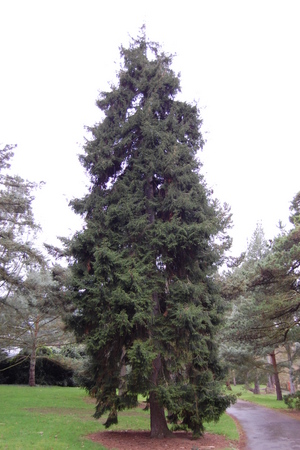
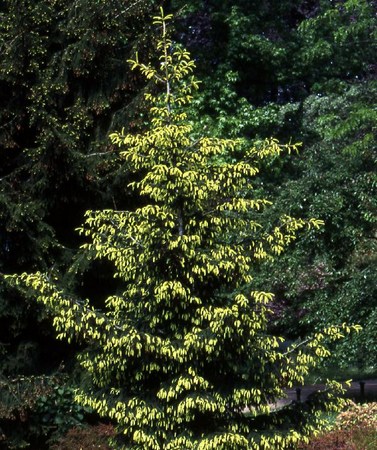
Picea orientalis ‘Aurea’ (09/02/2013, Kew Gardens, London)
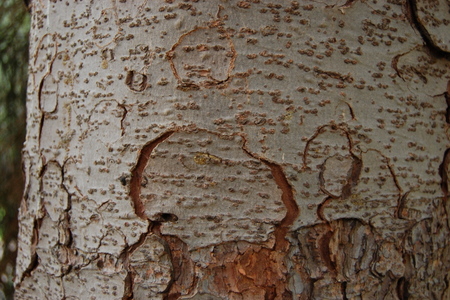
A medium-tall tree 10-12 (15-25) m in height with a broad, loosely conical, asymmetrical crown, reaching 4.5-5.5 (6-8) m in width. Trunk diameter reaches 1.5 m. Bark smooth and light brown when young, becoming fissured with age. Lateral branches hang down attractively. The plant is slow-growing, with an annual increase of up to 15 cm in height and 5 cm in width.
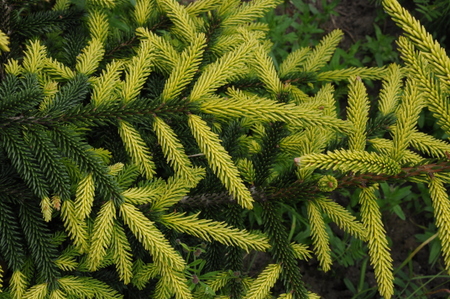
The foliage is acicular, short, up to 1 cm long, dark green and glossy. In spring the young needles are golden-yellow. During summer they acquire a green color, later becoming dark green.
Male flowers are red, ovate-rounded. Female flowers are purplish-violet, reaching 2-2.5 cm in length. Flowers in May.>
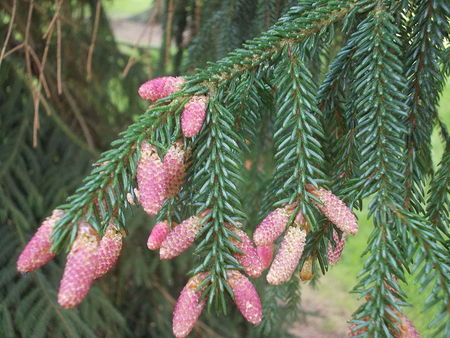
Cones cylindrical or ovoid, 5-8 cm long and 2-3 cm in diameter, purplish-violet.
Hardiness zone: 6a

Site: Prefers light, but can also grow in shade. Recovers well. Tolerance to urban conditions is moderate. Not demanding regarding soil fertility. Grows well on fresh, fertile soil with acidic or alkaline reaction. Prefers moist, well-drained soil. Needs protection from cold winds. Does not tolerate heat well.
Planting: Soil mix: turf and leaf soil, peat, sand in the ratio 2:2:1:1. Drainage is made from crushed brick, layer 15-20 cm. Recommended distance between plants – 2-3 m. Planting depth: 50-70 cm. Root collar at ground level.
Care: After planting you can apply 100-150 g of nitroammophos. In dry periods it is recommended to water at least once a week with 10-12 L per plant. Loosening is done to a depth of 5-6 cm, mixing the peat with the soil rather than removing it. Young seedlings need to be covered with conifer branches for the winter.
Pruning: does not require formative pruning.
Diseases: шютте, snow шютте, fusariosis, stem and root rot, bark necrosis, ulcerative (canker) disease, cone rust, еловый вертун.
Pests: spruce leafroller, spider mite, Sitka spruce aphid.
Propagation: cuttings and seeds.
Uses: used to decorate small landscapes and parks. Looks impressive as a specimen planting and in garden compositions