
Flowers for the garden
Peony
Paeonia L.
Synonyms: Moutan (DC.),
Peony (Paeonia L.) – the only genus of herbaceous perennial plants and deciduous shrubs in the family Paeoniaceae. The genus was first distinguished by Carl Linnaeus in 1753 in "Species Plantarum" p. 530. The genus name comes from the name of the physician of the gods Paean (Paieon, Peon) in Greek mythology, who healed Ares. According to another opinion, the name derives from the Greek name of a locality in Macedonia «paiōnia». The Latin name first appears with the ancient Greek philosopher Theophrastus.
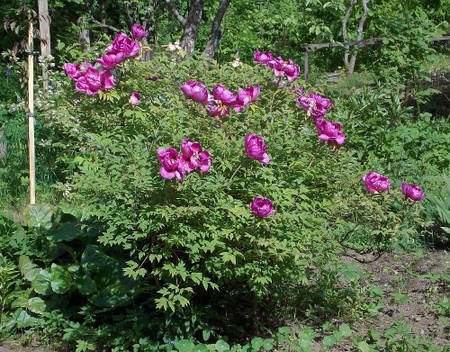
Tree peony (photo Lev Trofimuk)
In nature it grows in subtropical and temperate regions of Europe, Asia and North America. Shrub species originate from western China. In cultivation peonies have been known for about 2000 years. They were known in the ancient world of Europe and in Ancient China, where they were considered the imperial flower. The first interest in these flowers began as early as 200 BC during the Qin and Han dynasties. By the 6th century in China florists' catalogs already listed about 30 peony cultivars.
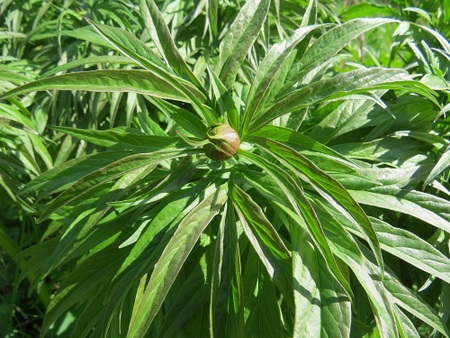
Paeonia anomala (photo Aleksey Malinovskikh)
Members of the genus are herbaceous perennials or deciduous shrubs and subshrubs with several stems up to 0.5-1 m high (shrubs can reach 3 m in height). The root system is powerful, roots large, thickened, tuberous.
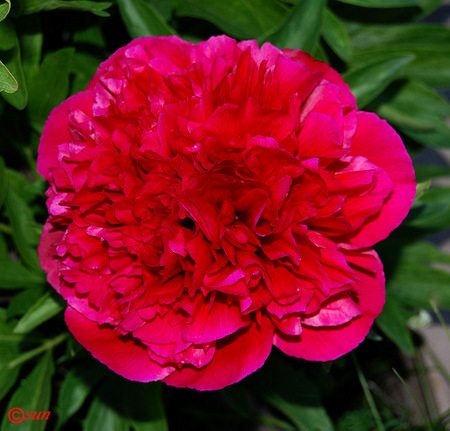
Paeonia lactiflora
Buds conical, scales few, overlapping like shingles. Leaves alternate, imparipinnately divided or ternate, lobes broad or narrow, dark green, more rarely glaucous. In autumn leaves acquire yellowish, brown, red or dark purple tones.
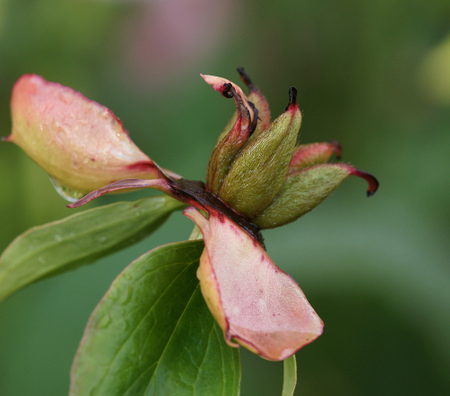
Paeonia lactiflora (photo Vitaliy Gumenyuk)
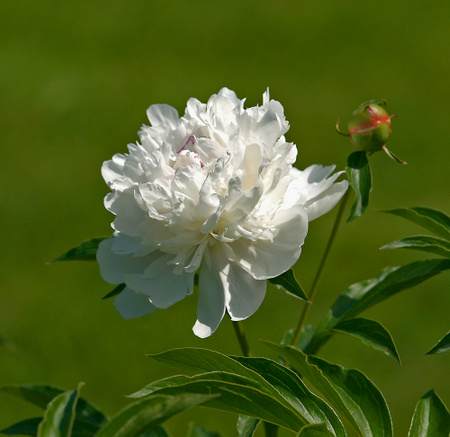
Flowers large, 15-25 cm in diameter, solitary, consist of a calyx and corolla. Calyx persistent, slightly leathery, consists of 5 dark green or reddish sepals. Petals 5, rarely more; they are larger than the sepals, broad, often notched at the tips, white, pink, red, cream or yellow, often with dark spots at the base, fragrant. Stamens numerous; pistils 1-8, borne on a fleshy disk.
Paeonia x moutan (photo Yuriy Pirogov)
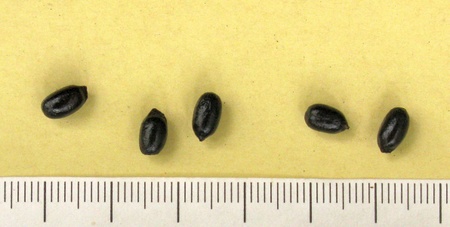
Fruits are compound follicles arranged in a star-like form, which open along a suture. Inside the follicles are seeds attached to the edge of the ventral suture. Seeds are large, round or oval, black or dark brown, shiny.
Species: (according to Wikipedia) the genus includes 32 species in 4 subgenera and 6 sections:
Subgenus Albiflora includes 1 species:
- Paeonia lactiflora Pall. — Paeonia lactiflora
Subgenus Moutan includes 10 species in 2 sections:
Section Delavayanae
- Paeonia delavayi Franch. — Paeonia delavayi
- Paeonia ludlowii (Stern & G.Taylor) D.Y.Hong
- Paeonia lutea Delavay ex Franch. — yellow peony
Section Moutan
- Paeonia decomposita Hand.-Mazz.
- Paeonia jishanensis T.Hong & W.Z.Zhao
- Paeonia ostii T.Hong & J.X.Zhang
- Paeonia ×papaveracea Andrews, hybrid of Paeonia jishanensis and Paeonia rockii
- Paeonia qiui Y.L.Pei & D.Y.Hong
- Paeonia rockii (S.G.Haw & Lauener) T.Hong & J.J.Li — Paeonia rockii
- Paeonia × suffruticosa Andrews — tree peony, or semi-shrub peony
Subgenus Onaepia includes 1 species:
- Paeonia brownii Douglas
Subgenus Paeonia includes 22 species in 4 sections:
Section Emodi
- Paeonia emodi Wall. ex Royl
Section Flavonia
- Paeonia mlokosewitschii Lomakin — Paeonia mlokosewitschii
- Paeonia wittmanniana Lindl. — Paeonia wittmanniana
Section Paeonia
- Paeonia anomala L. — Paeonia anomala, or the unusual peony, or Mary root
- Paeonia bakeri Lynch
- Paeonia broteri Boiss. & Reut.
- Paeonia clusii Stern
- Paeonia coriacea Boiss.
- Paeonia corsica Sieber ex Tausch
- Paeonia daurica Andrews — Crimean peony
- Paeonia hybrida Pall. — steppe peony
- Paeonia intermedia C.A.Mey.
- Paeonia mairei H.Lev.
- Paeonia mascula (L.) Mill.
- Paeonia obovata Maxim. — obovate peony
- Paeonia officinalis L. — medicinal peony
- Paeonia parnassica Tzanoud.
- Paeonia peregrina Mill.
- Paeonia rhodia Stearn
- Paeonia veitchii Lynch
Section Tenuifoliae
- Paeonia ×majko Ketsk.
- Paeonia tenuifolia L. — narrow-leaved peony
Cultivars: there are about 4,600 herbaceous peony cultivars and more than 500 tree peony cultivars. By flower structure cultivars are divided into: single ('Golden Glow', 'Nadya'), semi-double ('Legion Hancor'), Japanese ('Moon of Nippon'), anemone-type ('Longfellow'), double hemispherical ('Pearl Scatter'), rosette ('Robert Outen'), crown ('Kansas').
Hardiness zone: 4b (-23°C)

Location: prefer sunny, well-warmed sites. Can tolerate light shading at midday. In shade peonies will grow but not bloom. They require good air circulation, so it is recommended to plant them away from buildings, shrubs, or trees. Some species can grow under tree crowns (Paeonia lactiflora, Caucasian species and Paeonia anomala).
Soil: prefer cultivated loamy and slightly acidic soils with pH 6-6.5. On clay soils add sand; on sandy soils add 1.5 buckets of clay. On acidic soils it is recommended to apply 200-400 g of lime.
Planting: peonies should be transplanted and planted only in autumn. Prepare the planting site one month in advance. For this dig a hole 60x60x60 cm, fill it 2/3 with a mixture of humus or compost, peat, garden soil and sand in equal parts (approximately 1 bucket of each component). Add to the soil mix 250 g of double superphosphate or 500 g of bone meal, 1 tablespoon of iron sulfate, 1 teaspoon of potassium carbonate and a liter jar of wood ash. Fill the remaining space of the hole with ordinary garden soil. The soil in the hole will compact before planting. If you did not have time to prepare the hole in advance, it is recommended to tamp the soil mix and water it.
Care: after planting and for another 2 years foliar feeding is recommended. From mid-May once a month spray the leaves with a solution of complete mineral fertilizer. For better wetting of the surface you can add soap or laundry detergent to the solution (1 tablespoon per 10 L). Foliar feeding is carried out in the evening or in cloudy weather. Mature plants are fertilized 3 times at the beginning of the growing season, starting from mid-May. The first time give a urea solution (50 g per 10 L of water), the 2nd time add micronutrient tablets to the urea solution (1 tablet per 10 L), the 3rd time feed only with micronutrients – 2 tablets per 10 L. Also for abundant flowering at the end of March - beginning of April apply fertilizers containing nitrogen and potassium (10-15 g spread over the snow around an adult bush). During bud formation in late May - early June apply a complete mineral fertilizer (NPK — 10:20:10) or organic fertilizer (cow manure 1:10, poultry manure 1:25). A week after flowering apply 15 g of phosphorus and potassium. For the second and third feedings spread fertilizers evenly in a circular furrow around the bush, water it and cover with soil. In dry weather, early spring, during budding and flowering, water with 2-3 buckets per adult bush. After watering loosen the soil.
Pruning: in autumn before frosts cut herbaceous peonies to ground level. Sprinkle the remaining stems with ash — 2-3 handfuls per bush. In the first year after planting it is recommended to pinch the buds to stimulate root system development. In the second year one bud may be left.
Propagation: wild species are propagated by seed. When grown from seed the plant blooms in the 4th-5th year. For seed propagation it is best to use freshly collected seeds. Then the first seedlings appear the next spring. In August sow them into loose moist soil. Older seeds germinate in 2-3 years.
In cultivation they are propagated vegetatively – by division of the clump, cuttings, layering. Root cuttings take best – a small piece of rootstock with a dormant bud. It should be separated in July and will root by September. Such plants bloom in the 5th year.
The simplest propagation is division. Clumps can be divided from 3-4 years, when the plant has bloomed normally, the number of stems is more than 7 and the stems grow not in a tight bunch but occupy an area at least 70 cm in diameter. The optimal period for division is mid-August to the end of September. The dug-up clump is cut back to 10 cm stems. Wash the roots with water and leave in a dark place for a few hours to reduce root brittleness. Divide the clump into divisions with 2-3 renewal buds and a rootstock 10-15 cm long. Before planting disinfect divisions in a pale pink potassium permanganate solution or in a garlic infusion, then immerse for 8-12 hours in a heteroauxin solution (1 tablet per 10 L of water). When roots dry, dust them with crushed charcoal. It is also recommended to dip divisions in a clay slurry with addition of copper sulfate (1 tablespoon per bucket of water). Plant the division in a hole on a sand cushion and cover with garden soil with a layer not more than 5 cm above the buds. Then water the hole abundantly. In the first year after planting mulch with peat 5-7 cm thick and do not remove it until reddish shoots appear in spring.
Diseases: Botrytis blight (for prevention treat the plant 3 times with Bordeaux mixture at 50 g per 10 L or copper oxychloride - 50 g per 10 L, applying 2-3 L of solution per adult bush), rust (spray leaves after flowering with copper oxychloride (60-70 g per 10 L), Bordeaux mixture (100 g per 10 L) or colloidal sulfur (100 g per 10 L)). To improve adhesion to the leaf, add soap or 1 spoon of detergent to the solution. Also common are leaf ring mosaic (ring spot), tobacco mosaic virus (TMV), tobacco rattle virus (TRV), cucumber mosaic virus (CMV), alfalfa mosaic virus (AMV), strawberry latent ring spot virus (SLRSV), raspberry ring spot virus (RRSV), carnation mottle virus (CarMV), arabis mosaic virus (ArMV), petal variegation, bean yellow mosaic virus (BYMV), narcissus mosaic virus, tomato aspermy virus, barley yellow dwarf virus (BYDV), Cladosporium spot or brown spot (Cladosporium paeoniae), Phyllosticta (Phyllosticta paeoniae), Septoria or brown spot (Septoria macrospora), powdery mildew (Sphaerotheca fuliginea f. paeoniae, Erysiphe communis f. paeoniae), root rots (Fusarium, Botrytis, Rhizoctonia, Sclerotinia) (dust roots with crushed charcoal - charcoal powder mixed with Fundazol (2:1) or with sulfur (2:1), disinfect rootstocks for 30 minutes in a copper sulfate solution (1%), products Maxim (0.2–0.4%), Fundazol (0.2%), TMTD (1%) or a mixture of Fundazol (0.2%) with TMTD (0.6%). When planting pour with a mixture of Fundazol (0.2%) and zineb or TMTD (0.6%). During the growing season you can use Fundazol, Fitosporin-M, Baktofit, Alirin-B, Gamair). To combat leaf spots treatment is done before budding – Bordeaux mixture (up to 1%), copper oxychloride (0.5%), zineb (0.5%), Abiga-Peak (0.4–0.5%), Chistotsvet (4 ml per 5 L) or Fitosporin-M (6 ml per 10 L). For septoria use the same preparations as for leaf spots + Gamair (2 tablets per 1 L), immediately after flowering and every 10-12 days if necessary. To combat powdery mildew during the growing season treat the plant at 10-14 day intervals with: Fundazol (0.2%), Topaz (0.05–0.1%), Topsin-M (0.1–0.2%), Chistotsvet (4 ml per 5 L), solution of caustic soda with soap or copper-soap liquid, Fitosporin-M (6 ml per 10 L or 2 g per 10 L), Baktofit (0.7% or 10 g per 10 L), Alirin-B (2 tablets per 1 L). For comprehensive protection of the plant from diseases use copper sulfate (3–4%) or Bordeaux mixture (2–3%).
Pests: chafer beetles, root-knot nematodes, field ant, caterpillars of owlet moths, caterpillars of the hop looper.
Companions: garden geranium (including Geranium magnificum) for dark and brightly colored peonies; for creamy and light-colored ones – scented geranium, Nepeta with purple flowers. As a background it is ideal to use lilies (lily flowers should be smaller than peony flowers). In leaf texture companions can be phloxes, daylilies, sedums, irises and phytolacca. For vertical structure neighbors planted include digitalis, Veronica spicata, miscanthus, cistus or delphinium. In flower beds for edging suitable are violets, lady's mantle, asters, primroses, heucheras.
Usage: widely used in rock gardens, for decorating gardens, parks, in single and group plantings on lawns, beds and flower borders.