
Fruit trees
Medlar
Mespilus L.
Synonyms: чашковое дерево, чишковое дерево, эзгиль, чишка, згмартли
Medlar – a genus of deciduous plants in the Rose family (Rosáceae). The range extends from Southeastern Europe to Southwestern Asia, and also to North America. It has been cultivated for a very long time; Mespilus germanica was grown more than 3000 years ago in the Caspian regions of Azerbaijan. In Europe the first mentions appear as early as the second century BC in Greek and Roman writings. In the Victorian era Mespilus germanica was quite a popular plant in Western Europe. At present it is cultivated rather rarely.
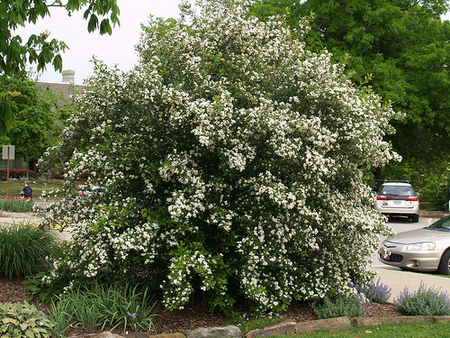
Stern's medlar
Members of the genus are large deciduous shrubs or small trees with a broad, spreading crown. Bark gray-brown, with deep vertical fissures that form rectangular peeling plates.
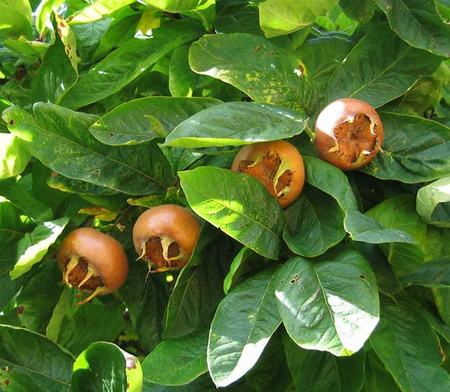
Fruits and leaves of Stern's medlar
Leaves dark green, opposite, oblong-ovate or elliptical. In autumn they turn yellow-brown or red.
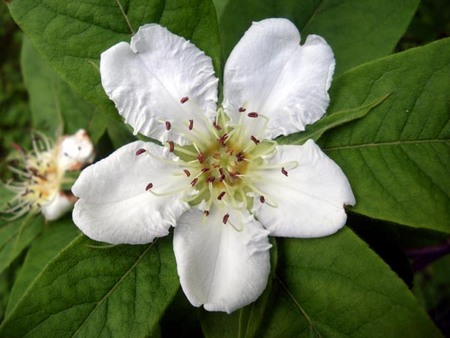
Flowers of Mespilus germanica
Blooms in late spring or early summer. Flowers five-petaled, white or pinkish, numerous. Flowering is short-lived. Pollinated by bees.
Fruits – globular or ovoid small apples with recurved sepals, reddish-brown in color, containing seeds inside, edible.
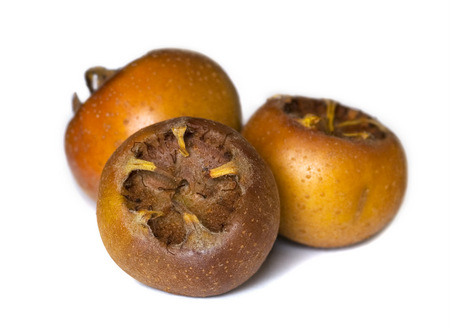
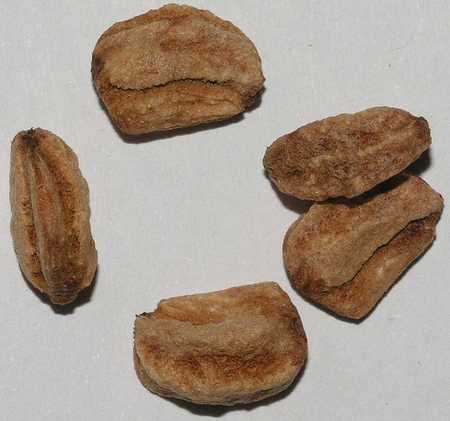
Seeds of Mespilus germanica
Species: There are 2 generally accepted species:
- Common medlar or German medlar (Mespilus germanica)
- Stern's medlar or gray medlar (Mespilus canescens)
According to The Plant List website the genus includes 5 species:
- Mespilus coccinea (L.) Castigl.
- Mespilus flava (Aiton) Dum. Cours.
- Mespilus germanica L.
- Mespilus monogyna (Jacq.) All.
- Mespilus punctata (Jacq.) Dum. Cours.
Hardiness zone: 4-7.

Location: prefers sunny and sheltered sites protected from strong winds. Undemanding to soil, but grows well on slightly acidic, moist and well-drained soil.
Planting: planting is best carried out in spring or autumn. Recommended distance between trees – 4.5 m. In the first years it needs staking, especially the weeping forms. When planting it is recommended to apply mineral fertilizer and bone meal. The trunk of the seedling should be positioned 5 cm from the stake. After planting it is recommended to mulch the soil with well-rotted manure or peat to a depth of 7-8 cm.
Care: care consists of lightly loosening the root circles and mulching (for example with mown grass). Watering is recommended at least once every 2-3 weeks, 2-3 buckets per plant.
Pruning: should be carried out in early spring before sap flow begins. Only sanitary pruning is required.
Propagation: readily propagated by seeds. Rooting of woody cuttings is rather low.
Uses: in landscape design it can be used in solitary and group plantings. Decorative during flowering and before leaf fall. Fruits can be consumed fresh and used for processing.