
Fruit trees
German medlar
Mespilus germanica
Synonyms: common medlar, shishki, shishkovnik, Mespilus sylvestris Mill., Mespilus communis Gueldenst., Mespilus vulgaris Reichenb., Crataegus mespilus O.Katze, Pyrus germanica Hook.f., Medlar.
German medlar – a species of fruit trees of the genus Medlar (Mespilus) of the family Rosaceae. Despite its name, its native range is considered to be Southwestern Asia and Southeastern Europe. It was introduced to Germany by the ancient Romans. In the wild it occurs singly or in shrub thickets on open slopes, as well as in the understory of forests. In the Caucasus it grows in light oak-hornbeam forests on the coasts of the Black and Caspian Seas where it ascends to 1800 m above sea level; in Talysh it reaches the upper vegetation layer; on Elbrus – up to 2050 m a.s.l. A light-loving mesophyte, mesotrophic species, and also a stable understory associate. It is found in Georgia, Moldova, the southern coast of Crimea, Armenia, Azerbaijan, and Algeria. It is also found in shelterbelt plantings in central Ukraine, for example in Uman, where it was introduced as a weak-growing rootstock for pear.
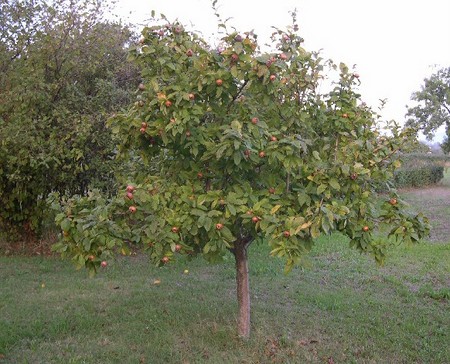
In the northern part of Iran, in the Caspian regions, it has been cultivated for more than 3000 years. The ancient Greeks cultivated it for over 2500 years, and the ancient Romans were growing it as early as 200 BC. In the Victorian era the German medlar was an important crop, but interest declined in the 17th-18th centuries and it was replaced by other crops. Today it is cultivated rather rarely.
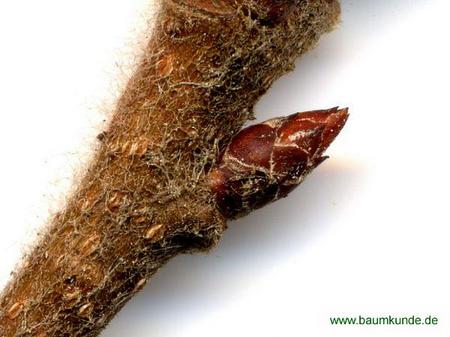
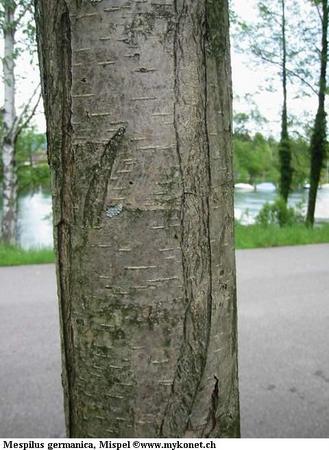
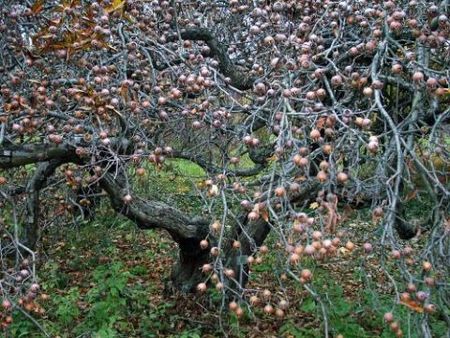
It is a deciduous tree up to 6-8 m in height. Growth rate is medium, actively growing in the first years, and also after 13. Crown wide, spreading. Trunk up to 20 cm in diameter. Bark gray-brown, with deep vertical fissures that create rectangular peeling plates. Scaffold branches gray, twigs reddish-brown, young shoots greenish, covered with dense woolly pubescence.
The plant is covered with a small number of short spines, but cultivated forms are completely without them. Root system is superficial and well developed.
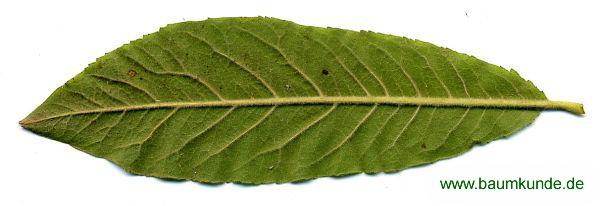
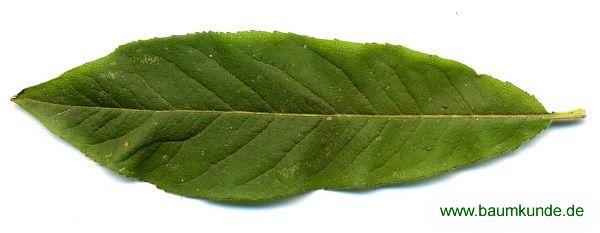
Leaves large, elliptic, 8-15 cm long and 3-4 cm wide, with an acute or obtuse apex, opposite, slightly pubescent, margins entire or toothed. The teeth are dull, bearing a red gland at the tip, arranged spirally. The upper surface of the blade is covered with scattered hairs, dark green; the underside is whitish-hairy, with the main veins covered by denser and longer pubescence, pale green. Young leaves on both sides are covered with dense pubescence. In autumn before falling the leaves turn yellowish-red or brown.
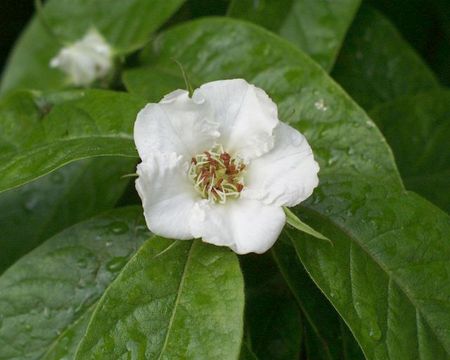
Flowers five-petaled, white, large, 3-5 cm in diameter, numerous, fragrant, borne at the tips of shoots. The bract is pale green, large, deciduous. Sepals longer than the petals, lanceolate-acuminate. Stamens numerous; up to 30 stamens may be present in a single flower, ending with bright pink dots of anthers. Flower longevity 3-5 days. Flowers appear in late spring, in April – May; flowering is brief, lasting up to 19 days.
Fruits apple-shaped, globose or pyriform, less often ellipsoid, 2-3 cm in diameter (in some cultivars up to 7 cm), fleshy, almost naked, with reflexed sepals. Initially dirty-green in color, later brown-red or yellowish. Flesh brown, with an astringent sweet-sour taste and fairly strong tannins.
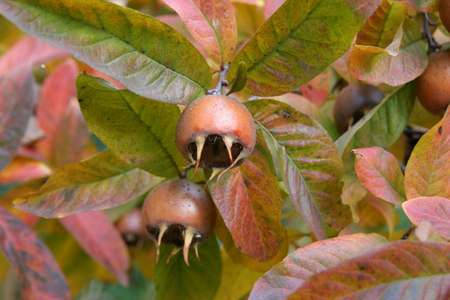
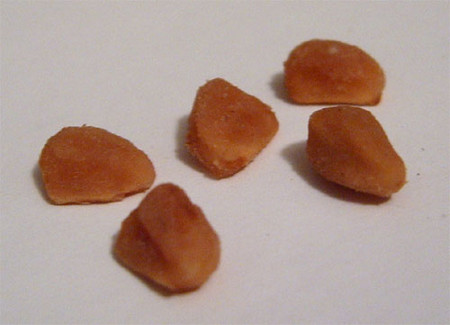
After exposure to frost the astringency disappears and a sweet pleasant taste develops. Harvested fruits together undergo acetic fermentation and become juicy and soft. Inside the fruit there are 5 brown hard seeds. Mass of a single fruit up to 10 g. 1000 stones weigh 140 g. Fruits ripen in October-November and remain on the branches practically all winter. Fruits are picked after the first frosts, sometimes even in spring. Begins fruiting in 3-6 years after planting.
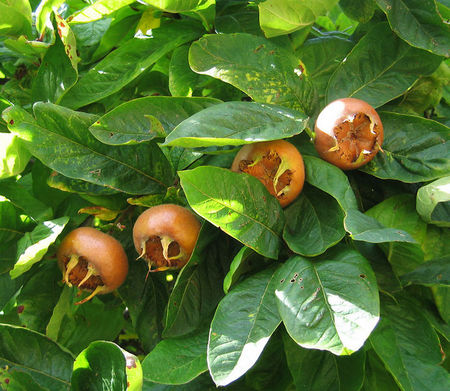
Varieties: Mespilus germanica «Dutch», M. germanica ‘Nottingham’, M. germanica ‘Royal’
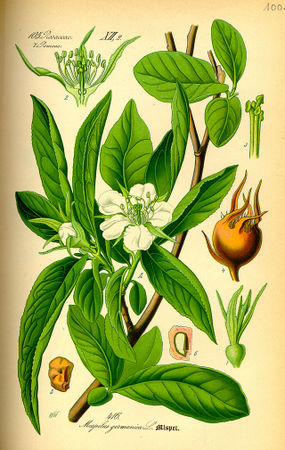
Botanical illustration from O. V. Tome's book «Flora von Deutschland», Österreich und der Schweiz, 1885

Location: prefers sunny and sheltered-from-strong-winds sites. Undemanding to soil, but grows well on slightly acidic, moist and well-drained soils.
Planting: planting is best done in spring or autumn. Recommended spacing between trees – 4.5 m. In the first years staking is required, especially for weeping forms. When planting it is recommended to apply mineral fertilizer and bone meal. The trunk of the seedling should be placed 5 cm from the stake. After planting it is recommended to mulch the soil with well-rotted manure or peat in a layer of 7-8 cm.
Care: care consists of shallow loosening of the trunk circles and mulching (for example with mown grass). Watering is recommended at least every 2-3 weeks with 2-3 buckets per plant.
Pruning: should be carried out in early spring before the onset of sap flow. In the first 3-4 years it is necessary to shorten the leaders of the main scaffold branches by 1/3 of the annual shoot growth to an outward-facing bud. Other branches may not be pruned. Subsequent pruning consists of removing dead or crown-thickening branches.
Propagation: propagates well by seed. Rooting of hardwood cuttings is fairly low.
For seed propagation a 2-year stratification is required.
Diseases and pests: practically not affected. Sometimes leaves may be damaged by foliage-chewing caterpillars.
Conservation status: is under protection.
Uses: in landscape design it can be used in solitary and group plantings. Decorative during flowering and before leaf fall. Fruits can be consumed fresh and used for processing. They are used to make compotes, jams, preserves, pastila (fruit leather), as well as non-alcoholic beverages. A good nectar source.