
Deciduous shrubs
Common Lycium, or barbarian
Lycium barbarum, или Lycium halimifolium
European representatives of the family Solanaceae are predominantly herbaceous plants. Among the few exceptions are several shrubby species of the genus Lycium, mainly distributed in Southern Europe.
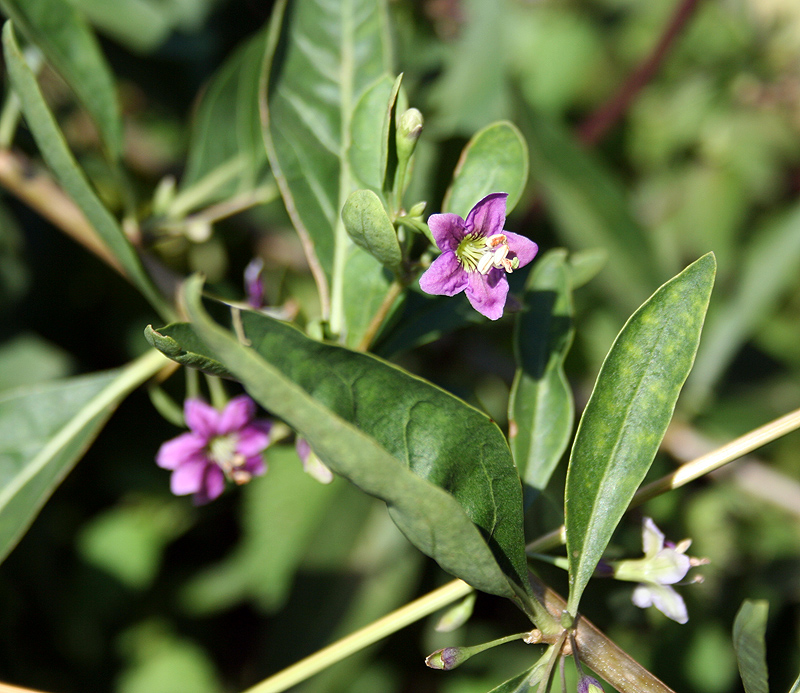
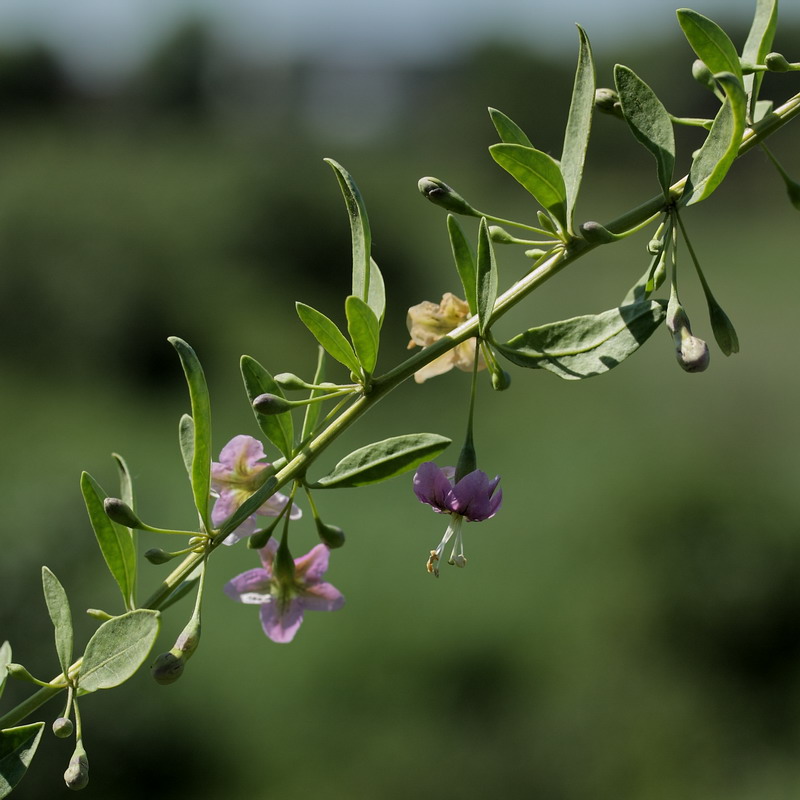
One of the species of the genus, the common Lycium, is sometimes cultivated as an ornamental plant and often becomes naturalized. At present this species can be found in most of Europe, although most botanists consider China its native home.
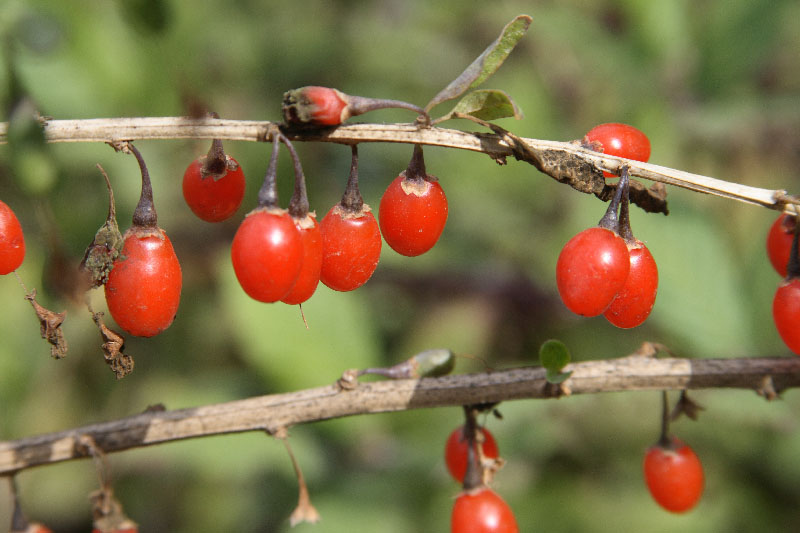
The common Lycium is a spiny shrub 1–3 m tall, with twig-like branches that are erect at first and later pendulous. Leaves range from narrowly elliptic to oblong-lanceolate, on short petioles, widest in the middle, acute at the tip and cuneately narrowed at the base. Flowers are lilac-purple or more rarely brownish, about 2 cm in diameter, solitary or grouped 2–5 in the leaf axils, with a pleasant fragrance. The calyx is two-lipped, the upper lip 2-toothed, the lower – 3-toothed. The corolla is sympetalous, its tube narrow, funnel-shaped, the limb spreading wheel-shaped, 5-lobed. The corolla lobes bear dark purple lines. The stamens protrude strongly from the corolla tube. The style is long, filiform, with a capitate stigma. The fruit is an oblong, red or orange, many-seeded berry.

Most often this species is encountered on forest edges, in shrub thickets, by fences and hedgerows, on dry slopes and screes, and along roadsides. In Central Europe it prefers sunny, well-warmed locations. The pendulous branches of Lycium with numerous flowers are very decorative, but it can spread extensively and displace other plants. All parts of the plant are poisonous; the fruits of Lycium are used in traditional Chinese medicine.