
Deciduous shrubs
Tatar honeysuckle
Lonicera tatárica
Synonyms: Lonicera karataviensis Pavlov, Lonicera micrantha (Trautv.) Regel
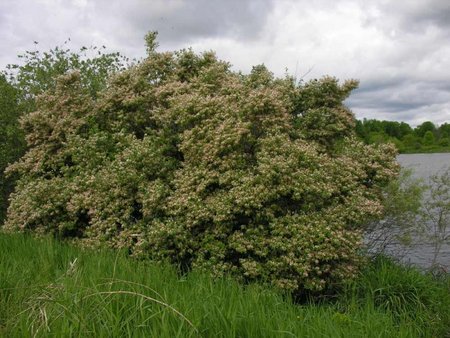
Tatar honeysuckle (Lonicera tatárica) – a species of the genus Lonicera (honeysuckle) of the Caprifoliáceae family. Naturally distributed in the steppe zone from the Lower Volga to Lake Baikal, in Kazakhstan and to the foothills of the Tien Shan. Forms large thickets in ravines, on hill slopes, at forest edges, in river valleys of forest-steppe and steppe zones, and less often occurs in the understory of broad-leaved forests. It rises into the mountains up to 1400 m above sea level. Cultivated in Europe, the USA, Russia, China and Central Asia. In cultivation since 1752.
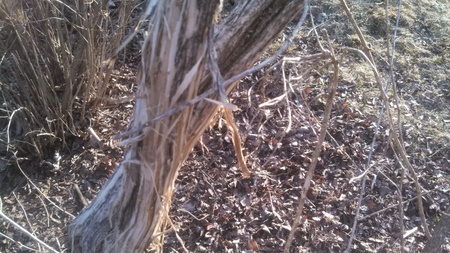
It is a deciduous shrub 1-3 (4) m high. Grows quickly, up to 35 cm per year. Crown densely branched, broadly spreading. Shoots grayish- or yellowish-brown, hollow, bare, with soft darkish lenticels.
Bark gray, peeling in strips. Buds ovoid-conical, short, 2-4 mm long, brownish, shiny, scales arranged crosswise. Lateral buds in series, sit 2-3 one above another. Bud scales ciliate at the margin, growing in fours. Leaf scar small, crescent-shaped, with 3 leaf traces. Pith brownish, sometimes hollow, wood yellowish-green.
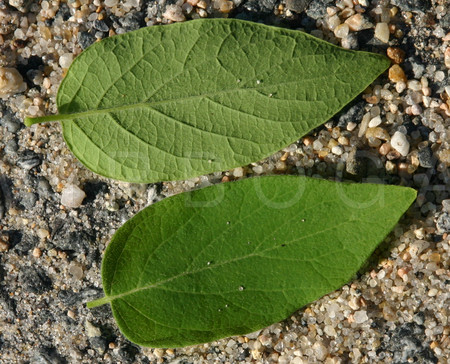
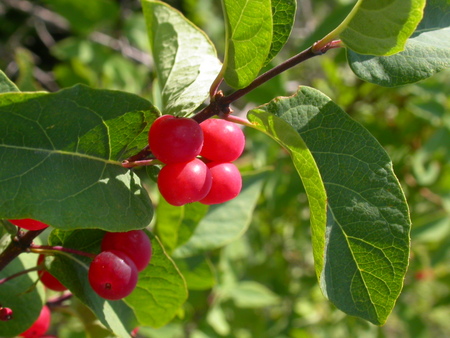
Leaves ovate or ovate-lanceolate, 3-6 cm long and 1.5-3 cm wide, on short petioles (2-6 mm long), dark green above, lighter below. Blade acute, entire, with a slightly cordate or truncate base.
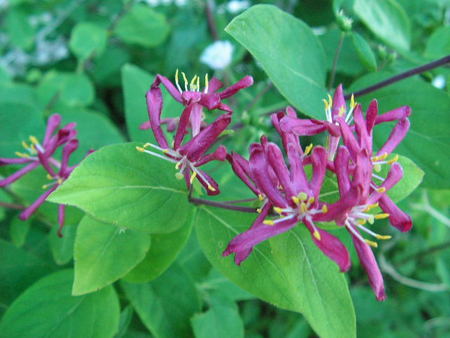
Flowers numerous, fragrant, borne in pairs in the axils of almost all leaves of flowering shoots; each pair is on a common bare, thin, arcuately curved or erect peduncle 1-3 cm long. Bracts linear. Bracteoles free, ovate. Corolla zygomorphic, 2-2.5 cm long, pale pink or deep pink, glabrous outside. Corolla tube straight, cylindrical, with a swollen or slightly narrowed base. Corolla limb two-lipped, up to 2 cm in diameter. Calyx with 5 sharp teeth. Flowers abundantly from May to June.
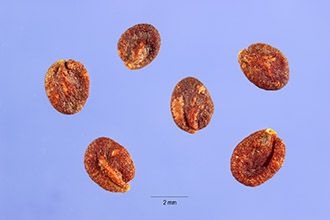
Fruits spherical berries 0.6 cm in diameter, red, less often orange or yellow, free or fused at the base, bitter, slightly poisonous, with 1-8 seeds inside, ripening in July-August.
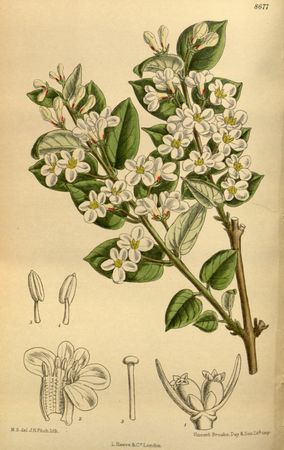
M.S. del., J.N.Fitch lith., Curtis's Botanical Magazine, London, 1916
Hybrids:
- with Lonicera morrowii A. Gray – Lonicera × bella Zabel
- with Lonicera korolkowii Stapf – Lonicera × amoena Zabel
- with Lonicera nigra L. – Lonicera × micranthoides Zabel
- with Lonicera xylosteum L. – Lonicera × xylosteoides Tausch
Forms: f. Alba (white flowers), f. Grandiflora (large white flowers), f. sibirica (red flowers), f. punicea (deep pink flowers and large leaves), f. latifolia (large leaves and pink flowers), f. angustifolia (bright pink flowers and narrow leaves), f. nana (dwarf shrub with small pink flowers), f. Lutea (yellow fruits).
Cultivars: 'Arnold Pink', 'Hack's Red', 'Arnold Red', 'Rosea', 'Hack Red'.
Hardiness zone: 4a (-34°C). In the conditions of Ukraine it tolerates winters well, may be occasionally damaged by frosts, but quickly regenerates.

Location: tolerates polluted air and shade, but for best flowering needs sunny or partially shaded sites. Undemanding.
Soil: prefers loose, well-drained soil. Poorly tolerates very dry sites and places with stagnant water. Tolerates soil salinity, does not like heavy wet and poor sandy substrates. Optimal pH 7.5-8.5.
Planting: Substrate: river sand, peat (humus) and turf soil in the ratio 1:1:3. A drainage layer 5 cm high should be placed at the bottom. Does not like heavy wet and poor sandy substrates.
Care: In early spring it is recommended to apply nitrogen fertilizers (from 20 to 30 g per sq.m.). Before flowering, complex fertilizers can be applied ("Kemira-Universal" 20 g per 1 bucket of water). During autumn digging wood ash can be applied 200 g per 1 sq.m. per bush. Loosening is carried out to a depth of 20 cm and the trunk circle is mulched with peat. Such mulching is recommended every autumn to protect roots from severe frosts in snowless winters and to retain necessary moisture in spring.
Watering is recommended 2-3 times during the season, in hot weather at a rate of 10 L per bush.
Pruning: carried out in autumn after leaf fall or in spring before bud break. Older bushes are rejuvenated and thinned every 2-3 years. Small and weak shoots are also cut out, leaving no more than 5 stems per bush. Upon reaching 6 years, sanitary pruning should be performed – remove all dry, damaged and diseased branches, as well as lower-tier shoots that lie on the ground.
Propagation: propagated vegetatively and by cuttings. For green cuttings choose strong shoots of the current year and cut cuttings up to 10 cm long with 2 nodes and 1 internode. "Heel" cuttings can also be used by breaking off the lower part of the shoot from the last year's branch. Planting material is placed at a 45° angle in a soil mixture of peat and coarse sand in a ratio of 1:3. The planting should be covered with film to help retain the necessary moisture of the substrate and air. Cuttings are protected from the sun, ventilated, sprayed and watered. Roots may form in 2 weeks with good care. Plants should not be transplanted in autumn because their root system is not yet sufficiently developed. It is recommended to leave cuttings in a greenhouse for the winter, and before cold weather remove the film and cover them with spruce boughs until spring. In the second year after planting, plants can be transplanted to a permanent place. Some specimens may begin to flower after one year. Mature bushes (from 3 years) can also be propagated by dividing the bush. Layers root well. With seed propagation, parental traits are not always passed on. Seed viability 100%, germination 40%. Rooting of summer cuttings – 100%. Seeds can be germinated in the dark without stratification at +12 to +20°C, first shoots appear in 15-30 days. Stratification at +3 to +5°C for 1-2 months significantly increases germination.
Pests: attacked by honeysuckle aphid, honeysuckle mite, mealybugs and scale insects, as well as leaf-eating pests (bugs, caterpillars, inchworms, etc.)
Diseases: "witches' broom", powdery mildew, leaf spot.
Conservation status: listed in the Red Book in Kazakhstan and in Russia (Tomsk Oblast)
Uses: widely used in landscape and park planting, for greening cities or settlements, as well as in steppe shelterbelt afforestation. Presents well in group and solitary plantings, on forest edges and for creating hedges. A good nectar source in May-July. Honey light, pollen dark yellow. Used in medicine.