
Climbing plants
Creeping honeysuckle
Lonicera japonica var. repens
Synonyms: Lonicera flexuosa, Lonicera japonica Purpurea
Japanese creeping honeysuckle (Lonicera japonica var. repens) – a variety of Japanese honeysuckle. Naturally occurs in Japan, where it forms thickets on hills and mountains, and also in the mountains and lowlands of Korea. It received the award of the English Royal Horticultural Society AGM (Award of Garden Merit).
It is a semi-evergreen or evergreen, climbing or creeping, fast-growing vine up to 8 m long and up to 1.5 m wide. Young shoots are pubescent, reddish-brown in colour.
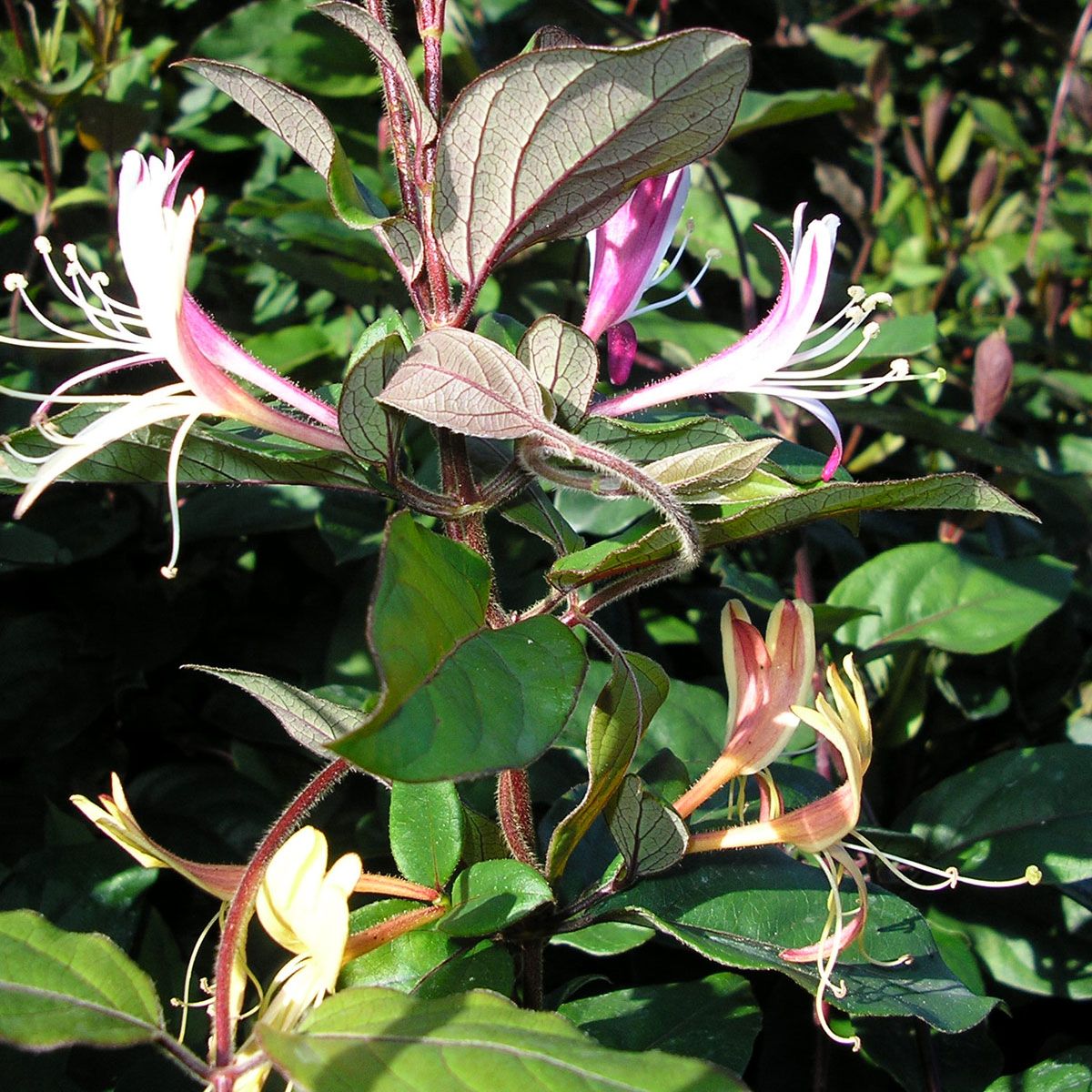
Leaves ovate to ovate-lanceolate, less often lanceolate-elliptic, shortly acuminate and acute, less often obtuse, with a slightly cordate or rounded base, 3-8 cm long and 1.5-4.5 cm wide, pubescent on both sides, later glabrous above, with a finely ciliate margin, dark green, turning purple in winter. Petiole glabrous or pubescent, about 5 mm long.
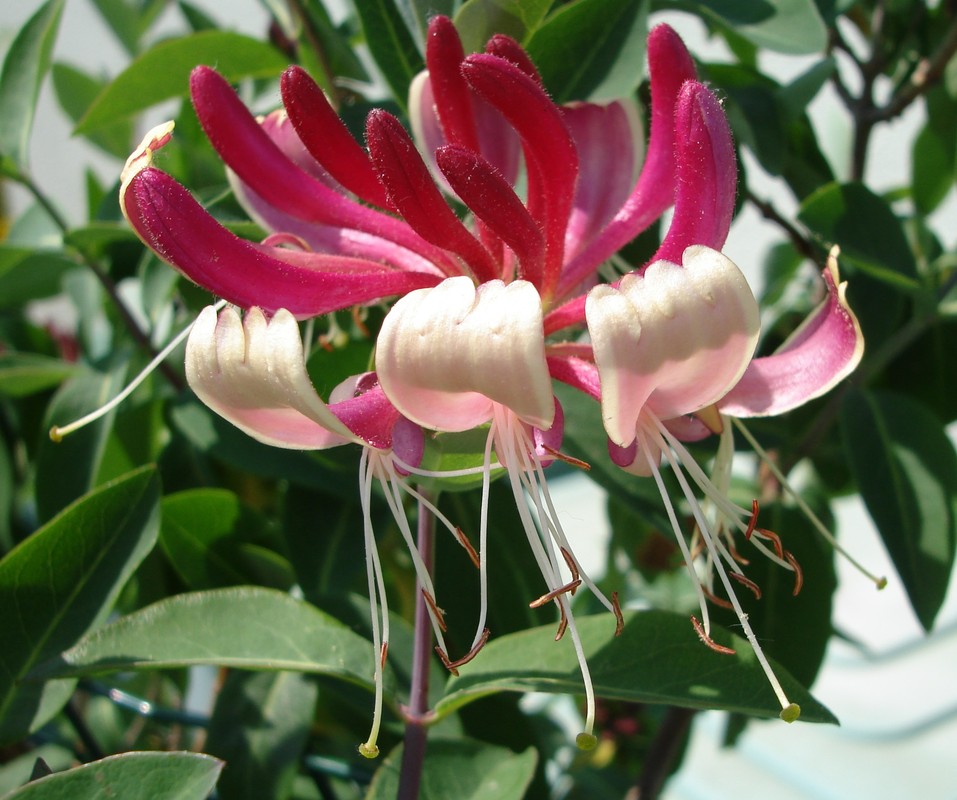
Flowers paired, located in the axils, two-lipped, very fragrant, white inside and purple outside, borne on pubescent peduncles which are usually longer than the petiole. As they fade the flowers turn yellow. Flowers in the second year after planting, abundantly and for a long period, from June to September.
Berries violet-black, glossy, rounded, 3-4 mm in diameter, containing a small number of elliptical, slightly pointed, black seeds, with an indistinct external longitudinal keel and a two-faceted inner side. Fruits in October-November.
Hardiness zone: 4a (-34°С).

Location: undemanding, light-loving, not particular about soil. Mesophyte, mesotroph, eutroph.
Planting: Substrate: turf, leaf soil, river sand in a ratio of 2:4:1.
Care: fertilization is recommended every 2 weeks. An optimal fertilizer is a cow manure infusion at a ratio of 1:8.
Pruning: tolerates clipping and pruning well.
Propagation: propagated by seeds and by layering. For seed propagation it is best to sow seeds in autumn immediately after ripening, sowing depth 1 cm. Older seeds require cold stratification for several weeks.
Diseases and pests: under conditions in Ukraine it has no diseases or pests.
Uses: used for vertical greening. Ideal for decorating rock gardens, pergolas, fences, high enclosures, tree trunks, trellises, espaliers, arbors; can also be used as a groundcover. A good nectar plant.