
Climbing plants
Caprifol, goat honeysuckle
Lonicera chrysantha
Honeysuckle caprifol or goat honeysuckle (Lonicera chrysantha) – the type species of the genus Honeysuckle of the Honeysuckle family (Lonicera). In Latin it means «goat leaf». Its range is Southern and Central Europe, as well as the Caucasus. It grows on forest edges, in woods, in well-lit sunny places with moist soil.
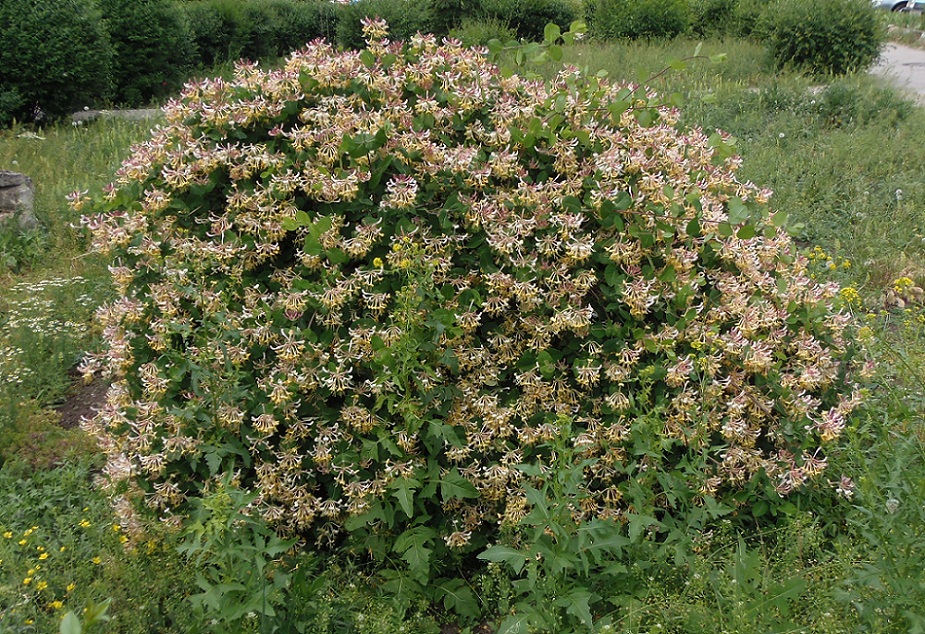
It is a climbing deciduous shrub 4-6 m high. The plant is fast-growing, increasing by 1.5-2 m in one season. Young shoots are light green, on the sun-exposed side purple-red, glabrous; on old shoots the bark is brown. Buds are oblong-ovate, large, acute, with numerous loosely arranged herbaceous scales that partly remain at the base of the shoots.
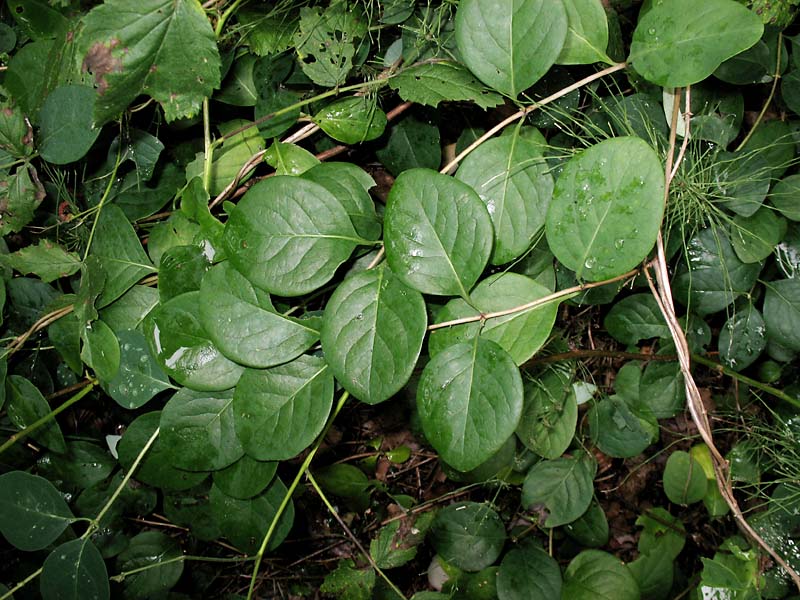
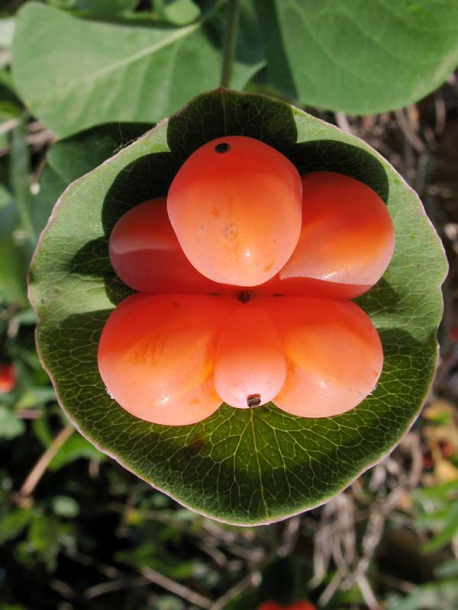
Leaves are opposite, elliptic or broadly elliptic in shape, 4-10 cm long, leathery, firm, dark green above and bluish-gray beneath. 2-3 pairs of the upper leaves are fused at the bases into a symmetrical elliptical disc. Leaves retain their color until late autumn and are among the last to fall in the garden.
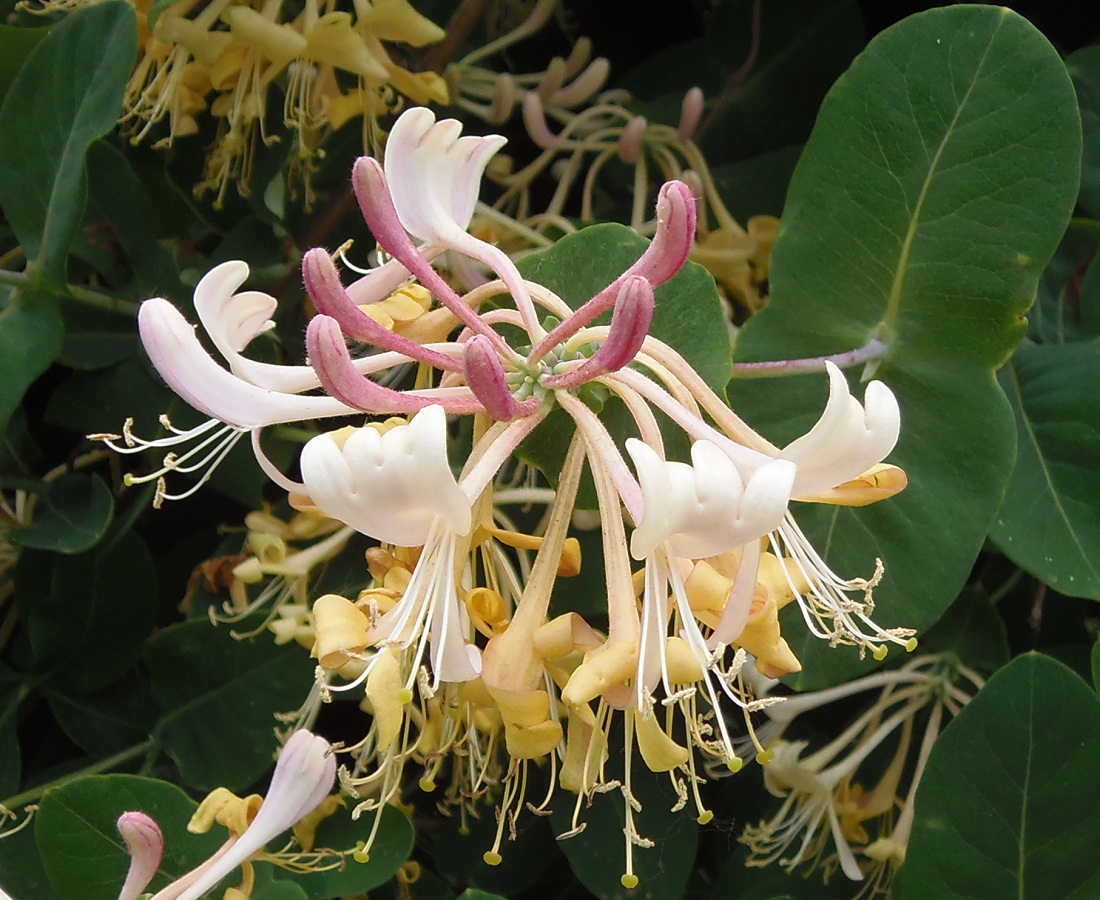
Flowers are sessile, grouped in whorls of 3-10 flowers, with usually one terminal whorl developing on a shoot. Bracts are small, free, shorter than the ovary, ovate, often glandular at the margin, and often entirely absent. The calyx limb reaches 1 mm in length, divided into 5 triangular teeth that are glabrous or glandular at the margin. The stamens protrude well. Flowers reach 5 cm in length, white or yellowish inside, purple or with a purplish-red tint outside, very fragrant, especially in the evening hours. A flower lives on average 3-4 days; flowering continues for 3 weeks. Blooms and bears fruit from 4 years of age. Fruits are orange-red berries, on short pedicels "glued" to the leaf.
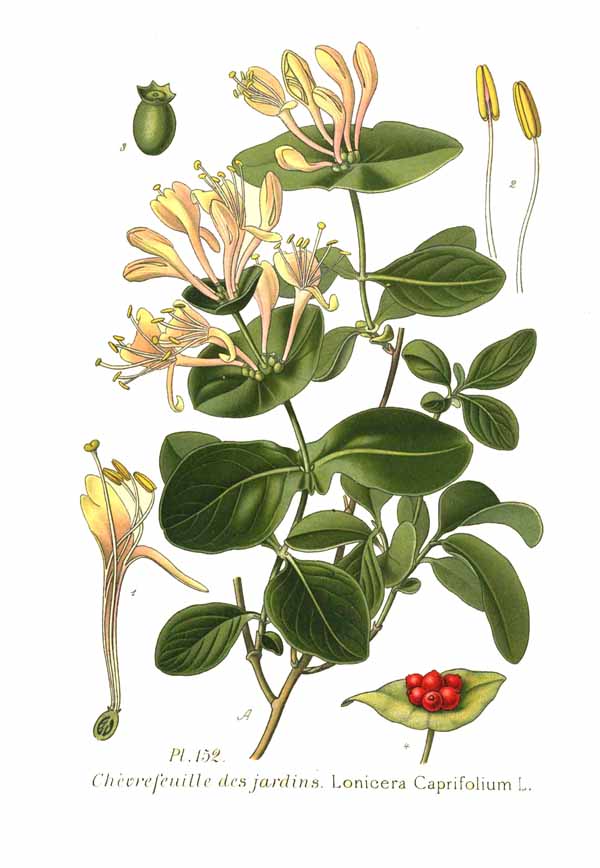
Amédée Masclef - Atlas des plantes de France. 1891
Can live more than 50 years.
Ornamental forms: white (f. alba) – has white flowers that open 2 weeks earlier than the typical form; and sparsely flowering (f. pauciflora) – flowers are pink-red but it blooms less abundantly than the typical form.
Hardiness zone: 3-7 (down to -40°C). During winter slight freezing of shoots is possible, but they then recover quickly. Flowers can withstand returning frosts down to -8°C.

Location: Light-loving, but can tolerate partial shade. Undemanding regarding soil (tolerates a wide pH range from 3.9 to 7.7), but flowers well on slightly acidic to neutral soils (pH 5.5-6.5). Moisture-loving, but does not tolerate waterlogging.
Pruning: during the first 5-7 years only sanitary pruning is carried out; in subsequent years the crown becomes dense, so rejuvenation pruning is recommended in autumn after leaf fall or in spring in March-April. The aging part of the crown should be cut above the point of origin of a large basal shoot by 30-50 cm. For thorough rejuvenation of the crown strong cutting "to the stump" at a height of 0.5 m from the ground is used.
Planting: Transplants well at almost any age. Planting is recommended in late autumn. Plants with a closed root system can be planted from spring until late autumn. Recommended spacing between plants is 1.5-2 m. Soil mix: topsoil, humus, peat or sand in a ratio of 3:1:1. The root collar at ground level. Planting hole depth 25-30 cm, diameter 25 cm for 2-3 year old bushes; for 5-7 year old plants depth and diameter reach 50 cm. When planting you can add 5-7 kg of manure, 50-80 g of superphosphate and 40-50 g of potash salt per bush. A drainage layer of broken brick or gravel 5-7 cm thick. When planting, branches do not need to be pruned; this is done in spring before strong bud swell. For spring planting branches are pruned immediately.
Care: needs a sturdy support. Young shoots are trained on the support, distributed evenly over the surface (note that honeysuckle twines counterclockwise). Once the desired height is reached, the vine tip is cut off, allowing side shoots to develop. Responsive to feeding and watering. In the first 2 years it is recommended to fertilize in spring with nitrogen. Dissolve 30 g (a matchbox amount) of urea or ammonium nitrate in 10 L of water and water with 1-1.5 L per plant. Watering can be applied over the leaves, providing both root and foliar feeding. Such feedings can be done from the start of the growing season every 2 weeks until mid-June. With abundant mineral fertilization serial (reserve) buds may open, producing additional shoots that thicken the crown.
Diseases and pests: practically not affected by diseases or pests.
Propagation: propagated by seeds, cuttings and layers. Softwood cuttings should be taken at the end of flowering (early July). Each cutting should have 2 internodes. Remove the lower leaves and shorten the upper ones by half. Plant them in a shaded frame at a distance of 20-25 cm from each other at a depth of 2-3 mm and cover with glass. Soil mix: peat, coarse sand and garden soil in a ratio of 2:2:1. It is also necessary to mist 2-3 times a day. Once leaves appear the glass can be removed. Cuttings should be mulched with peat for the winter, and in spring they can be transplanted to a permanent place. Rooting of cuttings without pre-treatment is about 50%.
Seed propagation is a longer process. Seeds are collected at the end of July, cleaned of pulp, washed and dried. Seeds are stored at room temperature. After storage for 0.5, 1.2 and 3 years the germination percentage is 85, 71.5 and 71.4% respectively. After 4 years germination falls to 36%, and after 5 years – only 6%. For propagation by this method a two-stage stratification is used: I - at 20°C for 1-2 months, II - at 5°C for 1-2 months. Seed germination occurs slowly; at 20°C 50% of seeds germinate in 1.5-3 months. Sowing depth is 0.9-1 cm.
Use: widely used for vertical landscaping of low structures. Combines well with climbing roses, deciduous and coniferous shrubs.