
Deciduous shrubs
Blue honeysuckle
Lonicera caerulea L.
Synonyms: edible honeysuckle, blue honeysuckle, Turchaninov's honeysuckle, Regel's honeysuckle, Kamchatka honeysuckle
Blue honeysuckle (Lonicera caerulé) – a species of the genus Lonicera (Lonicera). Its range is in the temperate zone of the Northern Hemisphere, where it grows in riverside meadows, forests, heaths and shrub thickets, in the subalpine and forest belts.
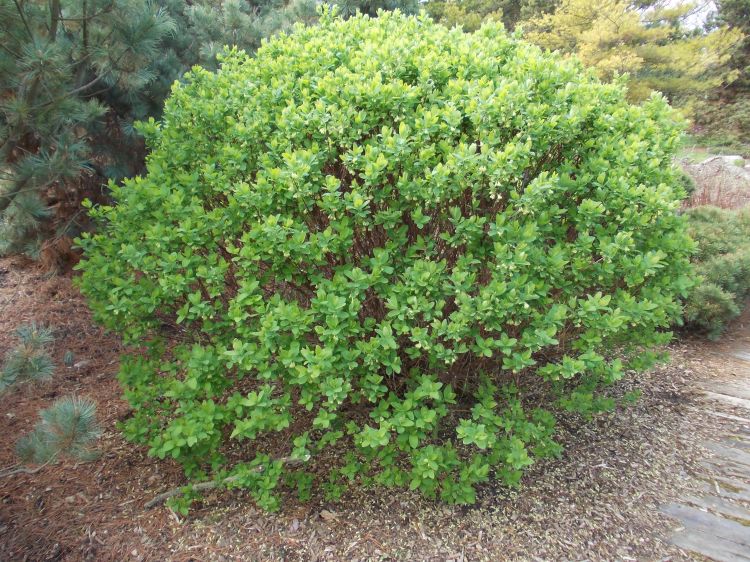
It is an erect, branched deciduous shrub with a flat-rounded crown. It reaches 1–1.5 (2.5) m in height. In the first 3–4 years it grows slowly, then faster; annual increase reaches 20–30 cm. Bark is brown, from 2–3 years it begins to crack longitudinally. Young shoots are reddish, densely pubescent, later becoming bare. Lives 20–30 years. 4
Root system taproot-type, powerful, densely branched.
Leaves entire, opposite, oblong-oval or broadly lanceolate, simple, nearly sessile on short petioles, 3–5 cm long and up to 3 cm wide, hairy on both sides, with an acute apex, dark green above and bluish-green beneath. Most cultivars have large disc-shaped stipules that do not fall in autumn and remain on the branches for 1–2 years. Young leaves are densely pubescent, later becoming sparsely pubescent or glabrous.
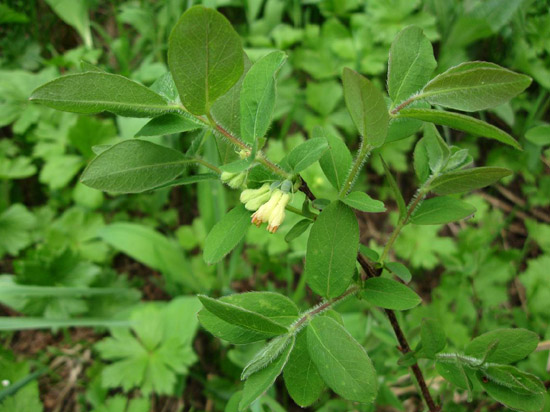
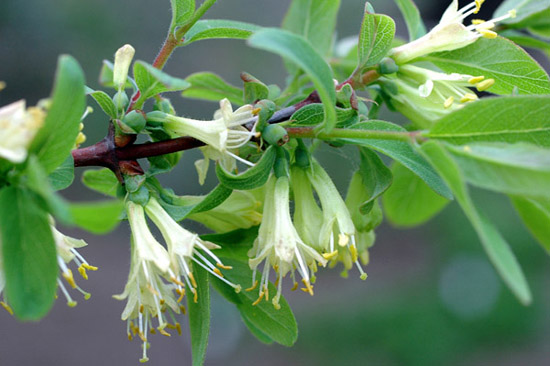
Flowers bisexual, pendulous, with a double perianth, borne on hairy short pedicels, in pairs in the leaf axils; bracts densely pubescent. Calyx 5-toothed, green. Corolla slightly zygomorphic, funnel-shaped, yellow, 8–13 mm long, with a short tube and 5 narrow long lobes of the limb. There are 5 stamens, equal in length to the corolla or slightly longer. The pistil has a long style that protrudes from the corolla tube and an inferior ovary. Flowers from May to June. Pollinated by insects.
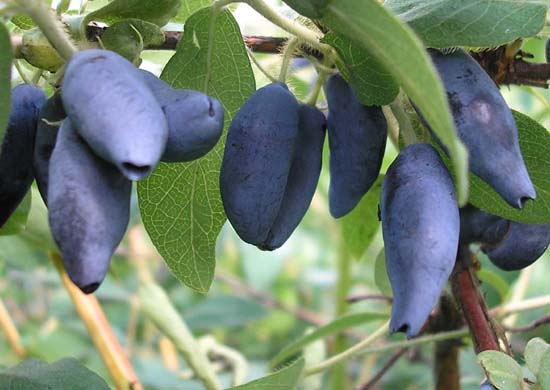
Fruits dark blue with a glaucous bloom, oblong-elliptic compound fruits that consist of two ovaries, expanded bracts and a juicy covering. The surface of the fruits may be bumpy or smooth. Weight of one berry 0.5–1.5 g with a length of 40 mm and a width of 15 mm. One fruit contains up to 20 brown ellipsoid seeds, up to 2 mm long, with a finely reticulate surface. Berries are edible. Average yield per bush is 1.5–2 kg; with good care can reach 3 kg, and under high-agronomic conditions 5–7 kg of fruit can be obtained. From the beginning of flowering to full ripening takes 30–40 days. Ripening occurs in June–July; fruits do not ripen simultaneously, so harvest is carried out in 2–3 picks. Berries may drop. Begins to bear fruit at 3–5 years of age.
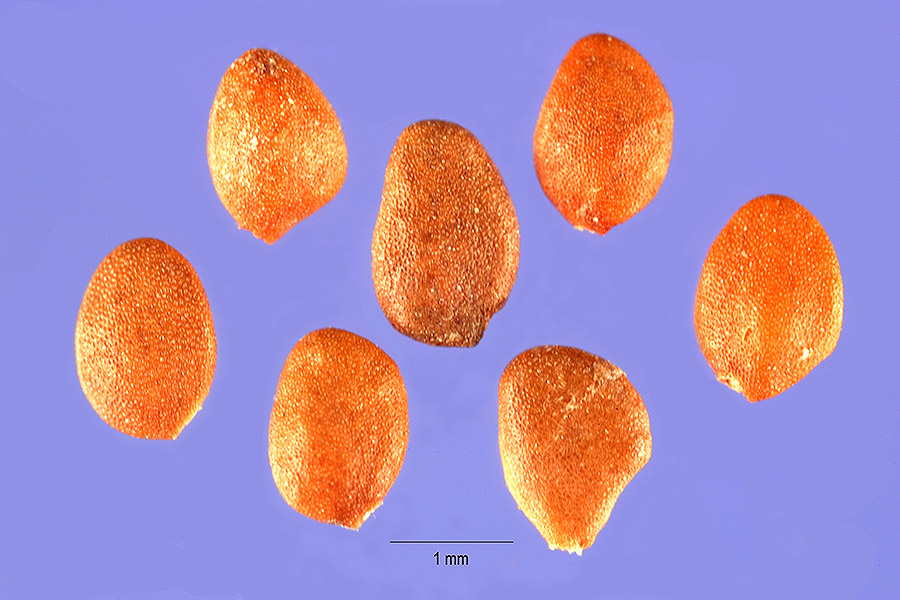
Fruits contain: 5–10% sugars, 4.5% acids, 0.8% pectins, as well as vitamins A, C, P, B1, B2.
Cultivars: Golubika, Kapel, Ivushka, Pavlovskaya, Amorfa, Nimfa, Fialka, Sinichka, Morena, Bogdana, Dlinnoplodnaya, Talisman.
Hardiness zone: down to -50°C. Slight frost damage to shoots is possible during winter, which then quickly recover. Flowers can withstand return frosts down to -8°C.
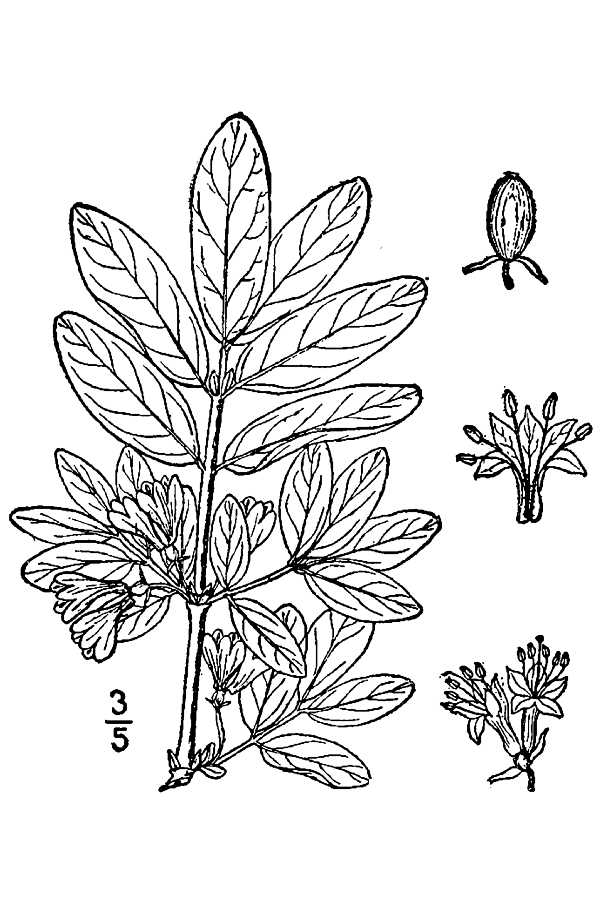
Britton, N.L., and A. Brown. 1913. An illustrated flora of the northern United States, Canada and the British Possessions

Site: Light-loving; in shade it does not flower or fruit. The required sum of active temperatures is 420–520°C. For good yields it is necessary to plant at least 2–3 different cultivars. Not demanding to soil (tolerates a wide pH range from 3.9 to 7.7), but gives good yields on slightly acidic and neutral soils (pH 5.5–6.5). Moisture-loving, but does not tolerate waterlogging. During spring droughts it needs watering at times of intensive growth and fruiting, as lack of water noticeably reduces flavor and yield.
Pruning: In the first 5–7 years only sanitary pruning is carried out; in subsequent years the crown becomes dense, so it is recommended to perform rejuvenation pruning in autumn after leaf fall or in spring in March–April. The aging part of the crown should be cut above the point of origin of large basal shoots by 30–50 cm. For fundamental rejuvenation of the crown, severe pruning "to a stump" is applied at a height of 0.5 m from the ground.
Planting: Tolerates transplanting well at almost any age. Planting is recommended in late autumn. Plants with a closed root system can be planted from spring until late autumn. Recommended spacing between plants is 1.5–2 m. Soil mix: topsoil, humus, peat or sand in a ratio of 3:1:1. Root collar at ground level. Depth of the planting hole 25–30 cm, diameter 25 cm for 2–3 year-old bushes; for 5–7 year-old plants the depth and diameter of the hole reach 50 cm. To ensure fruit set, plant at least 3–5 bushes of different cultivars. At planting you can apply 5–7 kg of manure, 50–80 g superphosphate and 40–50 g potassium salt per bush. A drainage layer of broken brick or gravel 5–7 cm thick. There is no need to cut branches at planting; this is done in spring before strong bud break. When planting in spring, branches are pruned immediately.
Care: Responds well to fertilization and watering. In the first 2 years it is recommended to apply nitrogen fertilizers in spring. Dissolve 30 g (a matchbox) of urea or ammonium nitrate in 10 L of water and water 1–1.5 L per plant. Watering can be done as foliar watering, providing both root and foliar feeding. Such feedings can be carried out from the beginning of vegetation every 2 weeks until mid-June. With abundant mineral feeding, serial (reserve) buds may break, from which additional shoots appear and thicken the crown.
Diseases and pests: Practically not affected by diseases or pests. During ripening, thrushes and sparrows peck at ripe fruits.
Propagation: Propagates well by green cuttings while retaining cultivar traits. The maturity of shoots is checked by bending — cuttings for propagation do not bend but break with a characteristic crisp snap. Time to take cuttings is at the end of flowering and when the first green fruits appear. Cuttings should be taken from the middle part of the shoot, with 2–3 nodes. The top cut of the cutting is horizontal, leaving 1–1.5 cm from the buds; the bottom cut is slanted (at an angle of 45°). Leaf blades on the lower nodes should be completely removed, on the upper ones trimmed to more than half. Single-node short cuttings root at 60%, traditional (2–3 nodes) at 70–95%. Shoot tips and heel cuttings (breaking off the lower part of the shoot from the perennial shoot) also root well. When cuttings are collected during active growth, survival is 45–60%. Immature cuttings can rot from excess moisture. They root without the use of stimulants, but their use increases the yield of developed plants. Soil mixture for cuttings: peat and sand in a ratio of 1:3. Cuttings are planted at a 45° angle. Substrate and air humidity should reach 85%, temperature 20–25°. Rooted cuttings are grown on at the rooting site for 1–2 years. Seed propagation is used for breeding purposes, as cultivar qualities are not transmitted by this method.
Uses: Valuable nectar plant. Berries are consumed fresh and used for making jam and compotes. Some cultivars have a rather striking dense hemispherical crown even without formative pruning, so they can be used in solitary and group plantings. Honeysuckle looks especially effective planted with columnar junipers.