
Conifers
Larch
Larix Mill.
Larch (Larix Mill.) – a genus of plants from the pine family (Juniperus). The most widespread group of coniferous trees in the world. It was first described in 1754 by the English botanist of Scottish origin Philip Miller in his work «The Gardener’s Dictionary containing the Methods of Cultivating and Improving the Kitchen Fruit and Flower Garden» (Gardener's Dictionary, containing the methods of cultivating and improving fruit and flowers) 4th ed.
The origin of the genus name is unclear. It was coined before Carl Linnaeus in the 16th century. According to one version, it is the Gaulish name of resin, deriving from the Celtic 'lar' – «abundant», «rich» (much resin). According to another version, the name comes from the Latin 'laridum', 'lardum' – «fat».
Cultivation
The genus is very ancient, presumably appearing at the end of the Cretaceous period. They grow in mountain forests in the temperate-warm zone and on plains in the temperate-cold zone. In places they can form light-needle larch forests. They grow in boreal and temperate regions of Asia, Europe and North America. In Russia there are 9 species, in China 11.
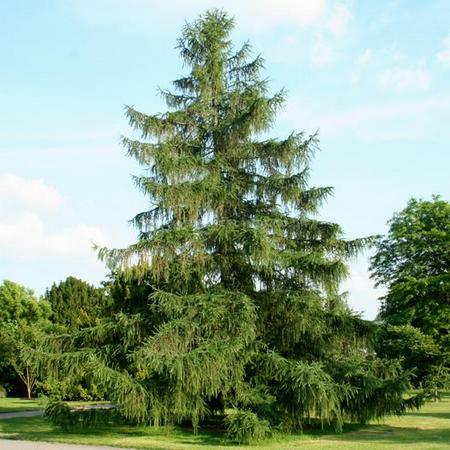
They are large deciduous coniferous trees up to 50 m tall, with trunk diameters up to 1 m. They grow quickly; annual increment can reach 1 m. They live 300-400 years. The oldest larch is 800 years old. The crown is loose and sun-penetrated; in young specimens it is conical. With persistent winds they become one-sided, flag-shaped.
The root system is powerful and well branched. A distinct taproot is not expressed, but lateral roots are strong and well deeply anchored.
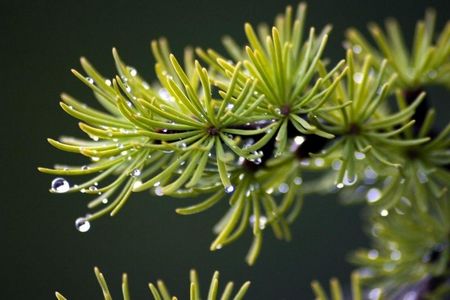
Needles are soft, annual, flattened, bright green, growing spirally on long shoots and in clusters on short shoots – up to 40 in each. In autumn they completely fall off until spring.
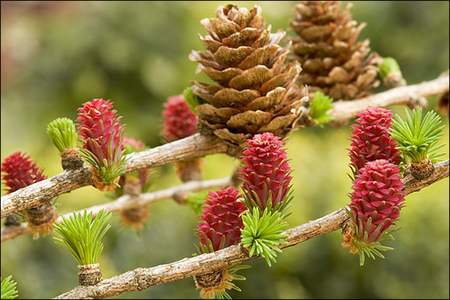
The plant is monoecious. Male catkins are round-ovoid in shape, yellowish. Pollen lacks air sacs. Female cones are reddish-pink or green.
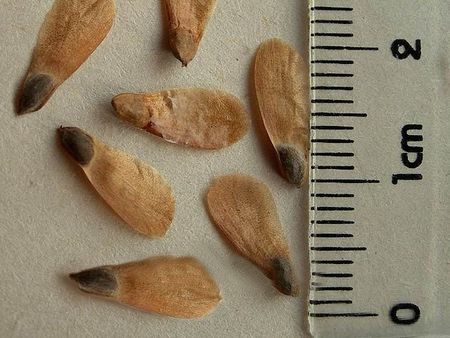
It bears fruit from 15-20 years. Pollination occurs simultaneously with the emergence of the needles or immediately after. In southern regions pollination occurs in May, in northern regions in June. Cones ripen in the autumn of the same year; they are ovoid or oblong-ovoid, 1.5-3.5 cm long. Seed scales are hard, slightly longer than the bracts. Mature cones mostly open immediately or at the beginning of spring. Seeds are small, ovoid, with wings tightly attached to them. Heavy seeding occurs every 6-7 years.
Species: according to Wikipedia materials:
- Larix gmelinii (Rupr.) Rupr. — Gmelin's larch = [syn. Larix dahurica Turcz. et Trautv. — Dahurian larch]
- Larix gmelinii var. gmelinii =
- Larix amurensis Kolesn. — Amur larch
- Larix cajanderi Mayr — Kajander's larch
- Larix kamtschatica (Rupr.) Carrière — Kamchatka larch
- Larix gmelinii var. japonica =
- Larix kurilensis Mayr — Kuril larch
- Larix gmelinii var. olgensis =
- Larix olgensis A.Henry — Olgin larch
- Larix koreana Nakai — Korean larch, nom. nud.
- Larix gmelinii var. principis-rupprechtii
- Larix komarovii Kolesn. — Komarov's larch
- Larix maritima Sukaczev — Maritime larch
- Larix middendorffii Kolesn. — Middendorff's larch
- Larix ochotensis Kolesn. — Okhotsk larch
About one and a half dozen species are commonly recognized:
- Larix kongboensis R.R.Mill
- Larix laricina (Du Roi) K.Koch — American larch
- Larix lubarskii Sukaczev [4] — Lubarsky's larch
- Larix lyallii Parl. — Lyall's larch
- Larix mastersiana Rehder & E.H.Wilson — Master's larch
- Larix ×marschlinsii Coaz
- Larix occidentalis Nutt. — Western larch
- Larix potaninii Batalin — Potanin's larch
- Larix sibirica Ledeb. — Siberian larch [syn. Larix sukaczewii Dylis — Sukaczew's larch]
Hardiness: 2-6 (-60°C)

Site: light-loving, not demanding of soil fertility, can grow even on very poor, boggy and waterlogged soils, in areas of permafrost. In maturity it can tolerate slight shading. Prefers well-moistened, drained loamy or sandy-loam soils on gentle slopes and river valleys.
Planting: planting hole size – 50x50 cm. Planting mix: turf soil and peat in a 1:1 ratio.
Care: requires watering when young. An adult tree should be watered during drought, about 20 L 1-2 times a week./p>
Pruning: not very suitable for formal shaping, but tolerates pruning well. Small branches can be removed in autumn and spring. The best period is when shoots have finished active growth but have not yet lignified.
Diseases: Schütte fungus, root sponge, fomitopsis pinicola (bracket fungus), the fungus " Judas' ear".
Pests: adelgids, caterpillars of the larch web-spinning leafroller, striped larch sawfly, caterpillars of the larch case-bearer, bark beetles, wood-borers, longhorn beetles.
Propagation: seed germination is low. Seeds should be soaked for 2-3 days in cold water. Spacing between rows at least 10-12 cm, sowing depth 3-5 mm. After germination you can fertilize with nitroammophoska. Watering is mandatory.
Uses: planted in parks, avenues. Used for greening large and small towns. In garden design it is used to create contrast among conifers or as solitary specimens on lawns.