
Deciduous shrubs
Kerria
Kerria
Kerria (lat. Kerria) — a deciduous shrub of the Rosaceae family.
Kerria originates from the forests and mountainous areas of Japan and southwest China. The name was given to the plant in honor of William Kerr, the first gardener of the Royal Botanic Garden in Ceylon and a plant collector.

There is only one species in the genus — Kerria japonica, which has several varieties and cultivars. The name «Easter rose» was given to the shrub because of its flowering time and the shape of the flowers, which resemble small roses.
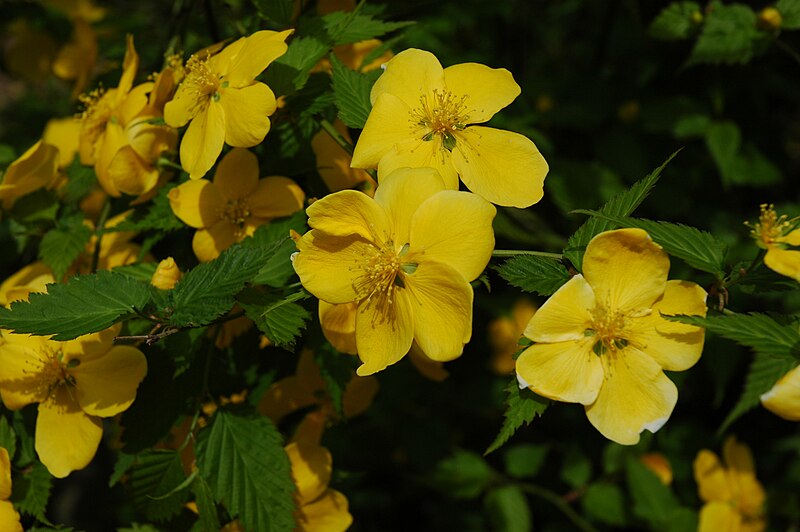
A deciduous, fast-growing shrub up to 3 m in height, with straight, green, rod-like shoots forming a conical crown. Leaves are lanceolate, up to 10 cm, long-pointed, double-toothed, glabrous above and pubescent beneath. In summer they are light green, in autumn bright yellow. Flowers up to 4.5 cm, golden-yellow, mostly solitary, often double (double-flowered), fragrant. Flowering lasts about 25 days; it often flowers again in autumn. The fruit is an aggregate, fleshy, black-brown drupe. In the temperate zone fruits on Kerria do not set. In very severe winters the tips of shoots that protrude above the snow cover may be frost-damaged, but after ornamental pruning the shrub regrows quickly and its decorative qualities are restored within a few weeks.

Location: Prefers well-lit sites, can also grow in partial shade where it flowers less abundantly. Requires a location sheltered from cold winds.
Soil: requires rich, moist soil.
Care: Requires pruning to shape. The shrub becomes denser and bushier and the number of flowers increases. Immediately after flowering, old 4-5 year-old shoots are cut out completely, i.e. to the base. After pruning a full fertilization with macro- and microelements is necessary. Since Kerria can be frozen back to the snow or ground level in severe winters, its shoots need to be covered. The cover must be dry. With such covering all shoots and flower buds are preserved, which promotes abundant flowering in late May - June.
Propagation: by cuttings, suckers and layering.
