
Conifers
Virginia juniper
Juniperus virginiana
Synonyms: pencil tree, Virginia juniper, eastern cedar, eastern juniper, eastern red cedar.
Virginia juniper (Juniperus virginiana L.) – a species of the genus Juniperus (Juniperus) of the family Cupressaceae (Cupressaceae). It was first described by Carl Linnaeus in 1753 in his «Species Plantarum». In cultivation in Europe since 1664. The oldest specimen is 795 years old (state of Missouri).
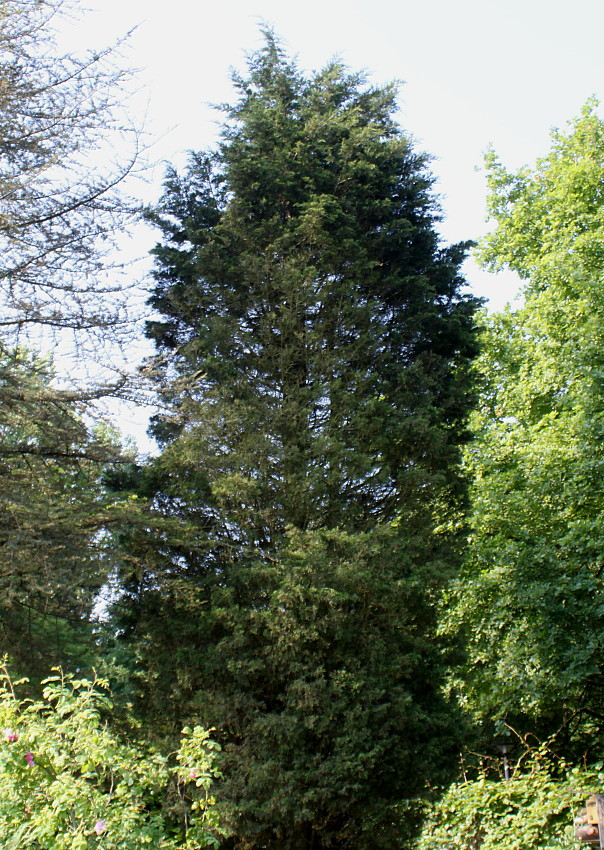
Photo V.Kudelya
In the wild it grows in North America – from southeastern Canada (Gulf of Mexico) and eastward to the Great Plains. It grows on poor gravelly mountain slopes, as well as along banks and streams.
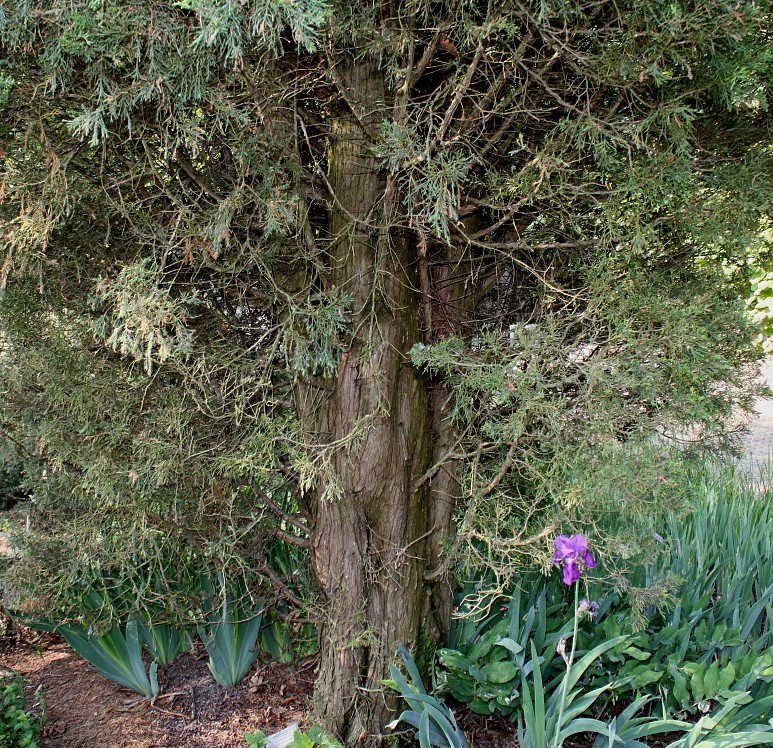
Photo V.Kudelya
It is a monoecious, less often dioecious evergreen conifer up to 30 m in height, with a trunk diameter of 150 cm. It grows slowly. Crown compact, columnar, dense, later becoming oval, spreading or broad-pyramidal. Bark brown or gray, peeling off in soft longitudinal strips. Shoots numerous, indistinctly four-angled. Young shoots green, thin.
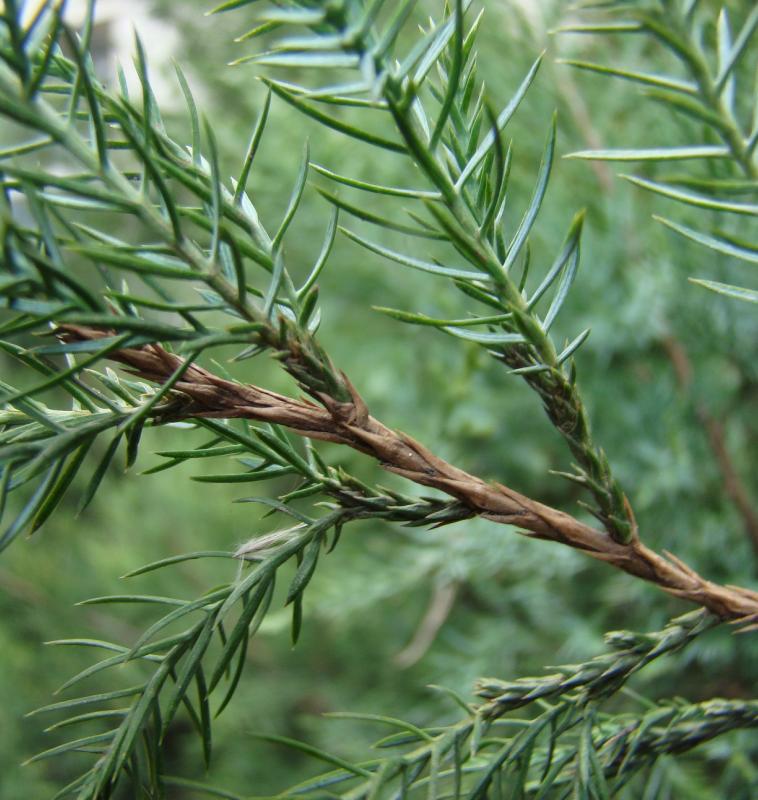
Photo. V.Epiktetov
Root system taproot with well-developed lateral roots.
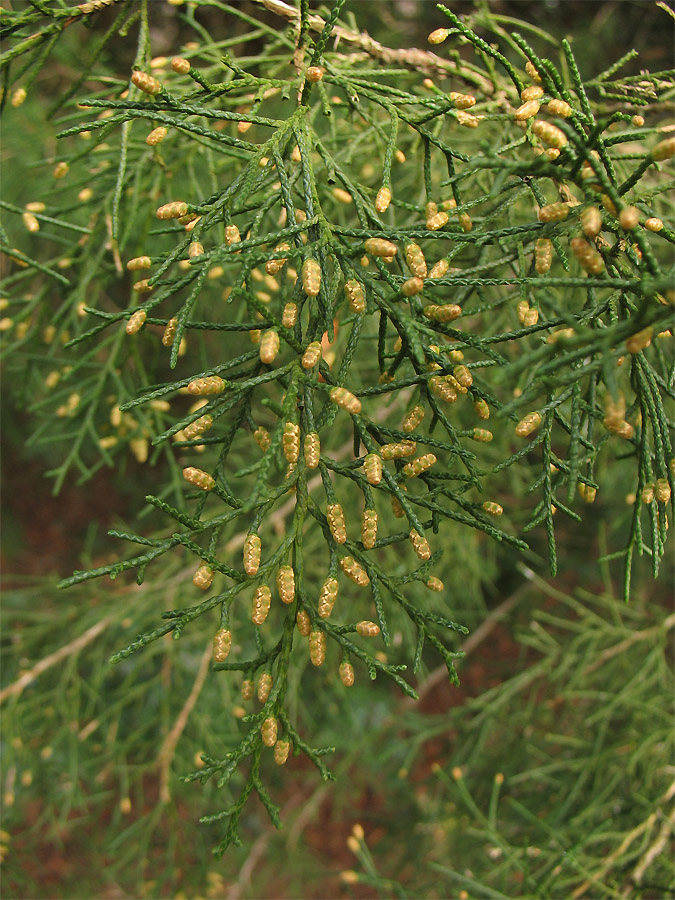 |
 |
| Microstrobili. Photo A.Kovalchuk | Megastrobili |
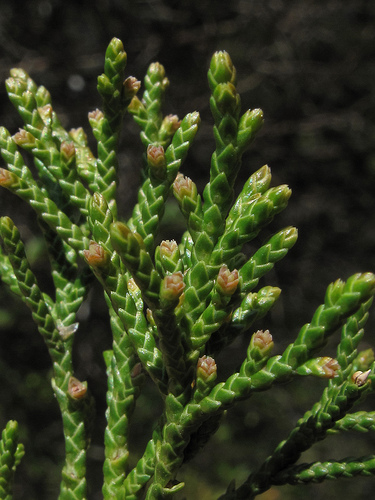
Juvenile foliage up to 12 cm long, awl-shaped, growing in pairs, less often in whorls of 3, thin-pointed, gray-green with white stripes, green beneath. Later the foliage becomes scale-like – shortly appressed, arranged oppositely in pairs in 4 rows, diamond-shaped, pointed, green or bluish-green, turning brownish in winter. Small tufts of juvenile leaves often occur at the tips of shoots on mature plants.
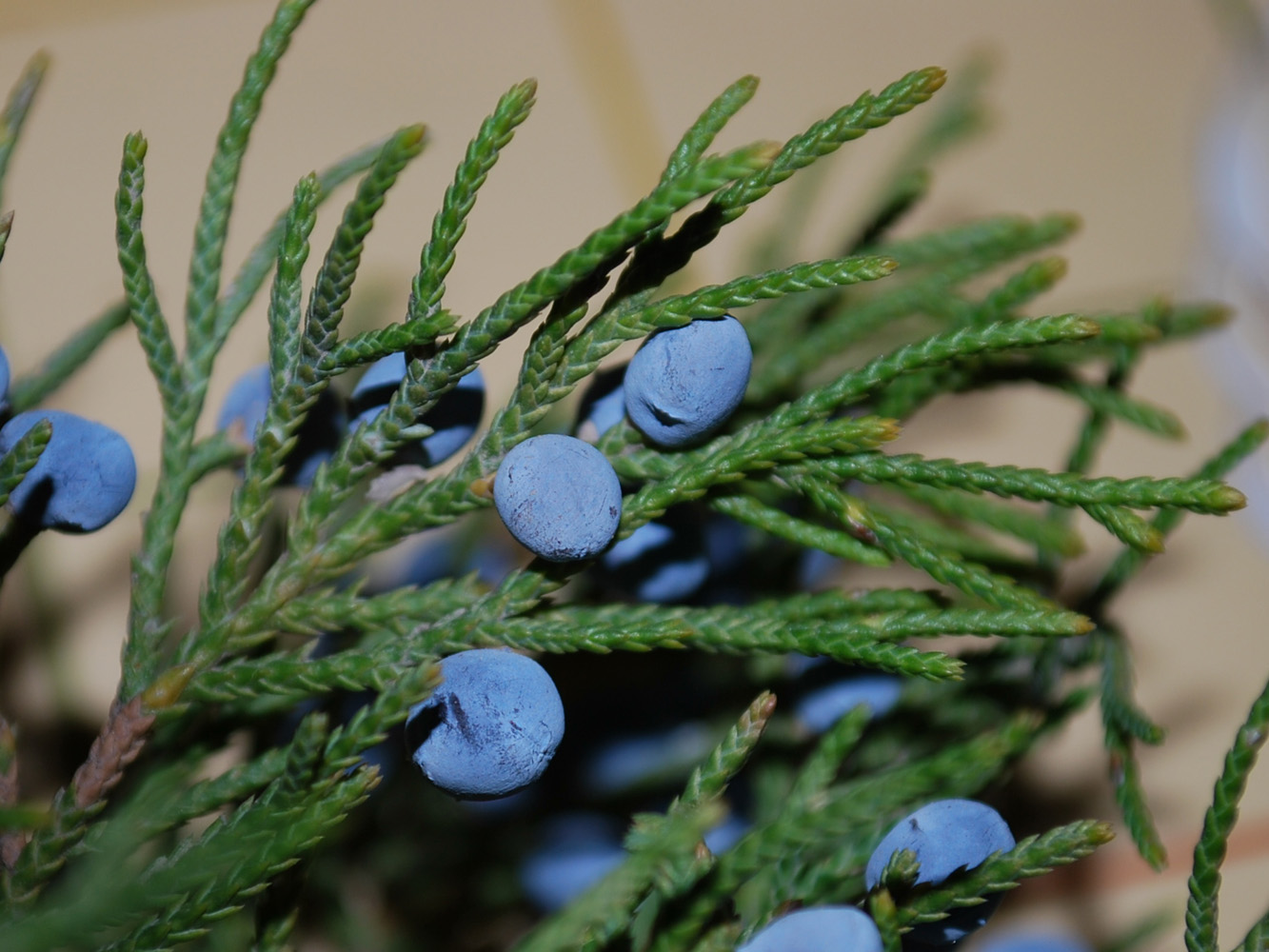
Photo T.Tillaev
Cones 0.6 cm in diameter, of various shapes, most often ovoid, dark purple with a bluish-white waxy bloom, almost sessile, numerous, containing 1-3 (rarely 4) seeds. Seeds ripen in the first year after pollination. Cones appear in October not only in the first year and remain on the branches for a long time.
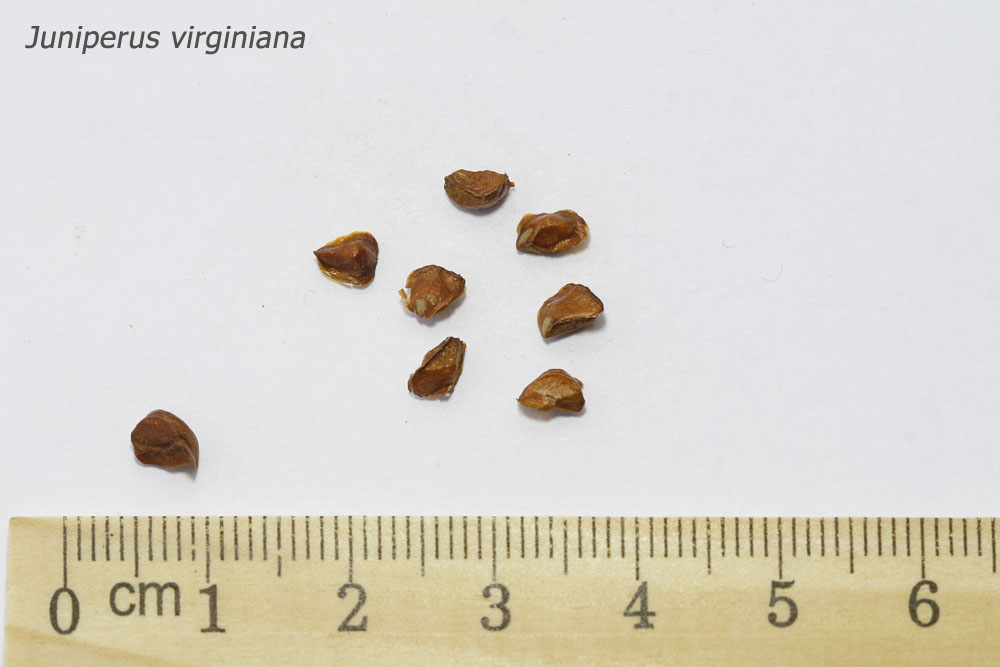
Photo A.Malyshenko
Varieties:
- Juniperus virginiana var. silicicola (Small) E. Murray
- Juniperus virginiana var. virginiana
Cultivars: 'Aurea', 'Blue Cloud', 'Blue Mountain', 'Brodie', 'Burkii', 'Canaertii', 'Corcorcor'(J. virginiana 'Emerald Sentinel'), 'Cupressifolia'( 'Hillspire'), 'Elegantissima', 'Glauca', 'Glauca Pendula'('Chamberlaynii'), 'Globosa', 'Golden Spring', 'Grey Owl', 'Helle'('Spartan'), 'Hetz', 'Hillii', 'Idyllwild', 'Manhattan Blue', 'Moonglow', 'Pendula', 'Princeton Sentry', 'Silver Spreader', 'Sulphur Spray', 'Taylor', 'Tripartita', 'Woodlander's Weeping'.
Of hybrid origin:
- Juniperus virginiana L. x Juniperus ashei J. Buchh.
- Juniperus virginiana L. x Juniperus horizontalis Moench
- Juniperus virginiana L. x Juniperus scopulorum Sarg.
- Juniperus virginiana L. x Juniperus chinensis L.
- Juniperus virginiana L. x Juniperus sabina L.
Cold hardiness: 4-7 (-34°C)

Site: drought-tolerant, undemanding to soil and moisture, but prefers fresh clayey and loamy calcareous and sandy soils. Tolerant of urban conditions. Shade-tolerant.
Planting: recommended spacing between plants 0.5 or 1.2-2 m. Planting depth – 70 cm. Drainage if necessary: crushed brick or sand layer 15-20 cm. Soil mix: turf soil, peat and sand in ratio 1:2:1. Transplants poorly even with a root ball.
Care: in spring (April-May) apply nitroammofoska 30-40 g/m2. In a dry summer it is recommended to water the plant 2-3 times per season and to perform evening spraying once a week. Mulch with peat or sawdust layer 5-8 cm.
Pruning: tolerates heavy pruning and clipping well, retains shape for a long time.
Diseases: rust (Arcerid (50 g per 10 l of water) spray 4 times at 10-day intervals), shutte, biatorrelloid and Nectria canker, alternaria.
Pests: aphids (Fitoverm (2 g per 1 l of water) spray 2 times at 10-14 day intervals), leaf-mining moth (Decis (2.5 g per 10 l) spray 2 times at 10-14 day intervals), spider mite (Karate (50 g per 10 l)), scale insects (karbofos (70 g per 10 l of water)), galls, sawfly, shoot moth, pine looper.
Propagation: propagated by seeds, grafting. With spring sowing seeds germinate after a year. Untreated cuttings root at 50%.
Uses: wood very durable, light, aromatic, used for pencil production, bows by ancient Indians, for posts, for shelterbelt strips. Essential oil is produced from the wood, branches and leaves. In the states of Missouri and Arkansas it is used as a Christmas tree. In ornamental gardening used as solitary and group plantings, in parks, on lawns, for creating